The Living Myth
The Primordial Abyss · The Prison Beneath the Roots
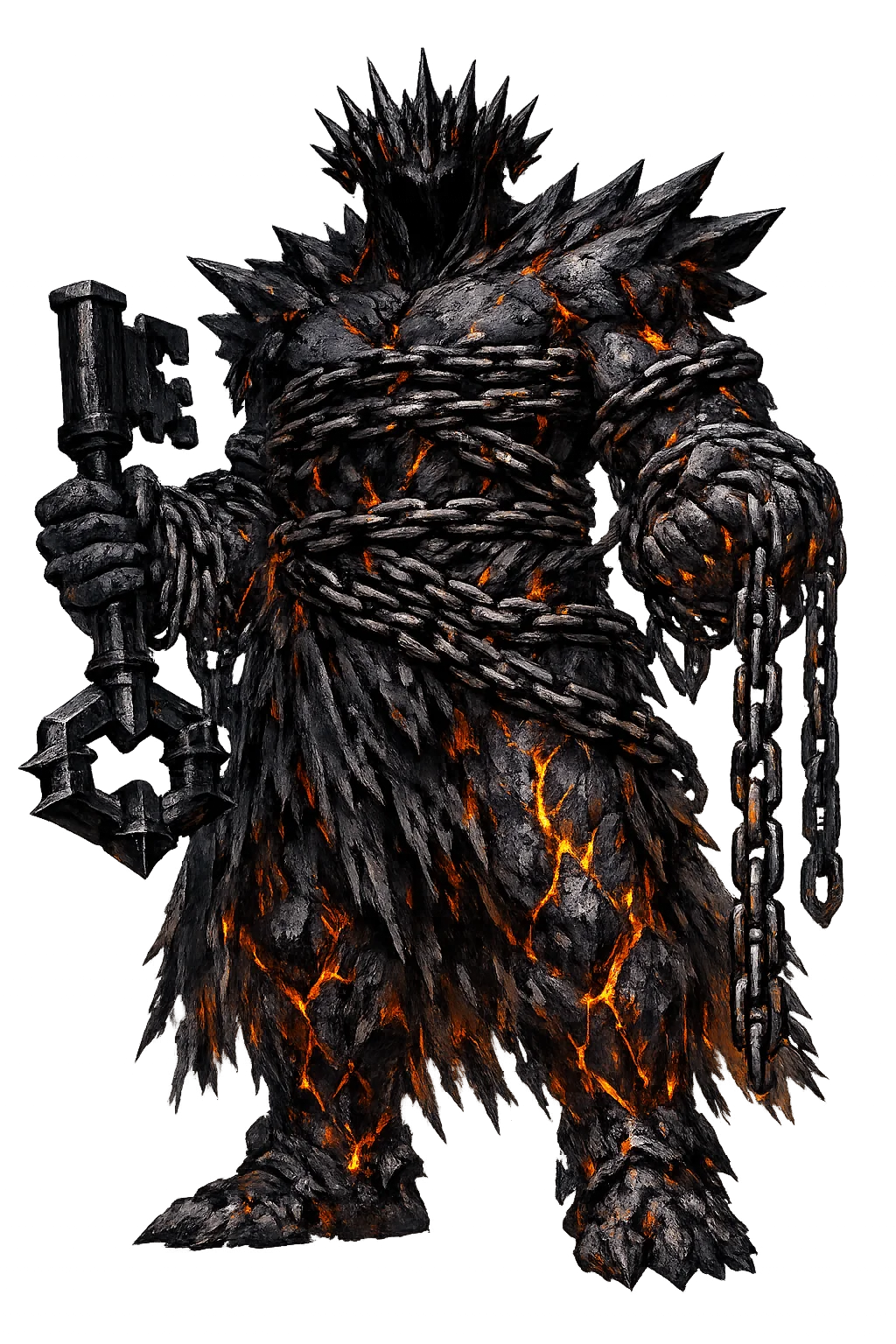
Stories of Tártaros
Tártaros appears almost as soon as the world begins. It is the third primordial in Hesiod's list — gap, earth, abyss — and it remains the final destination for every cosmic rebel, from the Titans to the greatest of mortal sinners.
When the world began, Hesiod names three things that came to be of themselves: Cháos, the yawning gap; Gaia, the broad-breasted earth; and 'dim Tártaros, in the depths of the broad-pathed earth' (Theogony 116–120). The name may be older than Greek itself: a Linear B tablet from Knossos (Fp 14) appears to pair an offering 'to Tartaro' with offerings to the gods. Homer adds the famous measurement: Tártaros lies as far beneath Hades as heaven is above earth, and a brazen anvil would fall nine days and nine nights before striking bottom (Iliad 8.13–16). The same passage sets the house of Hades at the edge of that vertical map, with Tártaros the deepest landmark on it. The myth gives the cosmos two domes — the bright one above and the dark one below — and Tártaros is the floor of everything.
When the ten-year Titanomachy ended, Zeus hurled the defeated Titans down 'under the murky gloom of the misty darkness' — into Tártaros, where a bronze fence runs round it, Poseidon fixed gates of bronze, and the Hundred-Handers stand as guards 'beyond the gates, the faithful wardens' (Hesiod, Theogony 713–735). The Iliad gives the scene from below: there the Titans sit at the threshold, 'a dreadful thing to hear' for any who would approach (Iliad 8.478–481). The terror is acoustic as much as visual — the passage stresses the sound that rises from below the threshold. Imprisonment rather than destruction is the telling detail — the old powers cannot be unmade, only stored, and the world's stability depends on their continued confinement. Tártaros is less a dungeon than a vault: the deep holds what heaven cannot afford to have loose.
Angered by the destruction of her children the Giants, Gaia lay with Tártaros and bore Typhōn, 'youngest of her children... a bane to mortals' (Hesiod, Theogony 820–822; cf. Apollodorus, Library 1.6.1–3). He was a thing of a hundred serpent heads, fire glaring from his eyes, voices like gods and bulls and lions and hounds; he fought Zeus for the cosmos and very nearly won, until the father of gods closed with him on Mount Aitne and burned the monster's heads with thunderbolts, flinging the trunk into Tártaros — or, in the other tradition, under Aitne itself, whose eruptions are Typhōn's breath. The genealogy is the point: when Gaia needs a weapon against heaven, she mates with the deep. Tártaros is not only the prison of the old gods; it is generative — the chthonic partner through which earth produces what heaven most fears.
In later tradition Tártaros became the place of punishment for the greatest sinners among mortals. Plato's Gorgias (523a–526d), mythologizing an underworld judgment, sends the incurable down to Tártaros itself, whence they never emerge. The canonical residents were known to every Greek: Sisyphus, who rolls his boulder forever up the hill; Tantalus, chin-deep in water he cannot drink, beneath fruit he cannot reach; Ixion, bound to a blazing wheel for his treachery to Zeus; Tityos, whose liver the vultures renew daily (Homer, Odyssey 11.576–600; Virgil, Aeneid 6.580–627). These images of eternal, futile labour shaped Jewish and Christian hell at second hand, and through them the whole Western imagination of damnation. Their power lies in the punishments' precision: each torment is the crime made perpetual. Plato adds that the judges themselves — Minos, Rhadamanthys, Aiakos — hold court at the divide and cast the incurable downward (Gorgias 523e–524a).
The Primordial Abyss
Tártaros is the deepest place. It lies beneath Hades as far as Hades lies beneath the earth, and the earth beneath the sky. It is not merely a dungeon; it is a cosmic depth, the inverted dome that balances the celestial dome above.
The bottomless chasm beneath the foundations of the world.
Hesiod describes walls and gates of bronze, built by Poseidon, guarded by the Hecatoncheires.
The "stormy pit" — winds, gloom, and the roar of imprisoned powers.
The place where the worst offenders — Titans and mortal sinners — receive eternal justice.
From the original script to the living URL
Τάρταρος
The name in its original Greek form. Tártaros (Τάρταρος) is attested in the source tradition — “Deep place (from τάρταρος)”. Its acute accents carry the full phonetic and orthographic weight of the source tradition.
tartaros
Reduced to plain tartaros, the name loses everything that made it specific: acute accents. What remains is an ASCII string that machines can parse but that no longer speaks with its original voice.
Tártaros
The Unicode restoration recovers what ASCII flattened. Tártaros restores acute accents, returning the name to its original written dignity. The domain encodes to Punycode, but the browser displays the truth.
Tártaros.com → xn--trtaros-hwa.com
The non-ASCII characters in Tártaros are encoded while the ASCII remains visible. To the DNS, it is Punycode. To humanity, it is Tártaros.
Owned, ideal, and ASCII forms of Tártaros
Tártaros
Restores Τάρταρος. The live temple domain — tártaros.com.
tartaros
Flattens Τάρταρος. The plain ASCII fallback — what DNS and legacy systems see.
How Tártaros was spoken
How Tártaros travels from ancient script to the modern URL
Greek Τάρταρος; the deep abyss beneath Hades; etymology uncertain, perhaps connected with ταρταρίζειν “to shiver".
The Primordial Abyss
The Unicode restoration Tártaros preserves Greek stress and length; the ASCII form tartaros loses these features.
The lore you have read is the living myth. Extended Lore opens the scholarly vault beneath it: the cult and its material remains, a history of the image, the name after antiquity, a meditation on what the name still means, and the full scholarly apparatus — etymology, orthography, sources.
Enter Extended Lore