
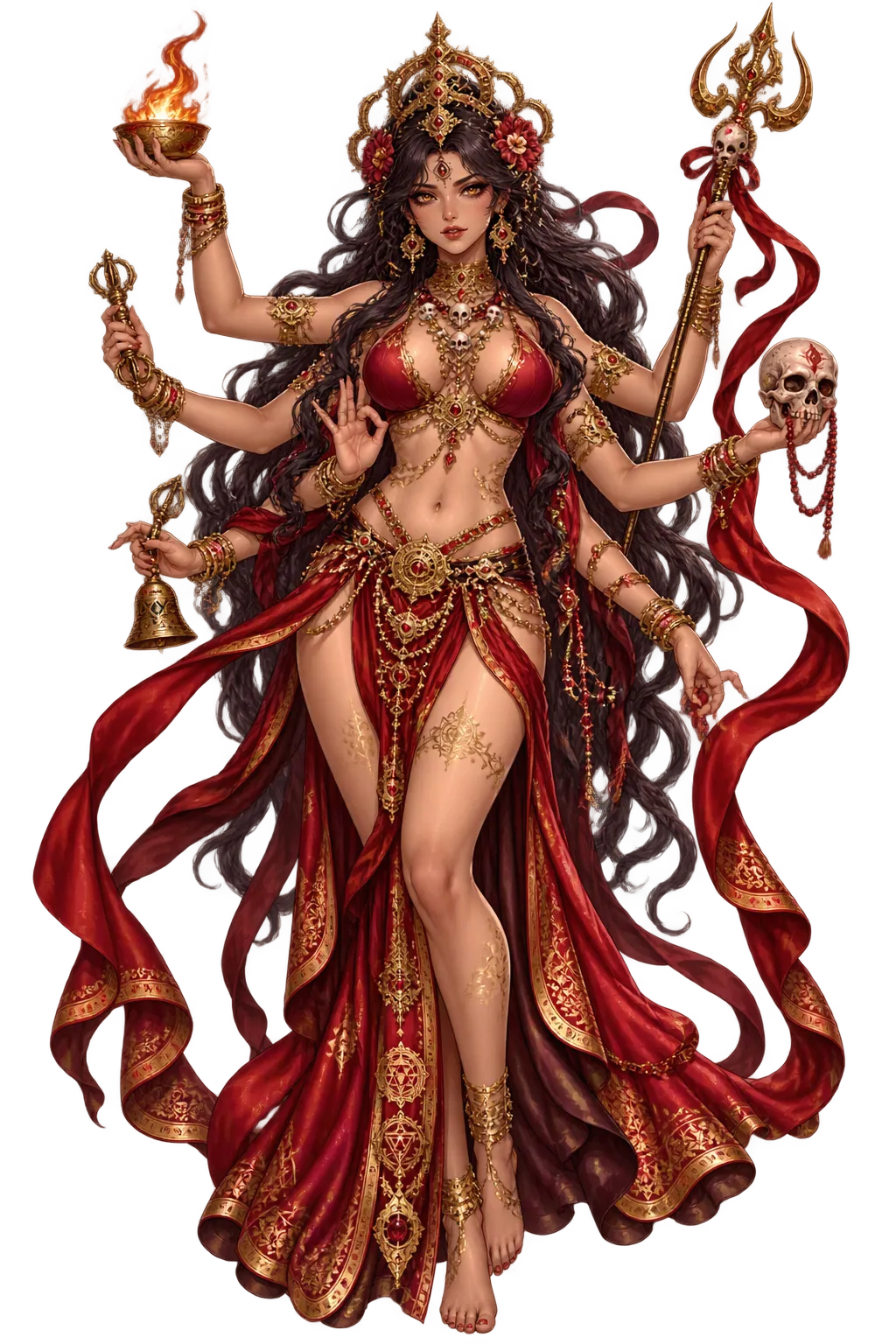
The hidden history behind Tantra
Behind the modern ASCII form tantra hides a much longer story. Tantra reaches back through manuscripts, inscriptions, and oral tradition long before it ever touched a keyboard, and every mark in the restored spelling is a receipt from that journey. In what follows we trace the name from its Devanagari attestations through its mythology, its cult, its symbols, and its afterlife in other cultures — and we show how the PuniCodex project turned that philological record into a Unicode domain that resolves today. The history was never lost. It was only waiting for the infrastructure to catch up.
At a Glance
- Restored name: Tantra
- ASCII form: tantra
- Meaning: "A class of works teaching magical and mystical formularies, mostly cast as dialogues between Śiva and Durgā; hence the esoteric systems of doctrine and ritual founded upon them."
- Domain of influence: Weaving, Esoteric System
- Pantheon: Sanskrit
- Restoration: ASCII-equivalent form
- Original script: तन्त्र (Devanagari)
Overview
Tantra (tantra) — The Loom of Esoteric Doctrine · A class of works teaching magical and mystical formularies, mostly cast as dialogues between Śiva and Durgā — belongs to the Sanskrit tradition, where it is catalogued under the domain "Weaving, Esoteric System". The name means "A class of works teaching magical and mystical formularies, mostly cast as dialogues between Śiva and Durgā; hence the esoteric systems of doctrine and ritual founded upon them.".
Tantra is the name of a scripture-class and the ritual systems those scriptures teach: works cast as dialogues between Śiva and the Goddess, embracing mantra, mandala, initiation, and the disciplined transgression of ordinary purity-rules. From the sixth-century Śaiva scriptures to Tibetan Vajrayāna, the tantras are the Indian religions’ most ambitious technology for accelerated transformation.
PuniCodex restores the name as Tantra and serves its temple at its temple. The restoration aSCII-equivalent form — a description computed from the displayed form itself. The plain ASCII form tantra survives as a modern convenience imposed by the early domain-name system; the restoration, not the fallback, is the form the project defends as philologically complete.
The Name
The name is attested in Devanagari as तन्त्र. Etymologically it means "A class of works teaching magical and mystical formularies, mostly cast as dialogues between Śiva and Durgā; hence the esoteric systems of doctrine and ritual founded upon them.".
The ASCII form tantra survives only because the early domain-name system could not carry diacritics; it is a technological compromise, not an ancient spelling. The Unicode restoration Tantra recovers the full diacritic detail of the scholarly transliteration directly in the address bar. The restoration aSCII-equivalent form — a description computed from the displayed form itself.
The letter-by-letter transformation runs:
- t → T — Same, capitalized
- a → a — Same
- n → n — Same
- t → t — Same
- r → r — Same
- a → a — Same
The Original Script
The name is preserved in Devanagari as तन्त्र.
The scholarly transliteration is Tantra.
The rendering proceeds step by step:
- Sanskrit Tantra is written in Devanagari as तन्त्र
- IAST transliteration maps each Devanagari vowel and consonant to a Latin equivalent
- Macrons mark long vowels (ā, ī, ū); dots beneath consonants mark retroflex articulation (ṭ, ḍ, ṇ, ṣ)
Pronunciation
The reconstructed pronunciation of the name is /ˈtʌntrə/ — Sanskrit (IAST: Tantra).
Phoneme by phoneme:
- Tan- — From √tan, “to stretch, extend, weave” — the same root as “tan” and “tend”.
- -tra — The instrumental suffix: the tantra is the “loom” or “warp” — the extended doctrine.
- ** — The word names both the scripture-class and the ritual systems those scriptures teach.
For the modern speaker, the closest approximation is: “TUN-truh”
Kindred and historical forms of the name:
- Root — √tan — to stretch; English “tend”, “tension” are cousins
- Etymology — tantra — the warp of a loom, the system’s threads
The word is a weaving-metaphor: the tantra is the warp into which the practice’s threads are stretched.
Mythology
Tantra’s mythology is its own theology of secrecy and speed: the god teaching the Goddess, the guru initiating the disciple, and the householder’s body becoming the ritual ground. Its stories are the scriptures’ frames — Śiva on Mount Kailāsa answering Pārvatī’s midnight questions, the siddhas flying on mantra-power, the kings protected by Śaiva rites.
The God Teaches the Goddess (Tantric Frame)
Nearly every tantra opens on a mountain: Śiva, asked by the Goddess how liberation may be quick for the poor in merit and short in life, answers with the system. The gender of the exchange is the doctrine — the god is knowledge, the Goddess is energy, and the tantra is their union written down for the age of decline.
The Clan-Traditions (Kaula & Śaiva Cycles)
The early Śaiva tantras organised themselves as kulas, clans — initiatory lineages bound to a deity, a mantra, and a guru. The clans’ mythology made heroes of the siddhas, the perfected ones who flew, stayed young, and turned the elements — the tantras’ advertisements and their cautionary tales.
The Thunderbolt Vehicle (Vajrayāna Cycle)
Buddhism absorbed the tantras wholesale: the Vajrayāna made the Buddha speak as Vajradhara, the thunderbolt-holder, and taught that buddhahood could be won in a single lifetime. The Tibetan canons — Kanjur and Tanjur — are the largest single body of tantric scripture preserved anywhere.
The State of the Rites (Royal Protections)
Medieval kings ruled by tantra: the Śaiva rites of protection (rakṣā) and the pacificatory rites (śānti) were statecraft. The inscriptions of the Cōḻas and the Pālas record land-grants to tantric monasteries that anchored their realms — the esoteric schools as the polity’s immune system.
Symbols & Iconography
The iconography associated with Tantra concentrates in a small set of recurring attributes, each a compressed statement about the name:
- The Scripture-Dialogue — The tantra is cast as Śiva’s answer to the Goddess’s questions — god and power, doctrine and energy, in conversation.
- The Maṇḍala — The deity’s palace-diagram, constructed from coloured sands or drawn, entered by initiation through the four gates.
- Mantra and Mudrā — Sound and gesture: the mantra pronounced, the hand-seal struck — the body made instrument of the doctrine.
- Transgression as Method — The pañcamakāra — the five M’s — consumed in ritual under vow, inverting purity to burn through it.
Archaeology & Evidence
The material record for Tantra survives in a small number of securely identified remains, catalogued below; the corpus is thin but unambiguous, and each site is tied to the name by ancient testimony.
Tantra leaves mandalas: the Borobudur’s galleries, the painted maṇḍala-halls of Alchi and Tabo, and the stūpa-temples of the Himalayan lineages. The colossal Hevajra and Cakrasaṃvara images of Khmer art are its royal monuments.
Realm & Domain
Tantra is the name of a scripture-class and the ritual systems those scriptures teach: works cast as dialogues between Śiva and the Goddess, embracing mantra, mandala, initiation, and the disciplined transgression of ordinary purity-rules. From the sixth-century Śaiva scriptures to Tibetan Vajrayāna, the tantras are the Indian religions’ most ambitious technology for accelerated transformation.
The Scripture-Dialogue
The tantra is cast as Śiva’s answer to the Goddess’s questions — god and power, doctrine and energy, in conversation.
The Maṇḍala
The deity’s palace-diagram, constructed from coloured sands or drawn, entered by initiation through the four gates.
Mantra and Mudrā
Sound and gesture: the mantra pronounced, the hand-seal struck — the body made instrument of the doctrine.
Transgression as Method
The pañcamakāra — the five M’s — consumed in ritual under vow, inverting purity to burn through it.
Across Cultures
Tantra swallowed its rivals: Vaiṣṇava, Śaiva, Śākta, and Buddhist tantras share a grammar of mantra, mandala, and initiation beneath their rival theologies. The Śākta tantras made the Goddess the system’s core; the Tibetan schools fused the whole into Vajrayāna; and modern global ‘tantra’ is a Western distillation of one strand of a much larger river.
Within the Sanskrit tradition, closely related names in the corpus include Aditi, Agni, Ambikā, Aṃśa, Arjuna, and Bhakti.
Cultural Legacy
The maṇḍala entered the world’s art-vocabulary; the mantra and the mudrā passed into global practice. Tantra’s academic rediscovery in the twentieth century rewrote the history of Hinduism and Buddhism — the ‘esoteric’ is now standard curriculum. And the word, in the West, became a byword for sacred sexuality, a reduction the tradition itself would barely recognize.
The Scholarly Record
The account of Tantra given in this edition rests on the witnesses and reference works listed below. Lexica and etymological dictionaries secure the form and meaning of the name; the literary and religious texts supply the narrative evidence.
- Mālinīvijayottara and Svacchandatantra (early Śaiva systems).
- Hevajra Tantra and Guhyasamāja (Buddhist Vajrayāna).
- Sanderson, ‘Śaivism and Brahmanism’ (historical framework).
- Tibetan Kanjur/Tanjur catalogues.
A Meditation
Tantra: the warp stretched on the loom, restored in plain letters that hold nothing back and reveal nothing. The name is the method — the system extended, thread by thread, until the whole fabric shows the pattern. Two syllables, one loom, every thread.
The Unicode Restoration
Tantra aSCII-equivalent form. The ASCII fallback tantra still resolves everywhere, but it is the restored form that carries the name's full information. That is the whole thesis of this temple: the marks are the message.
Character by Character
The journey from tantra to Tantra, one character at a time:
- t → T — Same, capitalized
- a → a — Same
- n → n — Same
- t → t — Same
- r → r — Same
- a → a — Same
The Sanskrit Pantheon
Tantra is one of 102 entries the PuniCodex lexicon catalogues under the Sanskrit pantheon. The Pantheon page gathers the tradition's major figures in one place, and the Lexicon lets you filter all 983 restorations by tradition or script — the fastest way to see where this name sits among its kin.
Frequently Asked Questions
What does Tantra mean? The traditional gloss is "A class of works teaching magical and mystical formularies, mostly cast as dialogues between Śiva and Durgā; hence the esoteric systems of doctrine and ritual founded upon them.."
Which tradition does Tantra belong to? Tantra is catalogued in the Sanskrit pantheon of the PuniCodex lexicon.
What does Tantra preserve that ASCII cannot show? The form itself answers: Tantra aSCII-equivalent form — and the marks in the restored spelling are exactly that evidence.
Can I use Tantra in a normal browser? Yes. The DNS resolves the punycode form automatically, and the type tool on this site converts tantra to Tantra for copying and pasting.
Where does the scholarly information come from? The entry is built from lexica, inscriptional evidence, and reviewed scholarly sources listed in the Scholarly Edition. Every claim is traceable to a canonical source.
Typing Tantra
You do not need a special keyboard to use this restoration. The PuniCodex Type Tool converts the ASCII form tantra into Tantra as you type, and the browser extension offers the same conversion inside any text field. Copy the restored form, paste it into the address bar, and the DNS does the rest.
Sister Temples
Other temples in the Sanskrit pantheon include Arjuna, Bhīṣma, and Cāmuṇḍā — each with its own restoration story, its own scholarly record, and its own place in the lexicon.
Why This Restoration Matters
The story of Tantra did not end in antiquity; it changed medium. Names that survive for millennia do so because each generation finds a new carrier for them — clay, papyrus, print, and now DNS. The PuniCodex restoration simply makes the carrier honest: the spelling that resolves is the spelling the evidence supports. If this post showed anything, it is that tantra and Tantra are not the same name with different styling. They are a summary and the text it summarizes. The web can now serve the text.
Explore Further
This post is one doorway into the temple. The home page carries the full character breakdown and the ambient canvas; the lore page tells the myths in long form; the Scholarly Edition preserves the sources, pronunciation data, and revision history; and the patron wall supports the restoration directly. For the wider map, browse the Lexicon, explore the Pantheon, or return to the PuniCodex blog.
A Closer Look at the Marks
A restored name is a small map. In the case of Tantra, the map does not lead through diacritics or special letters, because the source tradition wrote the name in Devanagari rather than in the Latin alphabet. The ASCII form tantra and the restored form share the same letters; the restoration is a decision about which conventional spelling should serve as the public reference.
That decision is not cosmetic. The original script attestation carries semantic and phonetic information that no romanization can fully reproduce. By fixing one conventional spelling as the canonical domain form, the project prevents the drift that happens when a name is romanized differently in every article, map, and database. The breakdown still lists each character — t, a, n, t, r, a — so visitors can see exactly what is being carried forward and what is not. What looks like "no change" is, in fact, a deliberate choice to keep the name stable, searchable, and addressable.
Tantra in Its Tradition
Tantra does not stand alone. It belongs to the Sanskrit tradition, where it is counted among 102 names in the PuniCodex lexicon. Its sphere — Weaving, Esoteric System — places it beside other figures who govern similar aspects of experience. The restored spelling is therefore not only a philological decision; it is a way of keeping the name in the company of its kin. When the address bar shows Tantra, it marks the boundary between a generic search term and a named entry in a living catalog of myth. That catalog is the point of the project. Every restored name is a vote for specificity: the web should know the difference between a figure and a keyword, between a tradition and a trend. Tantra is one such vote.
What You Will Find in the Temple
The temple page for Tantra is more than a landing page. The home tab presents the character breakdown, the pronunciation guide, and the live domain status in a single view. The lore tab gathers the myths and narratives that give the name its depth. The Scholarly Edition tab publishes the sources, variant forms, and review history that justify the restoration. Industry patterns show where the name appears in modern commerce and culture, while the gallery and creatives tabs collect visual and sponsor material. The patron wall lets visitors support the restoration directly. Each tab is generated from the same canonical sources, so the domain, the blog, the scholars page, and the search index all agree. The result is a single source of truth about a name, delivered through several doors.
The Restoration on the Live Web
A domain name is a kind of publication. When Tantra resolves, it proves that the restored spelling is not a theoretical exercise; it is a working address on the public internet. Search engines can index it, language models can encounter it, and anyone who copies it from a manuscript can paste it into a browser. That practical reality changes the status of the restoration. Before Unicode domains, a scholar could write the name correctly in an article while the public web flattened it to tantra. Now the public web can carry the correct form end to end. The punycode translation happens silently, so the infrastructure remains compatible while the visible name keeps its marks. That compromise — human-readable restoration, machine-readable encoding — is the foundation of every PuniCodex temple.
Restoration Notes
Restoring a name is not a single decision; it is a sequence of smaller decisions, each backed by a different kind of evidence. For Tantra, the chain begins with the attested form in Devanagari, continues through the standard scholarly romanizations, and ends with the DNS-compatible Unicode spelling used by this temple. The meaning "A class of works teaching magical and mystical formularies, mostly cast as dialogues between Śiva and Durgā; hence the esoteric systems of doctrine and ritual founded upon them." anchors the name in its semantic field; without that anchor, the marks would float free of the figure they name. The restored form Tantra and the ASCII form tantra share the same Latin letters; the restoration here is a conventional capitalization rather than a recovery of lost diacritics or special characters. Those adjustments are not arbitrary styling. They follow the restoration logic the displayed form wears openly: Tantra aSCII-equivalent form. The rule is mechanical, not editorial, which means the same standard applies to every entry in the lexicon. A visitor who disagrees with the classification can at least see exactly which evidence produced it, because every step is recorded in the Scholarly Edition. That transparency is the difference between a restoration project and a branding exercise. The name is being put back, not invented.
Related Names
Sources
The full scholarly apparatus — every citation, revision, and review — lives in the Scholarly Edition. Key references for this post:
- Mālinīvijayottara and Svacchandatantra (early Śaiva systems).
- Hevajra Tantra and Guhyasamāja (Buddhist Vajrayāna).
- Sanderson, ‘Śaivism and Brahmanism’ (historical framework).
- Monier-Williams Sanskrit-English Dictionary.
- Lexicon authorities for this entry: MW, Tantric texts.