The Living Myth
Weaving, Esoteric System · The Loom of Esoteric Doctrine · A class of works teaching magical and mystical formularies, mostly cast as dialogues between Śiva and Durgā
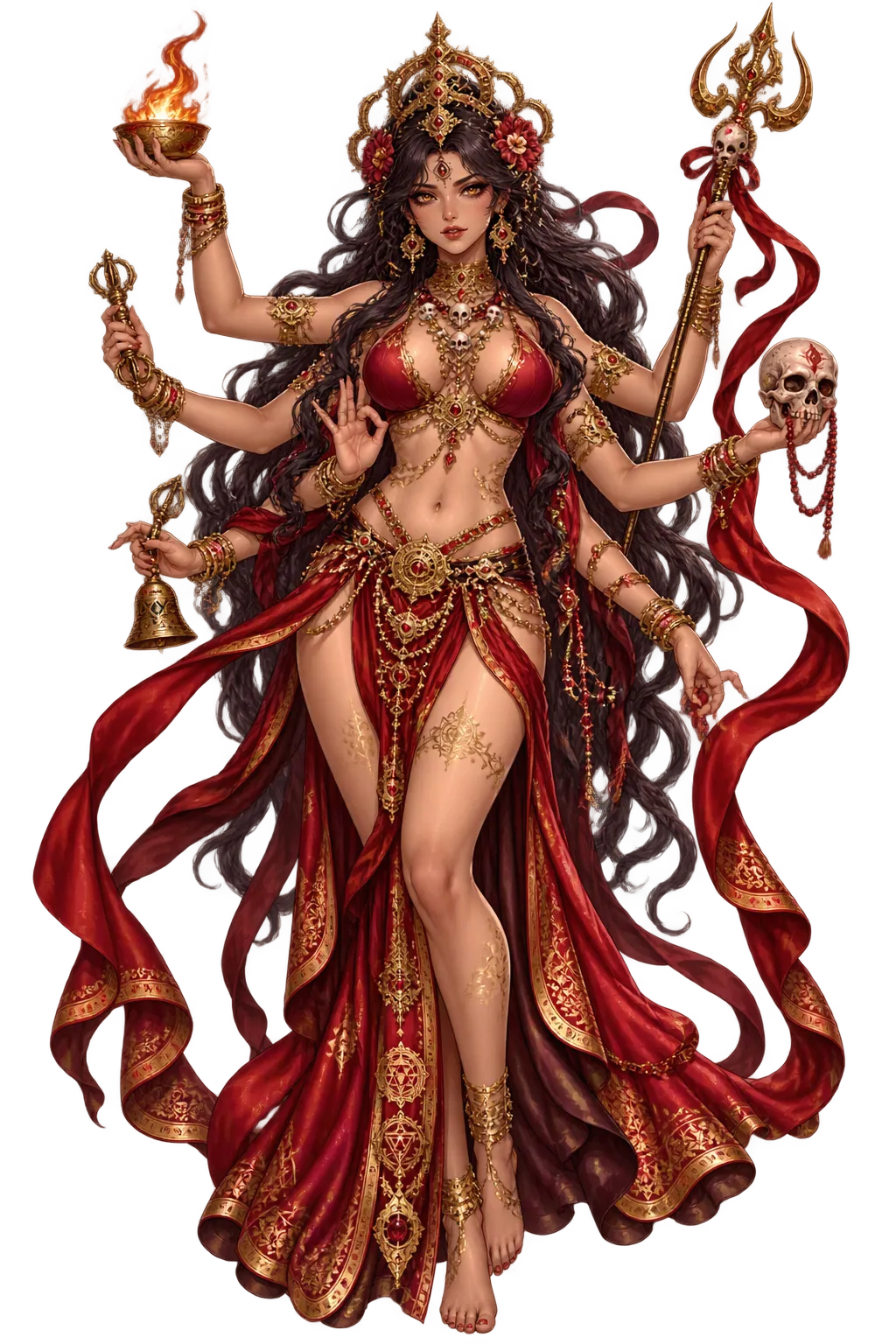
Stories of Tantra
Tantra’s mythology is its own theology of secrecy and speed: the god teaching the Goddess, the guru initiating the disciple, and the householder’s body becoming the ritual ground. Its stories are the scriptures’ frames — Śiva on Mount Kailāsa answering Pārvatī’s midnight questions, the siddhas flying on mantra-power, the kings protected by Śaiva rites.
Nearly every tantra opens on a mountain: Śiva, asked by the Goddess how liberation may be quick for the poor in merit and short in life, answers with the system. The gender of the exchange is the doctrine — the god is knowledge, the Goddess is energy, and the tantra is their union written down for the age of decline.
The early Śaiva tantras organised themselves as kulas, clans — initiatory lineages bound to a deity, a mantra, and a guru. The clans’ mythology made heroes of the siddhas, the perfected ones who flew, stayed young, and turned the elements — the tantras’ advertisements and their cautionary tales.
Buddhism absorbed the tantras wholesale: the Vajrayāna made the Buddha speak as Vajradhara, the thunderbolt-holder, and taught that buddhahood could be won in a single lifetime. The Tibetan canons — Kanjur and Tanjur — are the largest single body of tantric scripture preserved anywhere.
Medieval kings ruled by tantra: the Śaiva rites of protection (rakṣā) and the pacificatory rites (śānti) were statecraft. The inscriptions of the Cōḻas and the Pālas record land-grants to tantric monasteries that anchored their realms — the esoteric schools as the polity’s immune system.
The Extended System, Scripture and Practice
Tantra is the name of a scripture-class and the ritual systems those scriptures teach: works cast as dialogues between Śiva and the Goddess, embracing mantra, mandala, initiation, and the disciplined transgression of ordinary purity-rules. From the sixth-century Śaiva scriptures to Tibetan Vajrayāna, the tantras are the Indian religions’ most ambitious technology for accelerated transformation.
The tantra is cast as Śiva’s answer to the Goddess’s questions — god and power, doctrine and energy, in conversation.
The deity’s palace-diagram, constructed from coloured sands or drawn, entered by initiation through the four gates.
Sound and gesture: the mantra pronounced, the hand-seal struck — the body made instrument of the doctrine.
The pañcamakāra — the five M’s — consumed in ritual under vow, inverting purity to burn through it.
From the original script to the living URL
तन्त्र
The name in its original Sanskrit form. Tantra (तन्त्र) is attested in the source tradition — “A class of works teaching magical and mystical formularies, mostly cast as dialogues between Śiva and Durgā; hence the esoteric systems of doctrine and ritual founded upon them.”. Its original diacritics and script distinctions carry the full phonetic and orthographic weight of the source tradition.
tantra
The plain tantra form is identical to the Unicode restoration. Because this name is already written in Latin letters, no diacritics, stress, or script information were lost — only capitalization differs.
Tantra
The Unicode restoration does not need to recover lost marks for Tantra. Its value is canonical spelling and consistent cataloguing, not the reconstruction of erased orthography. The domain is readable as-is to both DNS and humanity.
Tantra.com
This restoration is written entirely in ASCII letters — no Punycode encoding stands between Tantra and the DNS. The domain reads identically to machines and to human eyes.
The attested spelling family of Tantra
Tantra
Restores तन्त्र. The full Unicode restoration. tantra.com is not in the PuniCodex collection — it is watched for release; if it drops, this temple upgrades to an owned flagship. Attested by MW, Tantric texts.
How Tantra was spoken
How Tantra travels from ancient script to the modern URL
The lore you have read is the living myth. Extended Lore opens the scholarly vault beneath it: the cult and its material remains, a history of the image, the name after antiquity, a meditation on what the name still means, and the full scholarly apparatus — etymology, orthography, sources.
Enter Extended Lore