
The Cult
The guru is the cult: initiation (dīkṣā) admits the practitioner to the clan, and the daily sādhana — the deity’s self-generation by mantra and visualization — is the liturgy. The fire-rites (homa) burn the offerings that seal the pacts.
Extended Lore
Etymology · Orthography · Cult · Iconography · Reception · Sources
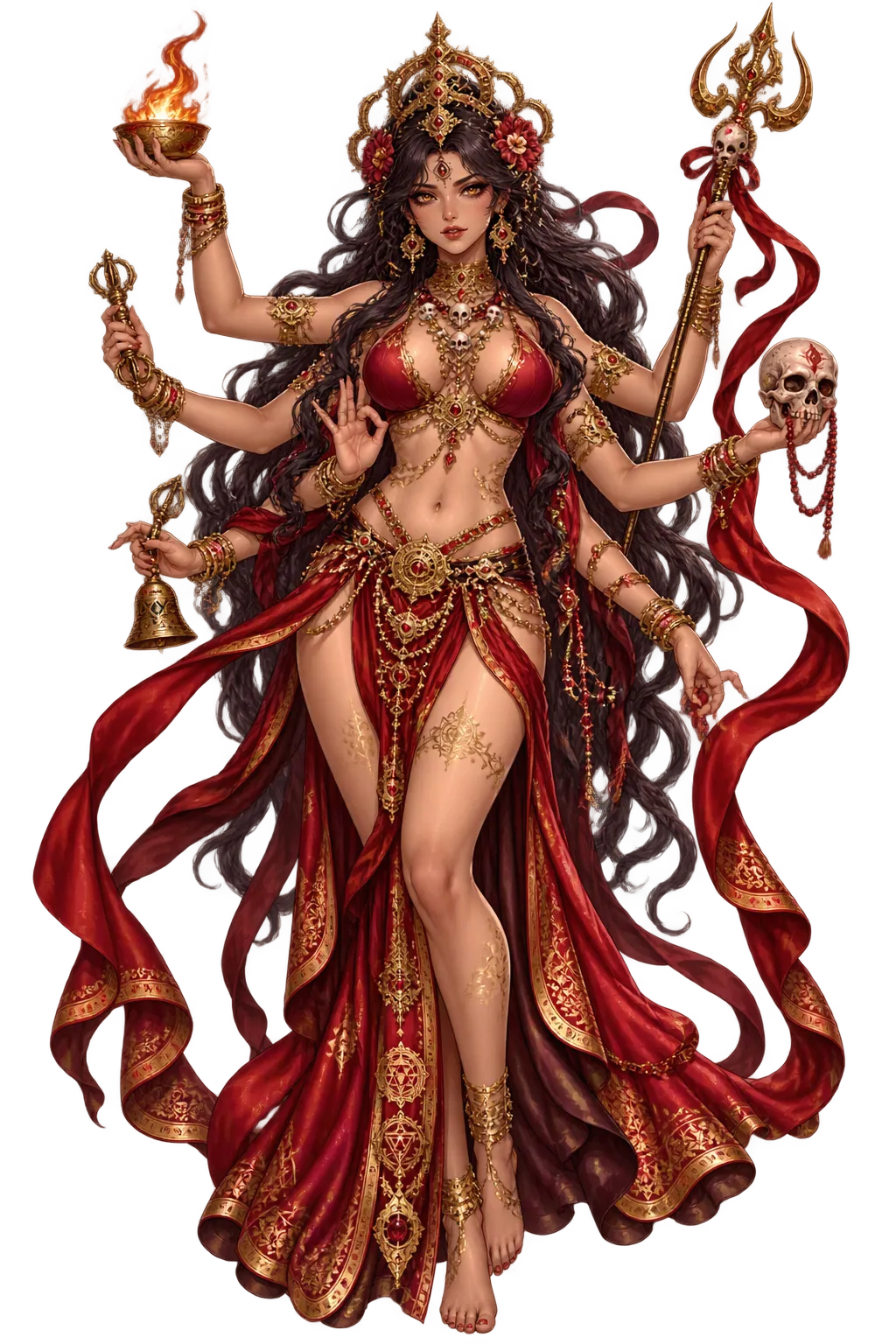
Essential information about Tantra, Weaving, Esoteric System
From original script to Unicode restoration
The name Tantra reaches the modern world through scholarly transliteration of the sanskrit tradition. Because the conventional spelling uses only Latin letters, its Unicode and ASCII forms coincide — the tradition it carries is in the name itself, not in diacritics.
Character-by-character philological analysis
| Character | Unicode | Name | Block | Phonetic Role |
|---|---|---|---|---|
| T | U+0054 | Latin Capital Letter T | Basic Latin | Same, capitalized |
| a | U+0061 | Latin Small Letter A | Basic Latin | Same |
| n | U+006E | Latin Small Letter N | Basic Latin | Same |
| t | U+0074 | Latin Small Letter T | Basic Latin | Same |
| r | U+0072 | Latin Small Letter R | Basic Latin | Same |
| a | U+0061 | Latin Small Letter A | Basic Latin | Same |
This restoration reflects fidelity to the attested tradition, not recovered diacritics: every character of Tantra already survives in ASCII. What the restoration preserves is the canonical spelling itself — the form scholarship standardised.
How the sacred was kept — rites, sanctuaries, remains
The guru is the cult: initiation (dīkṣā) admits the practitioner to the clan, and the daily sādhana — the deity’s self-generation by mantra and visualization — is the liturgy. The fire-rites (homa) burn the offerings that seal the pacts.
Tantra leaves mandalas: the Borobudur’s galleries, the painted maṇḍala-halls of Alchi and Tabo, and the stūpa-temples of the Himalayan lineages. The colossal Hevajra and Cakrasaṃvara images of Khmer art are its royal monuments.
How Tantra was imaged across the ages
The deity in union — the yab-yum of Tibet, the Śiva-Śakti of the Hindu tantras — the two-in-one that images the doctrine. The vajra, the bell, the skull-cup, and the curved knife are the instruments; the mandala is the ground.
The name after its own age — transmission, translation, survival
Religious studies treats tantra as the field’s great twentieth-century discovery — the recovery of the esoteric half of Asian religion. The Western ‘Tantra’ of the counterculture is a case-study in selective reception: one limb of the system, exported as the whole body.
Tantra swallowed its rivals: Vaiṣṇava, Śaiva, Śākta, and Buddhist tantras share a grammar of mantra, mandala, and initiation beneath their rival theologies. The Śākta tantras made the Goddess the system’s core; the Tibetan schools fused the whole into Vajrayāna; and modern global ‘tantra’ is a Western distillation of one strand of a much larger river.
The maṇḍala entered the world’s art-vocabulary; the mantra and the mudrā passed into global practice. Tantra’s academic rediscovery in the twentieth century rewrote the history of Hinduism and Buddhism — the ‘esoteric’ is now standard curriculum. And the word, in the West, became a byword for sacred sexuality, a reduction the tradition itself would barely recognize.
What Tantra means — beyond the dictionary
Tantra: the warp stretched on the loom, restored in plain letters that hold nothing back and reveal nothing. The name is the method — the system extended, thread by thread, until the whole fabric shows the pattern. Two syllables, one loom, every thread.
Common questions about Tantra, Weaving, Esoteric System, and Unicode restoration
In reconstructed pronunciation, Tantra is /ˈtʌntrə/ — approximately “TUN-truh”.
Tantra means A class of works teaching magical and mystical formularies, mostly cast as dialogues between Śiva and Durgā; hence the esoteric systems of doctrine and ritual founded upon them. in the sanskrit tradition.
Tantra is associated with The Scripture-Dialogue (The tantra is cast as Śiva’s answer to the Goddess’s questions — god and power, doctrine and energy, in conversation.), The Maṇḍala (The deity’s palace-diagram, constructed from coloured sands or drawn, entered by initiation through the four gates.), Mantra and Mudrā (Sound and gesture: the mantra pronounced, the hand-seal struck — the body made instrument of the doctrine.), Transgression as Method (The pañcamakāra — the five M’s — consumed in ritual under vow, inverting purity to burn through it.).
Tantra is written entirely in ASCII letters, so its restoration is about canonical fidelity rather than recovered diacritics: the temple fixes the name in its scholarly standard spelling, attested in the source tradition, instead of leaving it to drift.
“The God Teaches the Goddess” — the Tantric Frame story that anchors the mythology of Tantra, told in full on the lore page.
The philological foundations of this restoration
Every claim on this page is grounded in established scholarship. The orthographic restorations follow disciplinary convention. The etymological chain follows the best available reference works. This is not invention — it is resurrection through scholarship.
You have traced the name from its earliest attestation to its Unicode restoration. Now return to the myth. The story is where the name lives.
Back to Lore