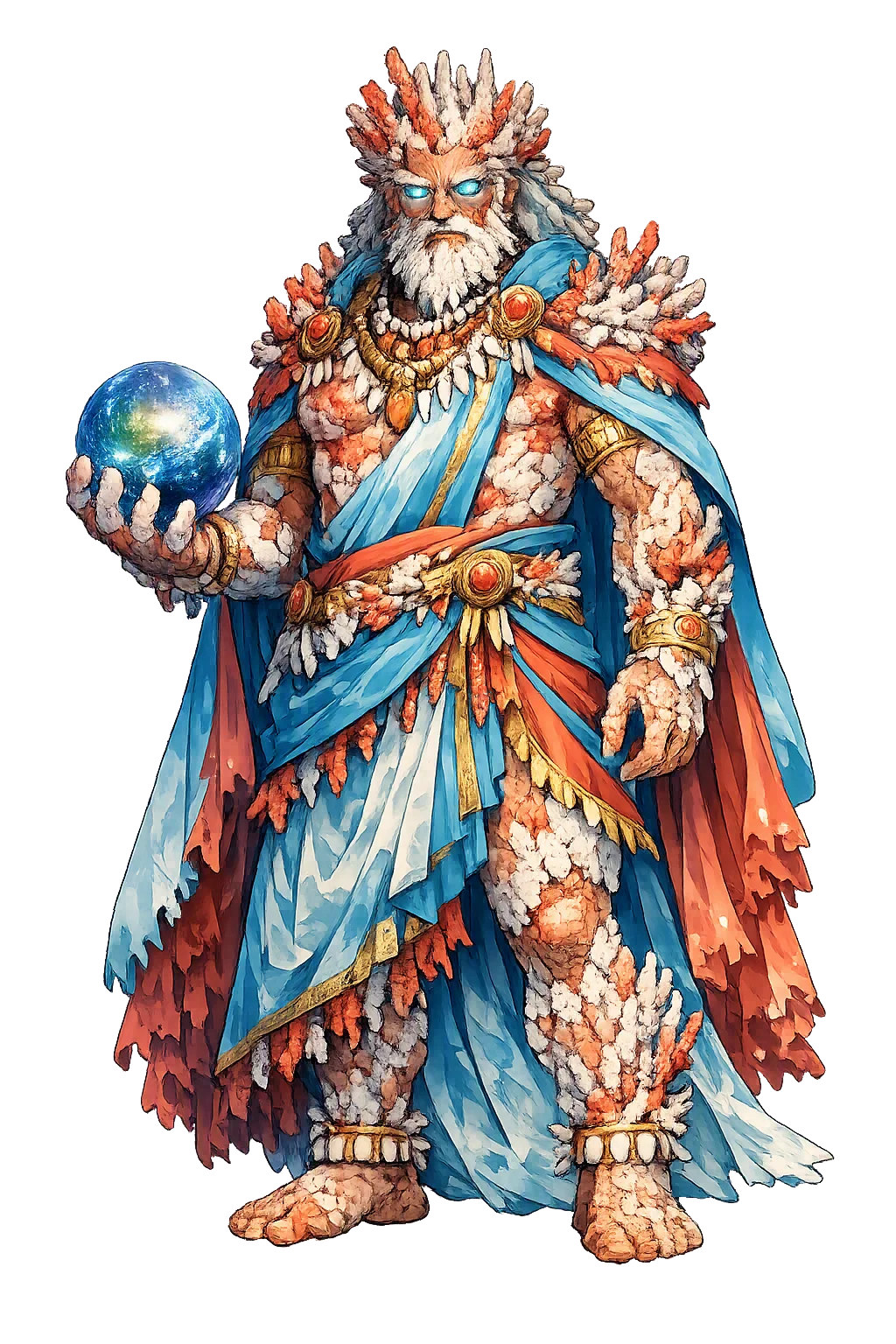
Stories of Tagaloa
Tagaloa's mythology is cosmogony in the strict sense — stories of how land, people, and rank came to be. It survives not in epic but in creation chants recorded by nineteenth-century missionaries and ethnographers, whose accounts disagree in detail but agree that the world began when the Lord of the Heavens acted upon the sea.
In the beginning Tagaloa dwelt alone in Lani-uli, the highest heaven, and beneath him lay only the boundless sea. He let down into the waters a vine from the sky; where its parts touched the surface, the islands of Samoa rose. On the largest he set the first settlement, and from the sky he watched over it. The fullest form of this creation account was recorded by the missionary J. B. Stair in Old Samoa (1897) and compared with related versions by Augustin Krämer in The Samoa Islands (1902); George Turner had published a shorter form in Nineteen Years in Polynesia (1861). Manu'a, the island group of the myth's first landing, is still styled the 'beginning of Samoa' in formal oratory, and the creation chant remained the deep charter for its paramount titles. The story is the charter of Samoan identity:The story is the charter of Samoan identity: the homeland is not discovered but made — thrown down from heaven and rooted in the sea.
Tagaloa's daughter Sina came down to the pool of Mata o le Alelo to bathe, where a great eel, Tuna, confessed its love. When the eel was killed at Sina's command, she buried its head, and from it grew the first coconut palm — its two eyes, mouth, and body still showing on the nut. The tale was recorded across Polynesia (Gill, Myths and Songs from the South Pacific, 1876; Beckwith, Hawaiian Mythology, 1970, §§ on the coconut cycle) and became the most retold of all Samoan stories. In Samoa the cycle carries a chiefly resonance as well: Sina's name became a byword for beauty in proverb, and her bathing pool, Mata o le Alelo, was pointed out to visitors into the twentieth century. The myth answers a child's questionThe myth answers a child's question — why does the coconut look like a face? — and binds the staple tree of island life to the death of an impossible love.
Samoan cosmology stacks the sky into storeys — Lani-uli, Lani-ʻula, and the heavens beneath them — and places Tagaloa at the summit, above the winds that carry rain. Krämer (The Samoa Islands, 1902) recorded prayers addressing the ascending heavens by name, each storey ruled or traversed on the way to the Lord's seat. No text gives a complete, consistent map; the ethnographers themselves note that districts preserved different orders of the heavens. Below the storeys of the sky the same cosmology placed the underworld and the remote ends of the earth, and prayers were imagined to rise through the layers like visitors announced at the thresholds of a great chief's house. Yet the structure is constant:Yet the structure is constant: the sacred is vertical, and the higher the heaven, the nearer the Lord. Cosmology here is not speculation but orientation — the same layering a navigator reads in cloud and star.
In the Māori version of the same divine name, Tangaroa is a child of Ranginui and Papatūānuku, the sky-father and earth-mother crushed in their parents' tight embrace. When Tāne thrust his parents apart to let in the light, Tangaroa fled to the ocean, and his enmity with Tāne — whose forests silt the sea — endures in myth (Grey, Polynesian Mythology, 1855; Orbell, A Concise Encyclopedia of Māori Myth and Legend, 1998). The Hawaiian Kanaloa and Tahitian Ta'aroa preserve further branches of the same god. Linguists reconstruct the shared ancestral form and read the god's names as a map of settlement itself — each island's dialect keeping its own office for the one Lord. Read across the ocean, the dispersalRead across the ocean, the dispersal of Tagaloa's name is itself the story: wherever Polynesians voyaged, the Lord went with them, changing office — creator in Samoa, sea-god in Aotearoa — but never name.
Creator
Tagaloa is the supreme creator god of the Samoan islands, lord of the layered heavens who looked down on the empty sea and made the land. He is the maker of islands, the father of gods and chiefs, and the dweller in the highest sky — the figure around whom Samoan cosmology turns.
He threw down the vine and stone from which the Samoan islands were formed, founding the world itself.
He dwells in Lani-uli, the highest of the layered heavens, above wind, rain, and the soaring birds.
His daughter Sina, mother of chiefs, anchors the island's greatest cycle of stories.
Across Polynesia his name is the sea's: Tangaroa in Aotearoa, Ta'aroa in Tahiti, Kanaloa in Hawai'i.
From the original script to the living URL
Tagaloa
The name survives in scholarly transliteration. Tagaloa is the standard Polynesian romanisation, documented in academic sources — “The lord”. Because the spelling uses only Latin letters, the form is the same in both ASCII and Unicode.
No indigenous writing system is securely attested for individual polynesian names. The form shown is a modern scholarly transliteration.
tagaloa
The plain tagaloa form is identical to the Unicode restoration. Because this name is already written in Latin letters, no diacritics, stress, or script information were lost — only capitalization differs.
Tagaloa
The Unicode restoration does not need to recover lost marks for Tagaloa. Its value is canonical spelling and consistent cataloguing, not the reconstruction of erased orthography. The domain is readable as-is to both DNS and humanity.
Tagaloa.com
This restoration is written entirely in ASCII letters — no Punycode encoding stands between Tagaloa and the DNS. The domain reads identically to machines and to human eyes.
Owned, ideal, and ASCII forms of Tagaloa
Tagaloa
The full Unicode restoration. tagaloa.com is not in the PuniCodex collection — it is watched for release; if it drops, this temple upgrades to an owned flagship.
How Tagaloa was spoken
How Tagaloa is preserved in writing
No indigenous writing system is securely attested for individual polynesian names. The form shown is a modern scholarly transliteration.
Contribute scholarly provenance →The lore you have read is the living myth. Extended Lore opens the scholarly vault beneath it: the cult and its material remains, a history of the image, the name after antiquity, a meditation on what the name still means, and the full scholarly apparatus — etymology, orthography, sources.
Enter Extended Lore