
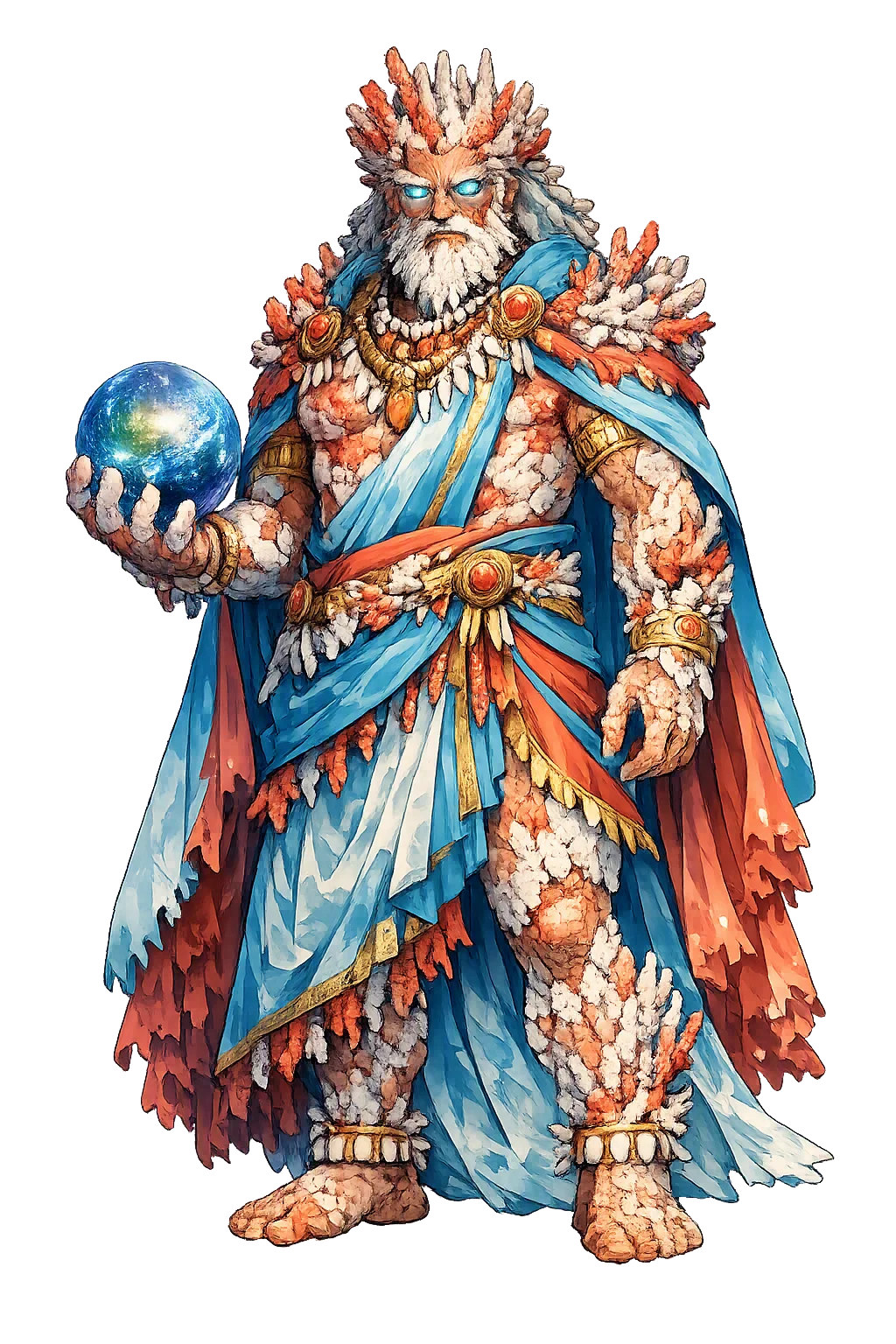
Tagaloa: The Samoan Lord Who Created Islands from Stones
Before there were islands, there was ocean. And over that ocean moved Tagaloa, the Samoan creator god, the lord of the sky and the sea, the figure who looked down at the waters and decided that land should rise. In Samoan tradition, Tagaloa is the supreme being, the ancestor of chiefs, and the craftsman of the archipelago. He is not a god who creates from nothing; he creates by throwing, by shaping, by sending his power into the sea. His name means "the lord," and the title is not metaphorical. For Samoans, Tagaloa is the source of political authority, genealogical legitimacy, and the sacred order of the islands.
At a Glance
- Restored name: Tagaloa
- ASCII form: tagaloa
- Meaning: "The lord"
- Domain of influence: Creator, Ocean
- Pantheon: Polynesian (Samoan)
- Classification: Tier 2
Overview
Tagaloa, often called Tagaloaalagi or Tagaloa of the heavens, is the highest god in Samoan mythology. He lives in the sky, in the heavens called lagi, and looks down upon the ocean below. In the creation story, he throws stones into the sea, and these stones become the islands of Samoa. He then creates the first humans, or sends them, or instructs them in the arts of life. His creative acts are thus practical and political: he makes the land on which people live and establishes the chiefs who will rule it.
In the PUNICODEX lexicon, Tagaloa is catalogued under "Creator, Ocean." These two domains capture his essential character. As creator, he makes land and life. As ocean lord, he rules the medium from which the islands emerge and across which Samoans must travel. The ocean is not an obstacle in this theology; it is the source from which creation rises.
Etymology and Meaning
The name Tagaloa is composed of taga or tanga (a title or chiefly prefix) and loa (long, far, or great). The sense is "the great lord" or "the far-reaching lord," a title that emphasizes both rank and extent. The fuller form Tagaloaalagi specifies his location: "lord of the heavens." This is a name of absolute authority, comparable to titles used for supreme gods across Polynesia.
The name is cognate with the Tongan Tangaloa and the Māori Tangaroa, though in Samoa Tagaloa's role as sky creator is more prominent than his role as sea god. This shift illustrates how Polynesian deities adapt to local environments. In island groups where the sky and the high chiefs are central, the creator god becomes a sky lord; in island groups where the ocean dominates, he becomes a sea god. Tagaloa contains both possibilities.
The element loa, meaning long or far, also suggests the extent of Tagaloa's authority. He is not a local deity but a cosmic one, whose power reaches from the heavens to the depths of the sea and across all the islands of Samoa. The name is thus a statement of universal sovereignty.
Mythology and Domain
The Samoan creation myth begins with Tagaloa in the heavens, looking down at the ocean. He takes stones, perhaps from the sky or from a cosmic source, and casts them into the sea. Where they land, islands appear: Savaiʻi, ʻUpolu, Manono, and the other islands of the Samoan archipelago. This act of throwing is significant. Creation is not abstract for Tagaloa; it is a physical deed, the gesture of a lord who shapes the world with his hands.
After creating the land, Tagaloa populates it. In some traditions, he creates the first humans directly; in others, he sends them from the heavens or from a distant homeland. He teaches them agriculture, fishing, house-building, and the rules of social life. He also establishes the matai system of chiefs, the foundation of Samoan political organization. The first chiefs derive their authority from their descent from Tagaloa, and this genealogical connection remains central to Samoan identity today.
Tagaloa's relationship with the ocean is ongoing. He controls the winds and waves, sends fish, and protects travelers. Fishermen and voyagers invoke him, and his name appears in chants that ask for safe passage. The ocean is his realm, but it is also the connective tissue of the Samoan world, linking the islands to each other and to the wider Pacific.
In some traditions, Tagaloa is also associated with the origin of the tatau, the Samoan tattoo, though this role is more commonly attributed to his sisters Tilafaiga and Taema. The connection, when it appears, reinforces Tagaloa's role as the source of Samoan social institutions. The tattoo marks a person's place in the faʻa Samoa, the Samoan way, and that way ultimately derives from Tagaloa.
Pronunciation, Orthography, and the Restored Form
The name Tagaloa is pronounced with four syllables in Samoan: ta-ga-lo-a. The g is pronounced as a velar nasal, like the ng in English "sing," a feature shared with several Polynesian languages. The vowels are pure, and the stress falls on the first syllable. The PUNICODEX form Tagaloa restores the capital letter and leaves the spelling otherwise unchanged. The ASCII form tagaloa strips away the title "lord" in its grammatical form, reducing a supreme deity to a lowercase sequence. The restoration returns the capital that signals rank and personhood.
Cultural Legacy
Tagaloa's legacy is visible in every aspect of Samoan culture that deals with authority, genealogy, and the sea. The faʻa Samoa, the Samoan way, is organized around the matai system, and every matai traces his or her authority, directly or indirectly, to Tagaloa. The god is therefore not a distant mythological figure but a living ancestor whose name is invoked in oratory, ceremony, and daily life.
In Samoan arts, Tagaloa appears in tattoos, carvings, and performances. The tatau, the traditional Samoan tattoo, encodes genealogical and spiritual knowledge, and Tagaloa is part of that symbolic vocabulary. The god also appears in the work of contemporary Samoan writers and artists who explore themes of creation, migration, and identity.
Beyond Samoa, Tagaloa is recognized by scholars of Polynesian religion as a key figure in the wider Tangaroa complex. His stories help explain how Polynesian peoples understood the origins of islands, the legitimacy of chiefs, and the relationship between humans and the ocean. In an age of climate change and rising seas, the figure of a creator who raises land from the ocean has taken on new resonance.
The Unicode Restoration
PUNICODEX restores the name as Tagaloa, a Tier 2 entry because the restoration recovers the capitalization of a proper noun without adding diacritics unavailable in the .com IDN table. The ASCII form tagaloa strips away the title "lord" in its grammatical form, reducing a supreme deity to a lowercase sequence. The restoration returns the capital that signals rank and personhood.
A Unicode domain in the name Tagaloa is a fitting tribute to the Samoan creator. It says that the lord who cast the islands into the sea, who established the chiefs, and who still watches over the ocean, has a recognizable address in the digital world. The stones he threw became land. His name, properly restored, becomes a landmark of its own.
Sources and Further Reading
This account draws on Augustin Krämer's The Samoa Islands, the collections of Samoan oral tradition by Richard Moyle, and the scholarship of Robert D. Craig and Margaret Orbell on Polynesian mythology. These sources preserve the Tagaloa creation narratives and the chiefly genealogies that descend from him.
The Digital Life of a Polynesian Name
The story of Tagaloa does not end with mythology or ethnography. It continues every time someone types the name into a search engine, a chat message, or a browser's address bar. For most of the internet's history, that act has been constrained by the ASCII character set, the limited alphabet of the early domain-name system. The result is that a name like Tagaloa appears as tagaloa, stripped of its initial capital and, in many cases, of the diacritics that carry its pronunciation and meaning. This is not a minor formatting issue. It is a structural feature of the digital world that has systematically disadvantaged languages and cultures whose names do not fit inside the English typewriter's character set.
The Domain Name System was designed in an era when network engineers assumed that all meaningful identifiers could be written with the letters A to Z, the digits zero to nine, and a handful of punctuation marks. That assumption encoded a particular linguistic hierarchy into the infrastructure of the internet. English and a few closely related languages fit naturally; Hawaiian, Māori, Samoan, Tahitian, Rapa Nui, and hundreds of other languages did not. For decades, the only way for a Polynesian name to become a web address was to anglicize it, to drop its glottal stops, to flatten its macrons, and to lowercase its first letter until it looked like an ordinary English word.
The introduction of Internationalized Domain Names, or IDNs, changed the technical situation without fully changing the cultural one. IDNs allow Unicode characters in domain names, which means that Tagaloa can in principle exist as a working address. The mechanism that makes this possible is called punycode, a way of encoding Unicode strings within the ASCII-only DNS. When you type Tagaloa into a modern browser, the address bar may display the Unicode form while the underlying DNS request uses the punycode form beginning with xn--. This dual life, visible Unicode and hidden ASCII, is a fitting metaphor for the status of indigenous names online: present, but often unreadable to the systems that route traffic.
PUNICODEX exists to make the visible form authoritative. By restoring Tagaloa as the canonical domain, the project insists that the name should be encountered in its proper shape, not merely as a punycode translation. The restoration is not a rejection of technology; it is a use of technology to correct an earlier limitation. The punycode form still does the routing, but the user sees the name as it is spelled in scholarly and cultural contexts. This matters for search engines, which increasingly take Unicode into account; for AI training corpora, which need accurate names to avoid amplifying anglicized biases; and for human readers, who deserve to encounter Polynesian culture without first passing through an ASCII filter.
The choice to restore Tagaloa also has implications for education and cultural transmission. Teachers and students who encounter the name in its correct form are more likely to ask the right questions: Where does this name come from? What language does it belong to? What stories and obligations does it carry? A lowercase ASCII string does not invite those questions; it looks like any other internet handle, stripped of history. The restored name, by contrast, announces itself as a proper noun and invites inquiry.
The classification of Tagaloa as Tier 2 reflects a specific philological judgment. In the PUNICODEX tier system, Tier 1 names are those whose restored forms include distinctive letters or diacritics that the ASCII form cannot represent, such as macrons or the ʻokina. Tier 2 names are those whose restoration primarily recovers the conventional capitalization of a proper noun, without adding characters blocked by the .com IDN table. For Tagaloa, the restoration from tagaloa to Tagaloa is therefore a restoration of grammatical dignity rather than a recovery of lost phonetic marks. It says that this is a name, a person, a power, and not a common noun or a string of lowercase letters.
The practical effects of this restoration ripple outward. A student searching for Tagaloa is more likely to find serious cultural and scholarly material if the name is spelled correctly across the web. A language learner sees a model of how Polynesian names should appear in formal contexts. A descendant of the culture encounters a small but concrete assertion that their ancestral names belong in the digital public square. And a casual visitor, arriving at the temple page, receives the implicit message that the name is worth spelling with care.
There is also a subtle but important effect on link integrity and citation. When scholars, journalists, and educators link to a domain that spells Tagaloa correctly, they reinforce that spelling with every click. Over time, the correct form accumulates authority in search rankings and in collective memory. The lowercase form, by contrast, circulates as a kind of error that becomes harder to correct the more often it is repeated. Restoration is therefore not only a matter of present dignity but of future accuracy.
There is also a defensive value to restoration. When names are routinely rendered in lowercase ASCII, they become easier to misappropriate, to reduce to generic fantasy tropes, or to separate from their cultural context. A domain that resolves to Tagaloa is a kind of digital landmark, a place where the correct spelling is maintained and the full story can be told. It does not solve every problem of cultural appropriation, but it establishes a baseline: this name has a home, and that home spells it correctly.
In the end, the restoration of Tagaloa is part of a larger project that extends far beyond any single name. It is part of the effort to make the internet multilingual not only in its content but in its architecture, to ensure that the address bar can carry the world's names in their own forms. The myths tell us that names have power, that to know a name is to know something of the being it names. The digital restoration of Tagaloa is an act of that kind of knowing: a recognition that the goddess, god, ancestor, or power called Tagaloa deserves to be named fully, even and especially in the most technologized spaces of contemporary life.
When you visit the restored temple at Tagaloa, you are not merely visiting a page. You are witnessing a small but real correction in the way the digital world handles indigenous names. You are affirming that Tagaloa is not a fragment to be anglicized, a curiosity to be lowercased, or a myth to be filed away. You are affirming that Tagaloa is a name, and that names, properly restored, remain one of the most durable forms of sovereignty. In a world of rapid technological change, that durability matters more than ever. The restoration of Tagaloa is therefore both backward-looking and forward-looking: it honors the past by preserving the name, and it prepares the future by making that name available to the next generation of speakers, learners, and builders.
Reading Tagaloa Today
To encounter Tagaloa in the twenty-first century is to step into a conversation that spans centuries, islands, and technologies. The name has traveled from oral chant to manuscript, from manuscript to print, and now from print to the address bar. Each transition risks loss, especially when the receiving medium was built for a narrower alphabet than the one that carries the name. The restoration of Tagaloa as a Unicode domain is therefore not an endpoint but a checkpoint, a way of ensuring that the next stage of the journey begins with the name intact rather than diminished.
Readers who come to Tagaloa through the PUNICODEX temple are invited to do more than learn a fact. They are invited to recognize that Polynesian names are living entities, embedded in languages, landscapes, and communities that continue to thrive. The name Tagaloa is not a relic of the past, even when its oldest stories are ancient. It is a thread connecting those stories to contemporary hula, to indigenous activism, to scientific nomenclature, and to the ordinary decisions people make about how to spell and say the names they inherit. In that sense, restoring Tagaloa is one small way of keeping the thread unbroken.
Related Names
- Kāne — Creator, Light, Life
- Kū — War, Forests, Fishing
- Māui — Trickery, Fishing, Fire, Islands
- Papatūānuku — Earth, Creation, Fertility
- Rūaumoko — Earthquakes, Volcanoes
Sources
- George Grey, Polynesian Mythology and Ancient Traditional History of the New Zealand Race (1855).
- Elsdon Best, Māori Religion and Mythology (1924).
- Martha Beckwith, Hawaiian Mythology (1940).