
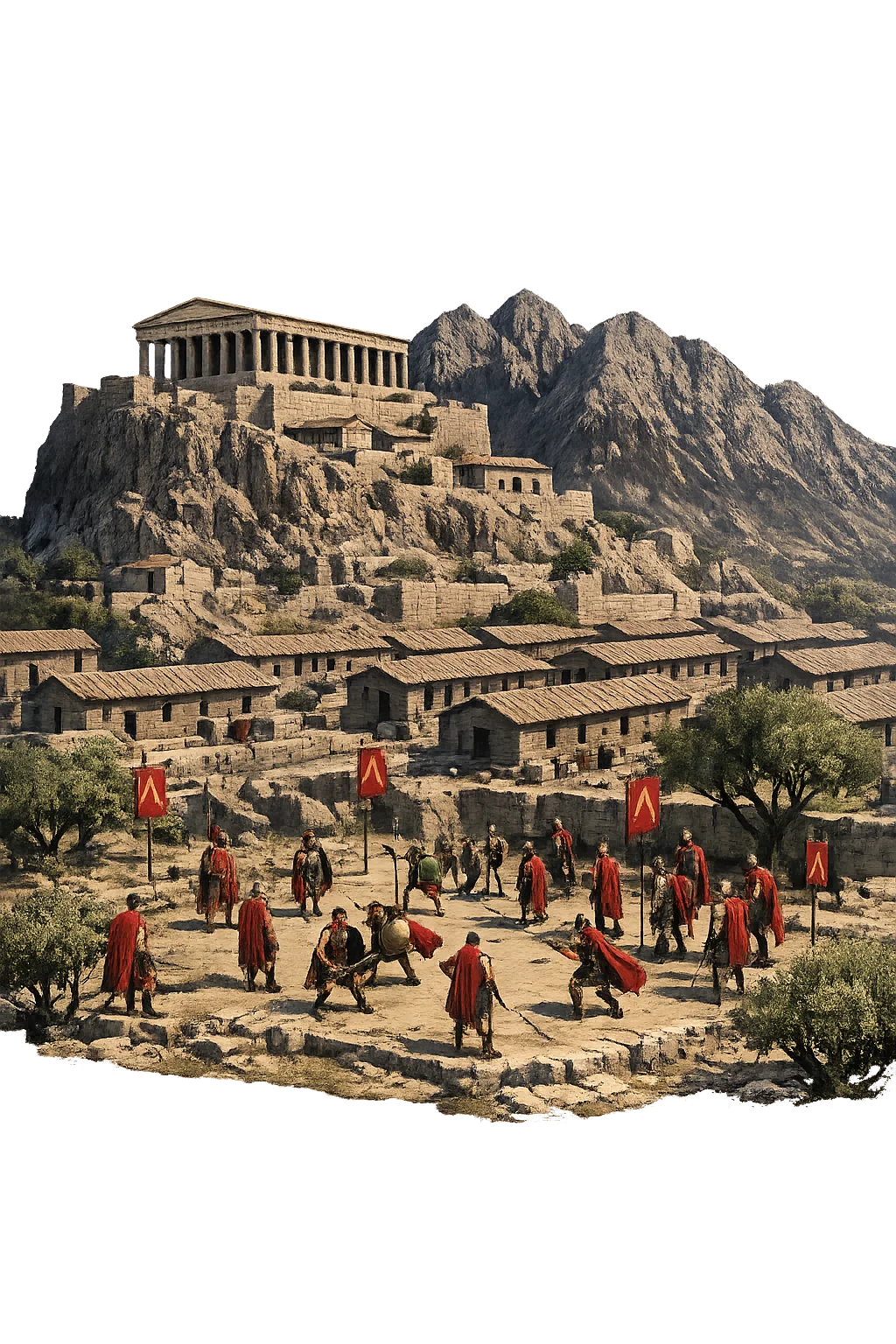
How Spártē was rebuilt, mark by mark
From the restoration bench — the working notes on Spártē, kept because the process is the proof.
What We Found
The attestation, as Homer, Iliad 2.581–590 (Sparta in the Catalogue of Ships); Odyssey 4 (Menelaus' palace) and Herodotus 1.65–68 (Lycurgus and the oracle), 7.202–239 (Thermopylae) preserve it: Σπάρτη. Meaning: "Sown land (from σπείρω)".
The figure behind the name: Greek myth gives Sparta a human namesake.
What the Name Carried In
Sparta and Lacedaemon. The river Eurotas had a daughter named Sparta, beautiful and vigorous. Lacedaemon, son of Zeus and Taygete, came to Laconia and married her, uniting two divine lineages.
Lycurgus and the Delphic Oracle. The Spartans attributed their distinctive customs to Lycurgus, a semi-legendary lawgiver of the eighth or seventh century BCE. Herodotus (1.
A spelling that has to carry stories like these is not a label. It is equipment.
Where It Stood Before Us
The Spartan acropolis preserves the temple of Athena Chalkioikos ('of the Bronze House'), the city's principal sanctuary, above the theatre where the absurdly fragmentary remains of Lacedaemon still impress. At Therapne across the Eurotas, the Menelaion — the hero-shrine of Menelaus and Helen — has been excavated since 1900, with votive offerings from the seventh century BCE onward. The sanctuary of Artemis Orthia by the Eurotas yielded the famous lead votive figurines and the 'diamastigosis' whipping altar described by Xenophon and Pausanias; at Amyklai, the colossal throne of Apollo Amyklaios (Pausanias 3.18–19) anchored the Hyacinthia festival. Linear B tablets from the Mycenaean palace at Thebes and Pylos attest the Laconian place-name, and recent surveys have traced the Iron Age villages that synoecized into classical Sparta. The bench inherits all of it — the web temple is the newest site, not the first.
What We Kept
The evidence, mark by mark — 2 features the keyboard form sparte cannot hold:
- a → á — Acute on alpha. Kept.
- e → ē — Eta: long epsilon. Kept.
What We Rejected
sparte as the primary form. It survives as the convenience it is; it does not get to lead. The hierarchy is full restoration first, and this name can afford to stand at the top of it.
What We Set Down
Spártē — What survives here cannot be shown in ASCII: a feature of the original that the fallback alphabet flattens. That is the Tier-1 test, and this name passes it without argument.
For the voice: 'SPAR-tay' — roll the 'r', stress the first syllable, and hold the final 'tay' long.
The temple stands at /sparte/ — the notes above are public in its Scholarly Edition, sources and all.
At a Glance
- Restored name: Spártē
- ASCII form: sparte
- Meaning: "Sown land (from σπείρω)"
- Domain of influence: Warrior City
- Pantheon: Greek-location
- Classification: Tier 1
- Original script: Σπάρτη
- Series: The Restoration Files, No. 455 of 546
The File Continues
The temple's founding dispatch tells the name's story; its Resonance File reads the myths into the industries; the blog index holds the whole archive.
Continue the series — previous file: Sosin (read it here) · next file: Sphínx (read it here).
The Restoration Files are written from the same canonical record as the temples themselves: the lexicon, the lore catalog, the pattern atlas, and the cited scholarly sources. If a file ever disagrees with its temple, the temple is right — tell us, and the file will be corrected.