
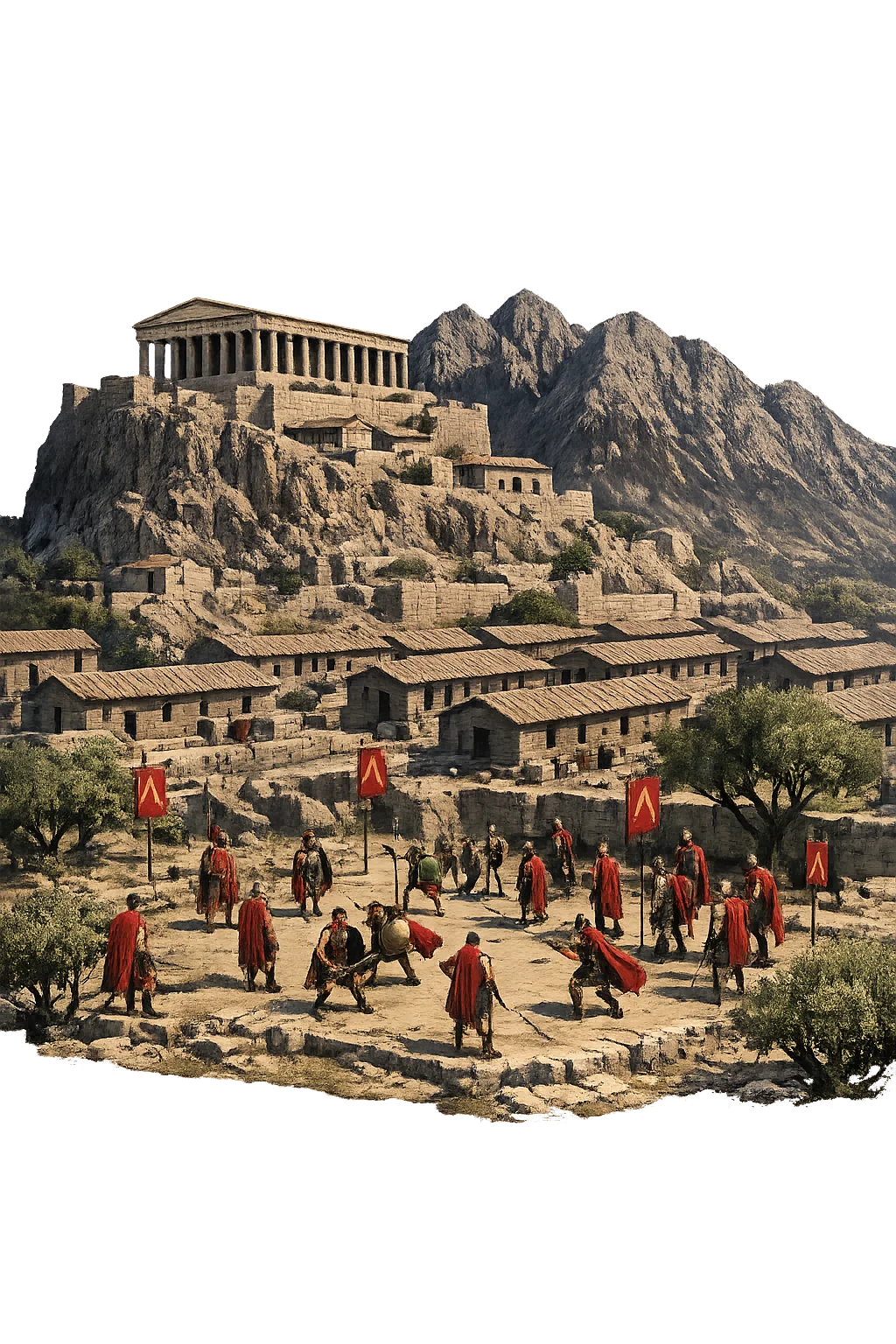
The appointments Spártē made — and who is keeping them
One myth is a story. A cycle of myths is a specification. Read Spártē's cycle in order and the industries fall out of it one by one.
At a Glance
- Temple: Spártē
- Pantheon: Greek-location
- Domain of influence: Warrior City
- Pattern seats: 5
- Sectors touched: Commerce & Governance · Culture & Entertainment
- Strongest seat: Defense, Military & Security
- Series: The Resonance Files, No. 455 of 546
The Cycle, Read Forward
Defense, Military & Security — through Sparta and Lacedaemon
The river Eurotas had a daughter named Sparta, beautiful and vigorous. Lacedaemon, son of Zeus and Taygete, came to Laconia and married her, uniting two divine lineages.
The atlas states the seat in one line: The warrior city; the adjective “spartan” still brands discipline. The story above is the long version of the same sentence. Industries do not invent their archetypes; they inherit them and call them best practice.
Leadership, Governance & Public Administration — through Lycurgus and the Delphic Oracle
The Spartans attributed their distinctive customs to Lycurgus, a semi-legendary lawgiver of the eighth or seventh century BCE. Herodotus (1.
The atlas states the seat in one line: Dual kings, gerousia, and ephorate; the mixed constitution studied from Polybius onward. The story above is the long version of the same sentence. That is the cycle working: story becomes duty, duty becomes trade.
Legal, Justice & Compliance — through Helen, the Dioscuri, and the Trojan War
When Paris abducted Helen, wife of the Spartan king Menelaus, he turned Sparta into the launching point of the Trojan War. Agamemnon gathered the Greek host, but the expedition was justified by the wrong done to Menelaus in his own palace.
The atlas states the seat in one line: Lycurgus brought her laws from Delphi; legislation itself is the city's founding myth. The story above is the long version of the same sentence. The trade thinks it is optimizing a process. It is re-enacting a charter.
Sports, Fitness & Competition — through Sparta and Lacedaemon
The river Eurotas had a daughter named Sparta, beautiful and vigorous. Lacedaemon, son of Zeus and Taygete, came to Laconia and married her, uniting two divine lineages.
The atlas states the seat in one line: The agoge forged the citizen-athlete; obstacle races still trade on her name. The story above is the long version of the same sentence. That is the cycle working: story becomes duty, duty becomes trade.
The Theme That Runs the Cycle
Greek myth gives Sparta a human namesake. Sparta is the daughter of the river-god Eurotas and the wife of Lacedaemon, son of Zeus; through her, the city receives both its name and its mythic charter. Around her cluster the lawgiver Lycurgus, the divine authorization from Delphi, and the Spartan share in the greatest cycle of Greek heroic legend, the Trojan War.
The Method, Stated Plainly
The atlas is not a horoscope. Seats are earned from the sources — argued, weighted, published — and every one of them can be challenged at the methodology page. A match that cannot survive an argument does not survive review. That is the whole trick: the patterns are claims, and claims can be tested.
For the Ones Who Work There
If you work in defense, military & security, leadership, governance & public administration, or any trade this temple holds a seat in, this is the honest version of what a placement means: your industry beside the story it has been re-telling all along — on the temple floor itself, before an audience that came specifically to read it. The patron tier and the advertising terms describe the mechanics; the resonance above describes the fit.
The File Continues
One of 546 Resonance Files — the series where the pantheon goes to work. Read the founding dispatch for the name, the Restoration File for the spelling, or the whole archive end to end.
Continue the series — previous: Sosin (read it) · next: Sphínx (read it).
The Resonance Files are argued from the same canonical record as the pattern atlas itself: the lexicon, the lore catalog, and the cited sources. Every seat can be challenged at the methodology page — and the challenge is the point.