
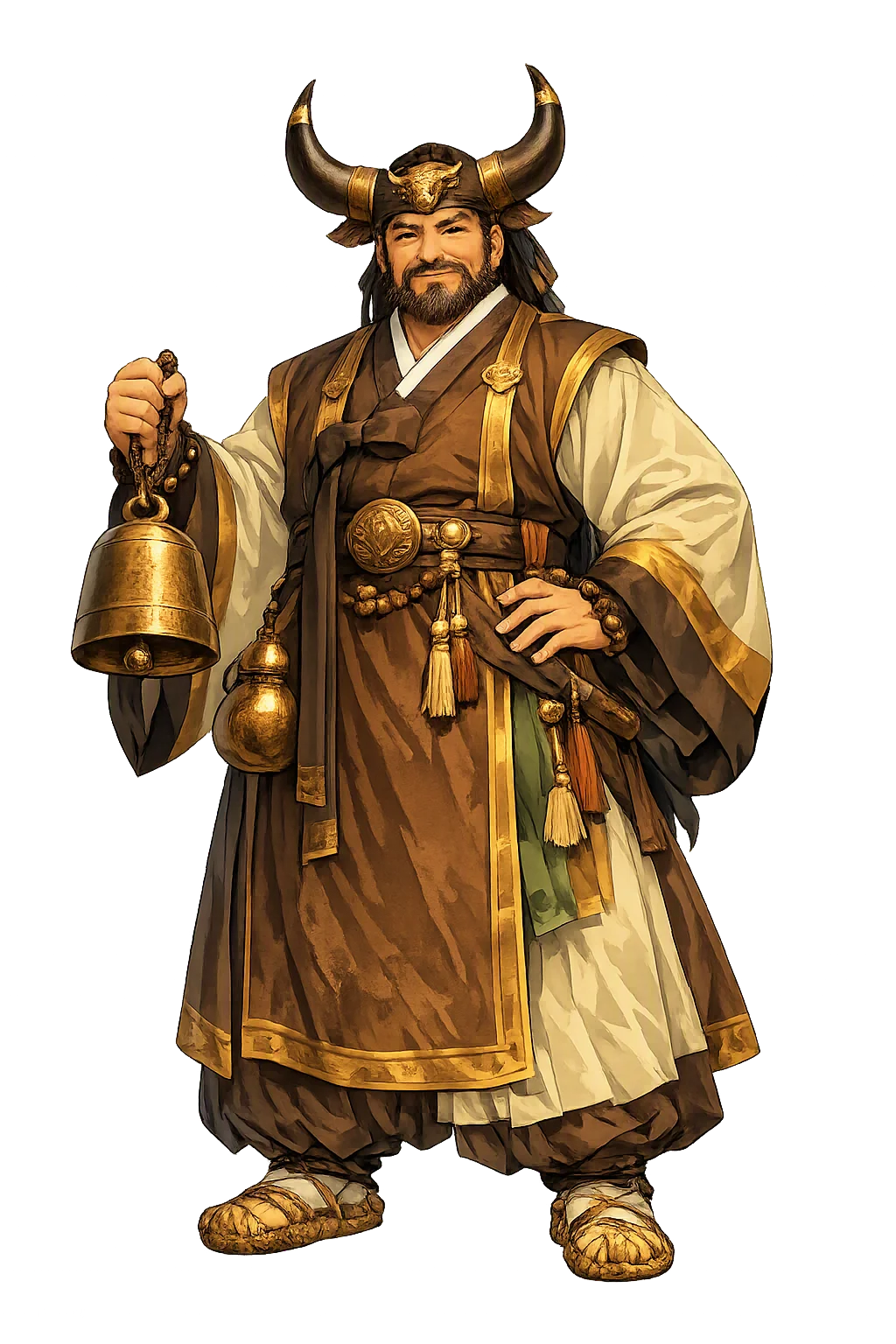
The provenance file on Sosin
Catalogue entry — Sosin. Every claim below carries its chain of custody.
Provenance
1. The attestation. —, from the tradition's own record. On record: Walraven, Boudewijn, Songs of the Shaman: The Ritual Chants of the Korean Mudang (Kegan Paul International, 1994)., Lee, Jung Young, Korean Shamanistic Rituals (Mouton, 1981)., Kendall, Laurel, Shamans, Housewives, and Other Restless Spirits: Women in Korean Ritual Life (University of Hawaii Press, 1985)., National Folk Museum of Korea, Encyclopedia of Korean Folk Beliefs (2015)..
2. The narrative record. The Government of Heaven — Korean shamanic cosmology, as the gut manuals and ethnographic records describe, models the spirit world on the old Korean state: a celestial bureaucracy of generals, ministers, and magistrates presided over by figures such as Cheonha Daejanggun, the Generalissimo of All-under-Heaven, with the mountain gods, household gods, and ancestors arranged in ranks below (Lee Jung Young, Korean Shamanistic Rituals; Walraven, Songs of the Shaman). Petitions do not ascend by themselves. Opening the Road — Every gut begins by making a way. The shaman sets out the divination flags and the offering table, drums the spirits toward the house, and invokes the road-opening messengers so that the petitions of the living can reach their recipients.
3. The physical record. No inscription, stele, or excavated shrine names Sosin; the figure's 'archaeology' is the archaeology of the gut itself. The material witnesses are the ritual paraphernalia preserved in Korean collections — the National Folk Museum of Korea in Seoul holds shamanic costumes, divination flags, bells, blades, and mirrors from twentieth-century performances — and the documented regional cycles of gut performance: the Jeju yeongdeunggut (inscribed by UNESCO in 2009), the chilseong-gut and jeseok-gut traditions recorded across the peninsula. Film and audio recordings of mudang made by scholars from the 1970s through the 1990s now function as the primary 'texts' for spirits of this class. Older strata are indirect: the Confucian and Buddhist polemics against 'exorcists and spirit-mediums,' reaching back well over a millennium, attest the tradition's antiquity even as they condemn it.
4. The current holding. The temple at /sosin/, classified Tier 2. Tier-2 here means one preserved truth — not less important, just singular. The temple shows it and names it.
5. The documented resonances. Education, Research & Knowledge, Mythic Name Restoration, Writing, Publishing & Media — seats argued and weighted in the pattern atlas, read through the myths in this temple's Resonance File.
6. The continuing record. Sosin is not a household name in the way that Yongwang or Samshin are, but it remains important within shamanic practice and the academic study of Korean religion. The figure appears in ritual manuals, recordings of gut performances, and ethnographic studies of mudang; the famous twentieth-century shaman Kim Keum-hwa and others carried the gut to national and international stages, turning village ritual into recognised performance art.
At a Glance
- Restored name: Sosin
- ASCII form: sosin
- Meaning: "Revealer of things"
- Domain of influence: Messenger, Revealer
- Pantheon: Korean
- Classification: Tier 2
- Original script: —
- Series: The Restoration Files, No. 456 of 548
The File Continues
Read the founding dispatch for the name's full story, the Resonance File for the archetype at work — or the whole archive in one sitting.
Continue the series — previous file: Šəlōmōh (read it here) · next file: Spártē (read it here).
The Restoration Files are written from the same canonical record as the temples themselves: the lexicon, the lore catalog, the pattern atlas, and the cited scholarly sources. If a file ever disagrees with its temple, the temple is right — tell us, and the file will be corrected.