
The name Sleipnir and the world it opens
A name is a door. Sleipnir opens onto an entire world: the domain of eight-legged steed, journey, offspring of loki, a Norse tradition, and centuries of storytelling, worship, and scholarship. This post walks through that world room by room — the name and its roots, the original script, the sound of it, the myths, the symbols, the sites, the afterlife across cultures — and ends at the newest room of all: a Unicode domain that makes the whole structure addressable. sleipnir gets you to the same building, but only the restored form tells you why it was built.
At a Glance
- Restored name: Sleipnir
- ASCII form: sleipnir
- Meaning: "Gliding one (from sleipr, slippery)"
- Domain of influence: Eight-Legged Steed, Journey, Offspring of Loki
- Pantheon: Norse
- Classification: Tier 2
Overview
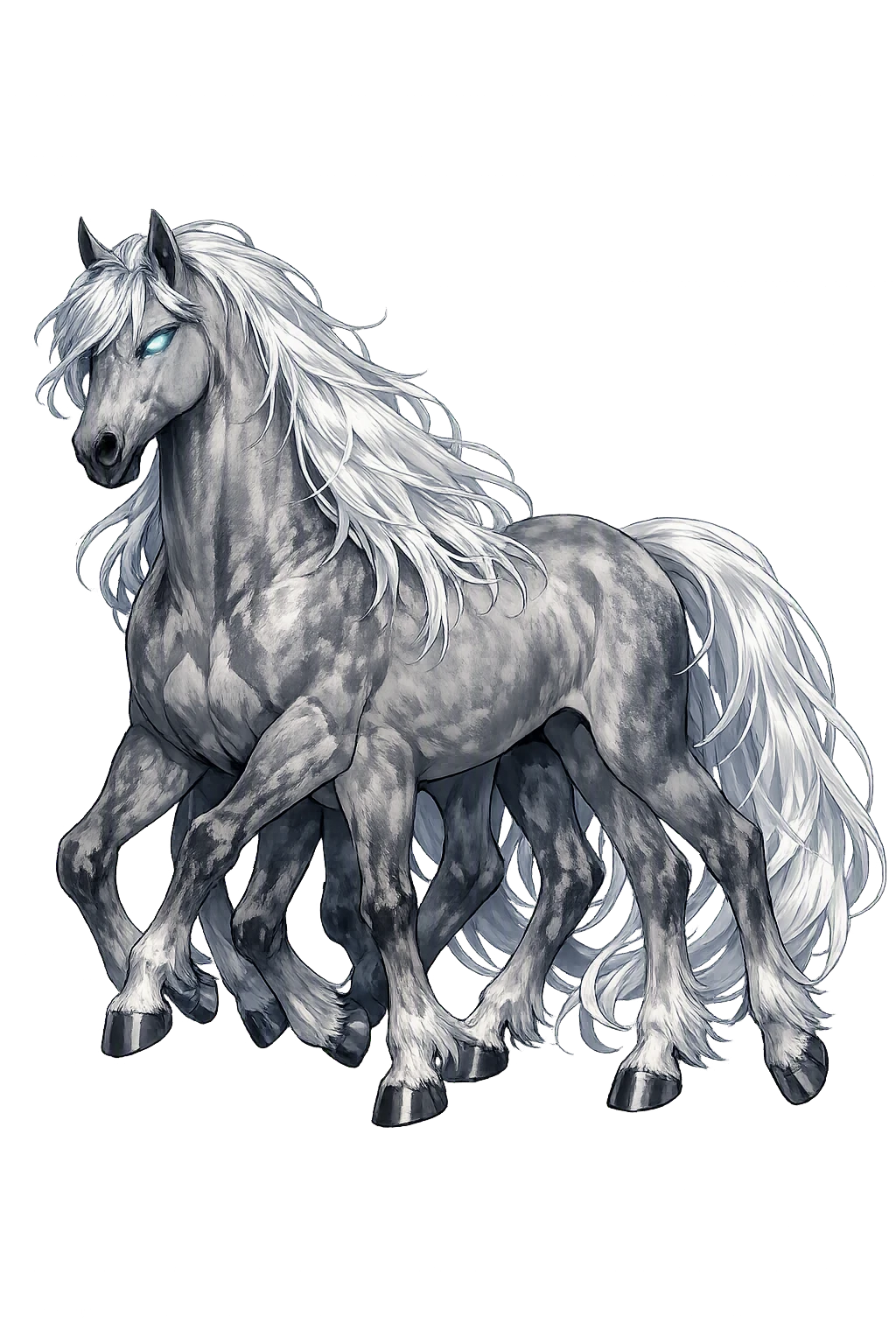
Sleipnir (sleipnir) — Eight-Legged Steed, Journey, Offspring of Loki · Gliding one (from sleipr, slippery) — is the grey eight-legged horse of Óðinn, 'the best horse among gods and men', and the strangest birth in the Edda: the foal of Loki in mare's form and the giant builder's stallion Svaðilfari, born of the night that broke the wall-bargain of Ásgarðr.
His dossier is three scenes and a pedigree. Snorri tells his begetting and the death of the builder; Snorri again gives him the corpus's one round trip to the land of the dead, when Hermóðr rides him nine nights down the Hel-road to ransom Baldr and the horse leaps Hel's gate with room to spare. The Poetic Edda gives him the superlative — Grímnismál names him best of horses in its catalogue of the best of all things — and the heroic cycle keeps his bloodline: Grani, Sigurðr's peerless grey, was of Sleipnir's lineage.
The name itself is from Old Norse sleipr, 'slippery, smooth' — the gliding one, the creature for whom every boundary becomes a road. PuniCodex restores the name as Sleipnir — identical to the ASCII input, because normalized Old Norse writes no diacritic in this name; the mechanical rule therefore places it in Tier 2. The temple is domain-less: no form of the name is owned, and the plain-ASCII sleipnir.com is watched for release.
The Name
The name is attested in Old Norse as Sleipnir, and its etymology is one of the secure ones. It derives from the adjective sleipr, 'slippery, smooth', with the agentive suffix that forms animal-names — hence 'the gliding one' or 'the sliding one', a name for the horse that slips past every obstacle. Cleasby–Vigfusson record sleipr and the related verb sleipa 'to slip, draggle'; Simek glosses the theonym 'the sliding one' without dissent, and de Vries carries the derivation without flagging a rival. Unlike Nanna or Baldr, there is no open question here — only the aptness of a speed-name for the fastest creature in the nine worlds.
The ASCII form is not a fallback but the form itself: normalized Old Norse writes eight plain Latin letters and a capital. The Unicode restoration Sleipnir therefore preserves nothing the ASCII alphabet loses, and the mechanical rule classifies the name Tier 2 — an orthographic fact, not a judgment on the horse of Óðinn.
The letter-by-letter transformation runs:
- s → S — Same, capitalized
- l → l — Same
- e → e — Same
- i → i — Same
- p → p — Same
- n → n — Same
- i → i — Same
- r → r — Same
The project holds no domain for this name. The plain-ASCII sleipnir.com is watched for release; this temple claims nothing it does not hold.
The Original Script
The name is preserved in medieval Icelandic manuscripts in the Latin alphabet as Sleipnir — Old Norse (North Germanic), attested 13th c. CE in the Codex Regius of the Prose Edda and related codices, recording material centuries older. Before the Latin bookhand, Old Norse names were carved in the Younger Futhark; no runic attestation of this name survives, so the manuscript form is the primary witness. The runic rendering is ᛋᛚᛁᛒᚾᛁᛦ (s-l-i-p-n-i-R).
The scholarly rendering proceeds step by step:
- The name is a derived agent-noun, not a compound: adjective sleipr 'slippery, smooth' plus the animal-name suffix, eight letters, two syllables.
- Old Norse orthography needs no diacritic here: the diphthong ei is written with plain letters, and no distinctive letter (þ, ð, æ, ǫ) occurs in the name.
- The Unicode restoration Sleipnir is therefore identical to the ASCII form — the restoration is a matter of canonical reference, not rescued orthography.
- The etymology itself is secure: the lexica carry 'the gliding one' from sleipr without a rival derivation, one of the few uncontested name-etymologies in the northern corpus.
Pronunciation
The reconstructed pronunciation of the name is /ˈslɛip.nir/ — Old Norse Reconstruction.
Phoneme by phoneme:
- Sl- — Voiceless alveolar fricative [s] released straight into a clear lateral [l]; Old Norse keeps the cluster intact, no helping vowel between
- -ei- — The falling diphthong [ɛi], as in steinn: a glide from open e to i, held in the stressed syllable
- -p- — Voiceless bilabial stop [p], unaspirated, closing the first syllable cleanly
- -nir — Nasal [n], short close [i], and the final nominative -r [r], lightly trilled and fully sounded
For the modern speaker, the closest approximation is: 'SLAYP-nir' — stress on the first syllable as in every Old Norse word, the ei a true two-part glide, the final r rolled and audible.
Kindred and historical forms of the name:
- Old Norse — Sleipnir, the eight-legged horse of Óðinn; attested only for this horse and as a horse-heiti in the þulur
- Younger Futhark — ᛋᛚᛁᛒᚾᛁᛦ (s-l-i-p-n-i-R), the Viking-Age runic rendering; the short-twig row writes e and i alike under ᛁ and p under bíarkan ᛒ
- Latin — none; Saxo Grammaticus, who euhemerizes the gods as mortal wizards, never mentions the eight-legged horse
- Modern Scandinavian — Sleipnir (Icelandic) / Sleipner (Swedish, Norwegian), preserved as a poetic horse-name and borrowed for ships, engines, and the North Sea Sleipner field
Sleipnir is Tier 2 because the restoration preserves nothing the ASCII form loses: no diacritic, no distinctive letter, no vowel length. English and Old Norse write the name identically.
Mythology
Sleipnir's mythology is three scenes and a pedigree — among the most economical dossiers in the Edda, and one of the most reproduced images in northern art.
The Master Builder's Wage (Gylfaginning 42)
A smith came to Ásgarðr offering to build the gods a wall in three seasons, high and strong against the mountain-giants, and named his wage: Freyja, and the sun and the moon. The Æsir bargained him down to one winter, alone — and at Loki's urging granted him the use of his stallion, Svaðilfari. The horse hauled boulders by night that the builder set by day, and with three days left before summer the work stood nearly finished. The gods threatened Loki with an evil death unless he made the builder lose; that night a mare ran from the wood and whinnied, the stallion broke his traces and ran after her, and the work stood still. The builder flew into a giant's rage, and Þórr smashed his skull with Mjölnir. Then Snorri's strangest sentence: Loki had had such dealings with Svaðilfari that somewhat later he bore a foal — grey, with eight legs, the best horse among gods and men.
The Ride Down the Hel-Road (Gylfaginning 49)
When Baldr lay dead and Frigg asked who would ride to Hel to ransom him, Hermóðr the Bold stood up, and Sleipnir was led out. He rode nine nights through dark and deep valleys to the river Gjöll and the Gjallarbrú, the bridge roofed with shining gold, where the maiden Móðguðr told him the dead had crossed the day before and the road lay downward and northward. At Hel's gate Hermóðr spurred the horse, and Sleipnir leapt it with so much to spare that the leap became proverb. Inside, Hermóðr found Baldr in the high seat; the ransom failed at the giantess Þökk's dry tears — but the ride itself, down and back, no other creature in the corpus performs.
Best of Horses (Grímnismál 44; Sigrdrífumál 15)
The Poetic Edda gives Sleipnir the superlative and a place in the rune-lore. Grímnismál names him best of horses in the catalogue of the best of all things; Sigrdrífumál counts his teeth among the places runes were carved — on the shield before the shining god, on Arvakr's ear and Alsvinnr's hoof, on Bragi's tongue, and on Sleipnir's teeth. The horse's mouth itself was writing's place.
The Bloodline (Reginsmál prose; Völsunga saga)
The heroic cycle keeps his descent: Grani, Sigurðr's peerless grey, was of Sleipnir's lineage — the best horse of the heroic age bred from the best horse of the gods, the line running down from Óðinn's stable into the Völsung story.
Symbols & Iconography
Sleipnir's iconography is fixed and small — the corpus gives a horse rather than a god, and fixes around him the objects of his three scenes:
- The eight legs — speed beyond nature's allowance: the mount that outruns every horse in the nine worlds
- The grey coat — the foal's colour at birth, noted by Snorri: grey, the working colour of northern horses
- Svaðilfari — the giant builder's stallion, his sire: the bargain's price become a gift
- The leap over Helgrindr — the gate of the dead cleared with room to spare: no boundary holds the gliding one
- The rune-carved teeth — Sigrdrífumál's image of runes lodged in the horse's mouth: the steed as a carrier of signs as well as riders
Archaeology & Evidence
Sleipnir has the strongest material attestation of any horse in the corpus: the Gotland picture stones. The Tjängvide stone from Alskog parish and Ardre VIII, carved in the eighth and ninth centuries, show an eight-legged horse bearing a rider toward a welcoming figure with a drinking-horn, before a hall — an image the standard scholarship identifies as Óðinn carried by Sleipnir, received at the boundary of the otherworld, centuries older than any manuscript that tells the myth. The identification rests on the one feature that needs no caption: eight legs, where nature and every other carved horse keep four.
No runic inscription names the horse, and no votive deposit can be tied to him — his cult, if any, was his master's. The textual witnesses are the Codex Regius and related codices of the Prose Edda for Gylfaginning 42 and 49, and the Codex Regius of the Poetic Edda for Grímnismál and Sigrdrífumál.
Realm & Domain
Sleipnir is catalogued under Eight-Legged Steed, Journey, Offspring of Loki — three headings that together hold the whole of him: what he is, what he does, and how he came to be.
Eight-Legged Steed
The mark no retelling can omit. Eight legs where every honest horse has four, and the superlative to go with them: the best horse among gods and men, Óðinn's mount above all others, carved with his rider on the Gotland stones centuries before the Eddas were written.
Journey
Sleipnir is the horse of the long road — above all the one road no other mount survives. On his back Hermóðr rides nine nights through dark and deep valleys, crosses the gold-roofed Gjallarbrú over the river Gjöll, and leaps the gate of Hel 'with so much to spare': the only journey in the corpus that goes down the Hel-road and returns.
Offspring of Loki
His parentage is the strangest in the Edda: borne by Loki in mare's form, sired by the giant builder's stallion Svaðilfari, given to Óðinn — the only one of Loki's children, beside the wolf, the serpent, and Hel, whose existence is a gift to the gods and not a threat.
Best of Horses
Grímnismál's catalogue of the best of all things — Yggdrasill of trees, Skíðblaðnir of ships, Óðinn of the Æsir — names Sleipnir the best of horses, the one animal in a list of gods and wonders.
Across Cultures
Sleipnir's closest kin is inside the corpus: Grani, Sigurðr's grey, whom Reginsmál's prose calls 'of Sleipnir's lineage' — the mythic superlative breeding the heroic one, as if the gods' stable stocked the sagas.
Beyond the North, scholars have ranged widely and cautiously. The eight-legged world-crosser has been read as the ritual mount of shamanic journey — the animal that carries its rider through the levels of the cosmos — an interpretation Simek registers as one modern reading among others, not an attestation. The old folkloric fancy that eight legs picture four pallbearers carrying a corpse has no medieval warrant, and the handbooks give it no house-room. What the sources support is narrower and stronger: a horse that belongs to no stable but Óðinn's, born of the one god who crosses every boundary himself, and used for the one ride — down to Hel and back — that no other mount could survive. Within the corpus his story binds Loki, Óðinn, Hermóðr, and the house of Baldr: he is the only one of Loki's children — beside the wolf, the serpent, and Hel — whose existence is a gift and not a threat.
Cultural Legacy
Sleipnir's afterlife is the afterlife of the image: the eight-legged rider of the Gotland stones has become one of the most reproduced figures of Norse art, carried from nineteenth-century antiquarian plates into every modern handbook of the mythology.
In the North itself the name never quite left the stables. Swedish and Norwegian kept Sleipner for engines and hulls — locomotives, naval vessels — and Norway gave the name to the Sleipner gas field in the North Sea, the undersea treasure-house named for the underworld runner. Modern Heathen and Ásatrú communities remember Sleipnir in Óðinn rites as the mount of the road between worlds, and every retelling of the Baldr cycle keeps his two great moments: the leap over Hel's gate, and the grey foal standing in the wreckage of the gods' broken bargain.
The Scholarly Record
The account of Sleipnir given in this edition rests on the witnesses and reference works listed below. Gylfaginning 42 and 49 supply the two great scenes; Grímnismál, Sigrdrífumál, and the Reginsmál prose the eddic frame and the bloodline; Völsunga saga carries the descent into heroic legend; Cleasby–Vigfusson and Zoëga fix the name's form, de Vries its derivation; Simek, Orchard, and Lindow arbitrate attestation and interpretation, with Lindqvist for the picture-stone evidence and Gordon for language and runes.
- Snorri Sturluson, Edda, Gylfaginning 42 (the master builder, Svaðilfari, and the birth of the grey eight-legged foal) and 49 (Hermóðr's ride on Sleipnir down the Hel-road and the leap over Hel's gate), ed. and trans. Anthony Faulkes (London: Everyman, 1987).
- Snorri Sturluson, Edda, Skáldskaparmál, þulur (jóa heiti — Sleipnir among the horse-names), trans. Anthony Faulkes (London: Viking Society for Northern Research, 1998).
- The Poetic Edda, trans. Carolyne Larrington, 2nd ed. (Oxford: Oxford University Press, 2014): Grímnismál 44 (Sleipnir the best of horses); Sigrdrífumál 15 (runes carved on Sleipnir's teeth); Reginsmál prose (Grani of Sleipnir's lineage).
- Völsunga saga, ch. 13 (Grani's descent), trans. Jesse L. Byock (Berkeley: University of California Press, 1990).
- Cleasby, Richard, and Guðbrandur Vigfússon, An Icelandic-English Dictionary, 2nd ed. (Oxford: Clarendon Press, 1957), s.v. sleipr, sleipa, Sleipnir.
- Zoëga, Geir T., A Concise Dictionary of Old Icelandic (Oxford: Clarendon Press, 1910), s.v. Sleipnir, sleipr.
- de Vries, Jan, Altnordisches etymologisches Wörterbuch, 2nd ed. (Leiden: Brill, 1962), s.v. Sleipnir, sleipr.
- Simek, Rudolf, Dictionary of Northern Mythology, trans. Angela Hall (Cambridge: D. S. Brewer, 1993), s.v. Sleipnir.
- Orchard, Andy, Dictionary of Norse Myth and Legend (London: Cassell, 1997), s.v. Sleipnir.
- Lindow, John, Norse Mythology: A Guide to the Gods, Heroes, Rituals, and Beliefs (Oxford: Oxford University Press, 2001), s.v. Sleipnir.
- Lindqvist, Sune, Gotlands Bildsteine, 2 vols. (Stockholm: Wahlström & Widstrand, 1941–42): Tjängvide (Alskog); Ardre VIII.
- Gordon, E. V., An Introduction to Old Norse, 2nd ed. rev. A. R. Taylor (Oxford: Clarendon Press, 1957).
A Meditation
Sleipnir is the Edda's quiet answer to the question of what Loki costs the gods. His other children are the wolf that devours the sun's lord, the serpent that girdles the world, and the daughter who keeps the dead — every one a debt that comes due at Ragnarǫk. Sleipnir alone runs the other way: the same transgression, the same mare-shape shame, and the foal is given to Óðinn and spends his strength on errands of rescue.
He is the proof that in this mythology nothing is only what it cost — not the broken oath, not the trickster's punishment, not the giant's death. The wall was never finished; the horse was. And the name says what he is for: the gliding one, the creature on whose back a wall, a river, and a gate of the dead are all one thing — ground. When the Æsir needed a road to the one place that has no road, they did not build one. They mounted the child of their own worst bargain, and he leapt.
The Unicode Restoration
Sleipnir is classified as Tier 2: the restoration needs no distinctive letters or diacritics its ASCII form would lose. The ASCII fallback sleipnir still resolves everywhere, but it is the restored form that carries the name's full information. That is the whole thesis of this temple: the marks are the message.
Why This Restoration Matters
A door only matters if people walk through it. The temple is open, and everything behind it — the myths, the scholarship, the canvas, the patrons — hangs on the restored spelling. The PuniCodex project bets that the web will make room for names as they were actually written, and Sleipnir is one of its standing proofs. Visit, share, cite, type it yourself: each use is a small rehearsal for a web where no name has to hide its marks to be found.
Explore Further
This post is one doorway into the temple. The home page carries the full character breakdown and the ambient canvas; the lore page tells the myths in long form; the Scholarly Edition preserves the sources, pronunciation data, and revision history; and the patron wall supports the restoration directly. For the wider map, browse the Lexicon, explore the Pantheon, or return to the PuniCodex blog.
Related Names
Sources
The full scholarly apparatus — every citation, revision, and review — lives in the Scholarly Edition. Key references for this post:
- Snorri Sturluson, Edda, Gylfaginning 42 and 49, ed. and trans. Anthony Faulkes (London: Everyman, 1987).
- The Poetic Edda, trans. Carolyne Larrington, 2nd ed. (Oxford: Oxford University Press, 2014): Grímnismál 44; Reginsmál prose.
- de Vries, Jan, Altnordisches etymologisches Wörterbuch, 2nd ed. (Leiden: Brill, 1962), s.v. Sleipnir, sleipr.
- Cleasby, Richard, and Guðbrandur Vigfússon, An Icelandic-English Dictionary, 2nd ed. (Oxford: Clarendon Press, 1957), s.v. sleipr, sleipa; Simek, Rudolf, Dictionary of Northern Mythology, trans. Angela Hall (Cambridge: D. S. Brewer, 1993), s.v. Sleipnir.
- Lexicon authorities for this entry: Poetic Edda, Prose Edda, Cleasby-Vigfusson.