
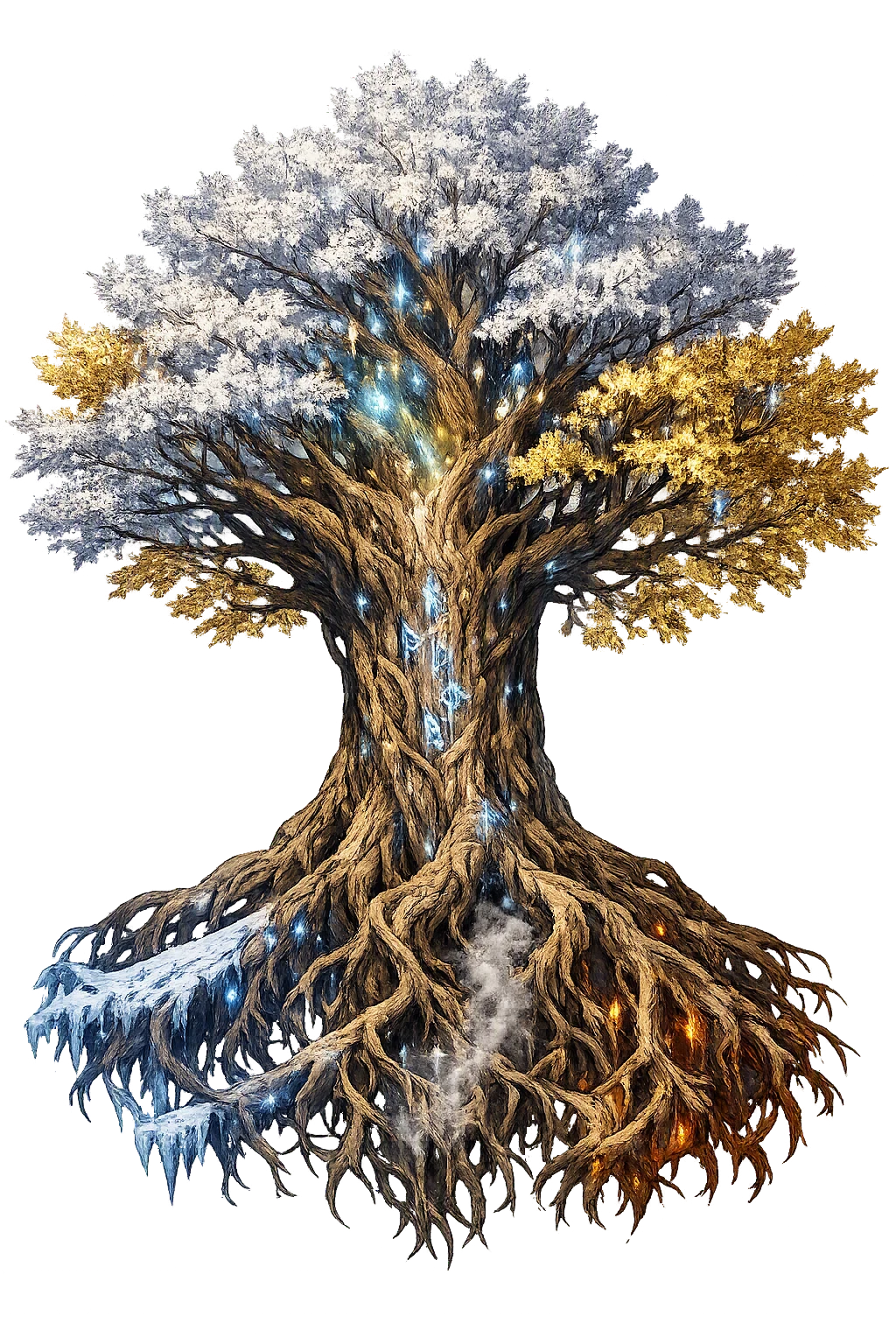
The provenance file on Yggdrasill
Catalogue entry — Yggdrasill. Every claim below carries its chain of custody.
Provenance
1. The attestation. ᚢᚴᚴᛏᚱᛅᛋᛁᛚᛚ, from the tradition's own record. On record: Poetic Edda: Völuspá 2 (mjötviðr, the measuring tree), 19–20 (the ash, the clay, the dew, the norns), 47 (the shuddering ash at Ragnarök); Grímnismál 29–35 (the three roots, the eagle and Veðrfölnir, Ratatoskr, the four stags, Níðhöggr, the tree's agony); Hávamál 138–141 (the nine nights on the windy tree); Vafþrúðnismál 44–45 (Líf and Lífþrasir in Hodd-Mímir's wood); Fjölsvinnsmál 19–26 (Mímameiðr), Snorri Sturluson, Prose Edda: Gylfaginning 8 and 15–16 (the ash, the three roots and three wells, the norns, the Æsir's daily court, Bifröst, the creatures, the watering); Skáldskaparmál (tree-kennings and þulur), Cleasby–Vigfusson, An Icelandic-English Dictionary, s.vv. Yggdrasill, drasill, Yggr (lexicon authority: 'Yggr's horse', the gallows-kenning), de Vries, Altnordisches etymologisches Wörterbuch, s.v. Yggdrasill (Yggr + drasill; the debated alternative derivations).
2. The narrative record. The Seeress's First Vision — The seeress of Völuspá, reciting the world's history to Óðinn, comes to the tree before almost anything else: 'An ash I know standing, called Yggdrasill, a high tree, sprinkled with white clay; from it come the dews that fall in the dales; it stands ever green over Urðr's well. ' Earlier still she remembered nine worlds and the mjötviðr, the measuring tree, beneath the earth — the frame was there before the filling. Nine Nights on the Windy Tree — Hávamál never names Yggdrasill, but the tradition has always read its most terrible stanzas onto it: 'I know that I hung on the windy tree nine whole nights, wounded by the spear, given to Óðinn, myself to myself, on that tree of which no man knows from what roots it rises. ' No bread fed him, no horn refreshed him; he peered downward, took up the runes screaming, and fell back.
3. The physical record. Yggdrasill is a textual cosmos: no runestone carves the name, no votive deposit invokes the tree, and no image can be securely identified with it. The witnesses are the great codices — the Codex Regius of the Poetic Edda (Reykjavík, GKS 2365 4to, c. 1270) for Völuspá, Grímnismál, and Hávamál, and the chief codices of Snorri's Edda (GKS 2367 4to, early fourteenth century; the Codex Upsaliensis, c. 1300; the Codex Wormianus) for Gylfaginning 15–16. The nearest material candidate is interpretive, not certain: the Överhogdal tapestries of Hälsingland, Sweden (late Viking Age or early medieval), depict a great branching tree with animals arranged about it, long read as Yggdrasill with its creatures — a plausible picture, not a proof. The truest 'archaeology' of the tree is literary-ethnographic: Adam of Bremen's report (c. 1075) of the evergreen tree and sacrificial spring beside the temple at Uppsala, and Tacitus's account (Germania 39) of the bound grove of the Semnones, show that the North really did worship at world-centering trees; the myth grew from soil that was still visible when the poems were copied down.
4. The current holding. The temple at /yggdrasill/, classified Tier 2. Tier-2 here means one preserved truth — not less important, just singular. The temple shows it and names it.
5. The documented resonances. Communication, Messaging & Logistics, Cybersecurity & Digital Protection, Software, Cloud & Developer Infrastructure — seats argued and weighted in the pattern atlas, read through the myths in this temple's Resonance File.
6. The primary sources. Poetic Edda, Prose Edda — the library this file answers to, open at the Sacred Texts collection.
7. The continuing record. Yggdrasill's modern afterlife begins with the romantic rediscovery of the Eddas and hardens into icon with Wagner: in the Ring cycle the Welt-Esche, the World Ash, anchors the whole drama — Wotan has torn a branch from it to make the spear on which the treaties are carved, the tree withers when the wellspring is disturbed, and the Norns spin their rope beneath it in the prologue to Götterdämmerung. From Wagner onward the tree became the default emblem of Norse myth itself, the one image every popular retelling reaches for.
At a Glance
- Restored name: Yggdrasill
- ASCII form: yggdrasill
- Meaning: "Ygg's horse (Odin's gallows)"
- Domain of influence: World Tree
- Pantheon: Norse
- Classification: Tier 2
- Original script: ᚢᚴᚴᛏᚱᛅᛋᛁᛚᛚ
- Series: The Restoration Files, No. 401 of 406
The File Continues
Read the founding dispatch for the name's full story, the Resonance File for the archetype at work — or the whole archive in one sitting.
Continue the series — previous file: Yánluó (read it here) · next file: Yīnyáng (read it here).
The Restoration Files are written from the same canonical record as the temples themselves: the lexicon, the lore catalog, the pattern atlas, and the cited scholarly sources. If a file ever disagrees with its temple, the temple is right — tell us, and the file will be corrected.