
Yggdrasill in 2026: why scholars still care
In 2026, names are treated as data points. Yggdrasill is a reminder that they are also cultural artifacts — and that the difference matters for search engines, AI training corpora, and anyone who types the name of a Norse figure into a browser. Scholars never stopped caring about the difference between yggdrasill and Yggdrasill; the web simply made that care actionable. What follows is the full scholarly picture — name, script, sound, myth, cult, and legacy — followed by the engineering compromise that lets a restored spelling live at a real address. The question is not whether the name is old. It is whether the digital world is old enough to hold it.
At a Glance
- Restored name: Yggdrasill
- ASCII form: yggdrasill
- Meaning: "Ygg's horse (Odin's gallows)"
- Domain of influence: World Tree
- Pantheon: Norse
- Classification: Tier 2
- Original script: ᚢᚴᚴᛏᚱᛅᛋᛁᛚᛚ (Younger Futhark)
Overview
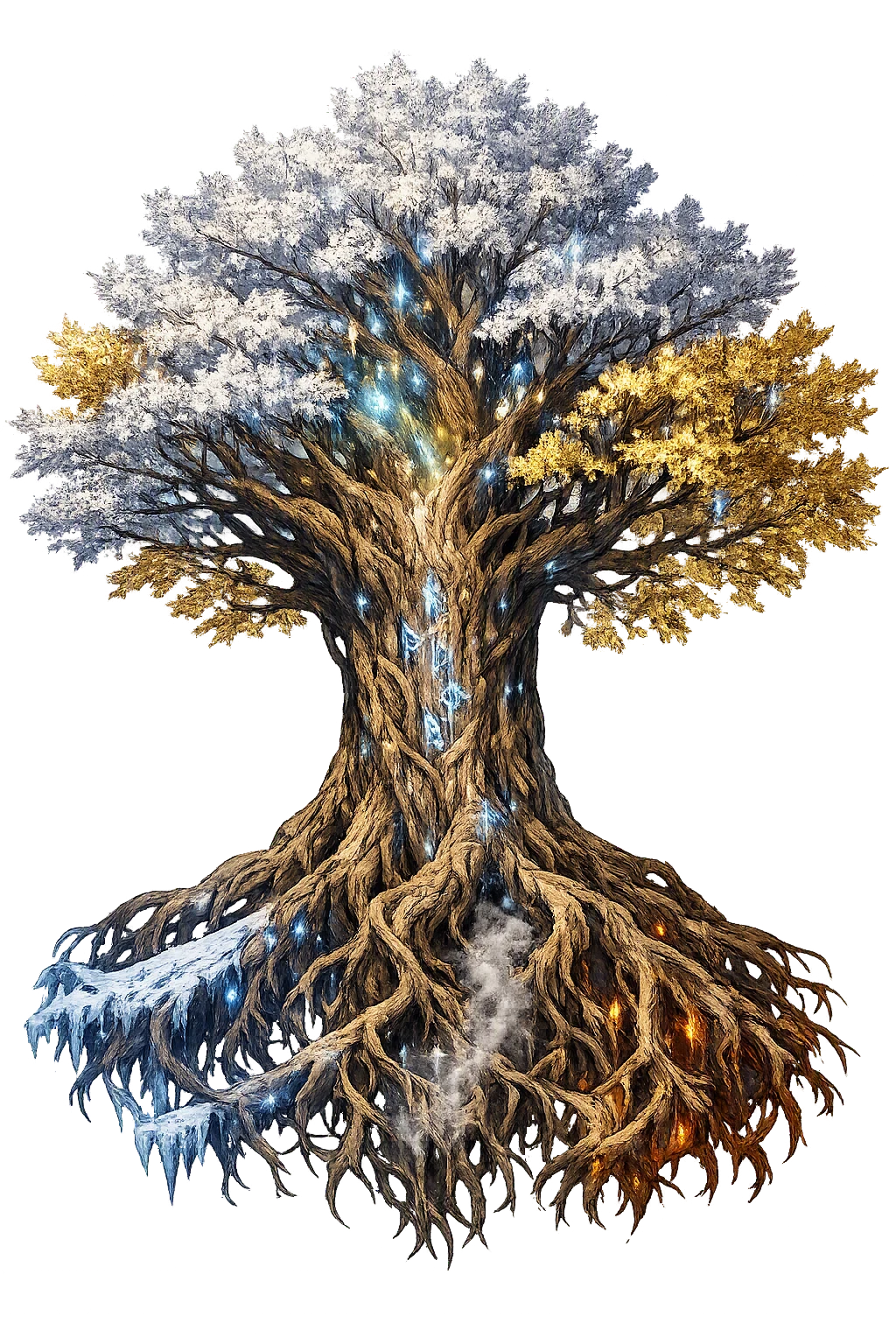
Yggdrasill (yggdrasill) — World Tree · Ygg's horse (Odin's gallows) — is the great ash at the center of the Norse cosmos: not a god and not a place but the frame on which all gods and all places hang. Völuspá's seeress sees it before almost anything else — the towering ash, sprinkled with white clay, dews falling from its branches into the dales, standing ever green over Urðr's well — and beneath it the three norns who lay down laws and allot life.
The name itself is the tradition's darkest compression: Yggr, 'the Terrible', is an attested heiti of Óðinn, and drasill is the poets' word for a horse — 'Yggr's steed', the gallows the hanged god rides, in the kenning-logic Hávamál's nine-night hanging made unforgettable. The axis of the universe is named for an execution, and specifically for the death a god inflicted on himself to buy the runes.
Three roots run from the tree to three wells: to Urðarbrunnr in heaven, where the Æsir ride daily over Bifröst to hold court; to Mímir's well among the frost-giants, where wisdom is hidden and Óðinn pledged an eye; to Hvergelmir in Niflheimr, where the serpent Níðhöggr gnaws. PuniCodex restores the name as Yggdrasill — identical to the ASCII input, because normalized Old Norse writes no diacritic in this name; the mechanical rule therefore places it in Tier 2, a statement about orthography and never about the concept. The temple is domain-less: the project holds no form of the name, and yggdrasill.com is watched for release.
The Name
The name is attested in Old Norse as Yggdrasill, almost always in the fuller phrase askr Yggdrasills, 'the ash of Yggdrasill'. Its etymology is the secure kind, for once: Yggr, 'the Terrible One', is a standard Óðinn-heiti, and drasill is a poetic word for 'horse' — so 'Yggr's horse'. The sense is completed by the old kenning-pattern in which the gallows is the hanged man's steed: the tree is the horse Óðinn rode when he hung nine nights, 'given to Óðinn, myself to myself'. A minority scholarly line has probed other derivations, and de Vries registers the debates without overturning the consensus; the poems' own theology — the windy tree, the hanging, the runes — argues for the gallows.
The ASCII form is not a fallback here but the form itself: normalized Old Norse writes ten plain Latin letters and a capital. The Unicode restoration Yggdrasill therefore preserves nothing the ASCII alphabet loses, and the mechanical rule classifies the name Tier 2 — an orthographic fact, not a judgment on the world tree.
The letter-by-letter transformation runs:
- y → Y — Same, capitalized
- g → g — Same
- g → g — Same
- d → d — Same
- r → r — Same
- a → a — Same
- s → s — Same
- i → i — Same
- l → l — Same
- l → l — Same
The project holds no domain for this name. The plain-ASCII yggdrasill.com is watched for release; this temple claims nothing it does not hold.
The Original Script
The name is preserved in medieval Icelandic manuscripts in the Latin alphabet as Yggdrasill — Old Norse (North Germanic), attested 13th c. CE in the Codex Regius of the Poetic Edda and the chief codices of the Prose Edda, recording material centuries older. Before the Latin bookhand, Old Norse names were carved in the Younger Futhark; no runic attestation of this name survives, so the manuscript form is the primary witness. The runic rendering is ᚢᚴᚴᛏᚱᛅᛋᛁᛚᛚ (ukktrasill).
The scholarly rendering proceeds step by step:
- The name is a compound: Yggr ('the Terrible', an Óðinn-heiti) + drasill (poetic 'horse') — 'Yggr's horse', the gallows-steed.
- ᚢ (úr) writes the rounded back vowels /u, o, ø, ǫ, y/ and /w/, so the initial Y- needs no special rune.
- ᚴ (kaun) writes both /k/ and /g/ (and the ng cluster), so the geminate gg surfaces as kk in the runic row.
- ᛏ (Týr) writes both /t/ and /d/, so the d of drasill appears as t.
- The spelling ukktrasill is a normalized phonetic reconstruction; Younger Futhark does not distinguish voiced/voiceless stops or separate short and long vowels.
- Old Norse orthography needs no diacritic in the Latin form either: the vowels are short, and no distinctive letter (þ, ð, æ, ǫ) occurs in the name. The Unicode restoration Yggdrasill is therefore identical to the ASCII form — the restoration is a matter of canonical reference, not rescued orthography.
Pronunciation
The reconstructed pronunciation of the name is /ˈyɡː.drɑ.silː/ — Old Norse Reconstruction.
Phoneme by phoneme:
- Y- — Close front rounded [y], as in German ü, stressed on the first syllable as in every Old Norse word; the letter is a vowel here, never the English consonant 'y'
- -gg- — The geminate voiced velar stop [ɡː], held long across the syllable boundary, as in modern Icelandic
- -dr- — The onset cluster [dr] opening the second element — drasill, the poets' word for 'horse'
- -a- — Short open back unrounded [ɑ], held brief — Old Norse short a, not long á
- -sill — Voiceless sibilant [s], short close front [i], and the geminate lateral [lː] closing the word, fully sounded
For the modern speaker, the closest approximation is: 'UEG-drah-sill' — the first vowel rounded like German ü, the double g and double l each held a fraction long.
Kindred and historical forms of the name:
- Old Norse — Yggdrasill, usually askr Yggdrasills, 'the ash of Yggdrasill'; also mjötviðr, 'measuring tree', in Völuspá 2
- Younger Futhark — ᚢᚴᚴᛏᚱᛅᛋᛁᛚᛚ (ukktrasill), the normalized Viking-Age runic rendering
- Learned Latin-script — Yggdrasil, with a single l, the standard modern scholarly simplification in English and German handbooks
- Modern Icelandic — Yggdrasill, the unbroken living form
Yggdrasill is Tier 2 because the restoration preserves nothing the ASCII form loses: no diacritic, no distinctive letter, no vowel length. English and Old Norse write the name identically.
Mythology
Yggdrasill has no adventures — it is the stage on which all adventures happen. The sources do not tell stories about the tree so much as take attendance at it, each witness from a different height of the cosmos.
The Seeress's First Vision (Völuspá 19–20)
Reciting the world's history to Óðinn, the seeress comes to the tree before almost anything else: 'An ash I know standing, called Yggdrasill, a high tree, sprinkled with white clay; from it come the dews that fall in the dales; it stands ever green over Urðr's well.' Beneath it come the three maidens — Urðr, Verðandi, Skuld — who carve on slips of wood and lay down laws, allotting life to the children of men. Earlier still she had remembered nine worlds and the mjötviðr, the measuring tree, beneath the earth: the frame was there before the filling.
Nine Nights on the Windy Tree (Hávamál 138–141)
Hávamál never names Yggdrasill, but the tradition has always read its most terrible stanzas onto it: 'I know that I hung on the windy tree nine whole nights, wounded by the spear, given to Óðinn, myself to myself, on that tree of which no man knows from what roots it rises.' No bread fed him, no horn refreshed him; he peered downward, took up the runes screaming, and fell back. The name is the commentary — Yggr's horse is the gallows-steed of the hanged god.
The Burden of the Ash (Grímnismál 29–35)
Bound between the fires, Óðinn recites the tree's census: three roots running to the Æsir, to the frost-giants, and over Niflheimr where Hvergelmir boils; the eagle in the branches with Veðrfölnir between its eyes; Ratatoskr running between the eagle and the gnawing Níðhöggr; the four stags biting the highest shoots. Then the verdict: 'The ash of Yggdrasill suffers more agony than men know — a stag bites it from above, its sides are rotting, Níðhöggr gnaws it from below.'
Snorri's Map of the Worlds (Gylfaginning 15–16)
Snorri systematizes what the poems scatter: the chief sanctuary of the gods, its branches over the whole world; the root at Urðr's well where the Æsir hold court daily, riding over Bifröst; the root at Mímir's well where Óðinn pledged his eye; the root over Hvergelmir. The norns water the tree from the well with its white clay so it shall not wither, and the dew that falls from it men call honey-dew. Snorri's cosmology ends in hygiene: the tree must be watered, or the world dries out.
The Tree at Ragnarök (Völuspá 47; Vafþrúðnismál 44–45)
When the end comes, the seeress gives the tree one line of pure dread: 'Yggdrasill's ash shudders as it stands, the old tree groans, and the giant slips free.' The cosmos announces its collapse through its axis — by trembling, not by falling. Vafþrúðnismál looks past the fire: Líf and Lífþrasir hide in Hodd-Mímir's wood through Fimbulvetr, living on morning dews, and from them the new mankind springs — the tree named for a gallows ending as the refuge of the living.
Mímameiðr (Fjölsvinnsmál 19–26)
The late eddic Svipdagsmál gives the tree a sister-image: Mímameiðr, 'Mímir's tree', whose branches spread over every land, which no fire nor iron harms, and from whose fruit women in childbirth are helped — the world tree read through the lens of wonder-tale, proof the image kept growing after the classical poems.
Symbols & Iconography
The iconography of Yggdrasill is structural rather than cultic — the corpus gives it no temple regalia, but fixed around the tree a set of creatures and waters no retelling can omit:
- The great ash — askr Yggdrasills: the axis that holds the nine worlds, greatest and best of trees
- The white clay and the dew — the shining loam the norns spread on the roots, and the dews that fall from the branches into the dales: the tree as the weather of the world
- The eagle and the hawk — the wise unnamed eagle in the crown, with Veðrfölnir sitting between its eyes: knowledge perched at the top of the world
- Ratatoskr — the squirrel bearing words of spite between the eagle above and Níðhöggr below: communication as mischief
- The four stags — Dáinn, Dvalinn, Duneyrr, Duraþrór, browsing the highest shoots: the living world feeding on its own frame
- Níðhöggr — the serpent gnawing the root beneath Niflheimr, with more snakes than any man can count: entropy working at the foundation
- The well of Urðr — where the norns shape fate and the Æsir ride over Bifröst to hold their þing: law and destiny at the tree's foot
Archaeology & Evidence
Yggdrasill is a textual cosmos: no runestone carves the name, no votive deposit invokes the tree, and no image can be securely identified with it. The witnesses are the great codices — the Codex Regius of the Poetic Edda (Reykjavík, GKS 2365 4to, c. 1270) for Völuspá, Grímnismál, and Hávamál, and the chief codices of Snorri's Edda (GKS 2367 4to, early fourteenth century; the Codex Upsaliensis, c. 1300; the Codex Wormianus) for Gylfaginning 15–16.
The nearest material candidate is interpretive, not certain: the Överhogdal tapestries of Hälsingland, Sweden (late Viking Age or early medieval), depict a great branching tree with animals arranged about it, long read as Yggdrasill with its creatures — a plausible picture, not a proof. The truest material context is literary-ethnographic: Adam of Bremen's report of the evergreen tree and sacrificial spring beside the temple at Uppsala, and Tacitus's account of the bound grove of the Semnones, show that the North really did worship at world-centering trees; the myth grew from soil that was still visible when the poems were copied down.
Realm & Domain
Yggdrasill is catalogued under World Tree — and the heading is exact: the sources give it no personality, no cult-statue, no priesthood, only structure. Everything the tradition knows about the arrangement of existence is hung on this one ash.
The Axis of the Nine Worlds
Snorri calls it the chief sanctuary of the gods, greatest and best of all trees: its branches spread over the whole world and reach above the sky, and Völuspá's seeress remembers nine worlds and the measuring tree beneath the earth before she remembers anything else. The cosmos is not a map in the Eddas; it is a tree.
Fate
At Urðr's well, under the root that runs to heaven, the norns — Urðr, Verðandi, Skuld — lay down laws and allot the lives of men, and daily pour water and white clay over the roots so the tree shall not wither. Destiny in this tradition is not written in a book; it is watered like a garden.
Wisdom
The second root runs to Mímir's well, where wisdom and understanding are hidden, and where Óðinn left an eye as a pledge for one drink. The tree draws its life partly from the cost of knowledge.
Sacrifice
The name remembers the gallows: Hávamál's windy tree, the spear-wound, the nine nights, the runes taken up screaming. The axis of the world is consecrated by a death that was also a self-offering.
Endurance
Grímnismál's verdict is the darkest said of any tree: the ash of Yggdrasill suffers more agony than men know — bitten from above, rotting at the sides, gnawed from below — and still stands. Order, for the North, is not the absence of damage but the refusal to fall.
Across Cultures
Yggdrasill's truest parallels are cultic, and the closest stands at Uppsala. Adam of Bremen, writing about 1075 from the reports of eyewitnesses at the Danish court, describes beside the temple a great tree, evergreen in winter and summer, its species unknown, with a spring into which human sacrifices were plunged — a living cult-tree of exactly the kind the poems mythologize. Tacitus, a thousand years of habit earlier, reports the sacred grove of the Semnones, entered only bound in cords, where the Germanic peoples believed their race began: the pattern of the world-centering tree and grove is old in the North.
Cross-culturally, nineteenth-century mythographers ranged Yggdrasill beside every axis-tree of Eurasia — the shamanic world-trees of Siberia, the bodhi tree, the garden trees of Eden — and modern handbooks keep the comparisons while lowering the confidence: the world-tree motif is broadly Eurasian, but the specifically Norse details — the hanged god, the wells of fate and wisdom, the census of creatures — are native growth. The Hávamál hanging itself has been read both as a genuine sacrificial self-immolation and, by older scholars, as an echo of the crucifixion; current scholarship is cautious, noting that 'myself to myself' resists any simple Christian gloss. What can be said cleanly is that no other tradition's world-tree is named for a gallows, and none keeps its fate and its wisdom in wells at its roots.
Cultural Legacy
Yggdrasill's modern afterlife begins with the romantic rediscovery of the Eddas and hardens into icon with Wagner: in the Ring cycle the Welt-Esche, the World Ash, anchors the whole drama — Wotan has torn a branch from it to make the spear on which the treaties are carved, the tree withers when the wellspring is disturbed, and the Norns spin their rope beneath it in the prologue to Götterdämmerung. From Wagner onward the tree became the default emblem of Norse myth itself, the one image every popular retelling reaches for.
Modern Heathen and Ásatrú communities treat Yggdrasill as the living diagram of their cosmology — the nine worlds hung on a single axis — and the name has spread into fantasy literature, games, and film as shorthand for any world-connecting tree, usually in the single-l Yggdrasil of the handbooks. Through it all the name keeps its strange fidelity: a modern world still speaks of the universe's scaffold in a word that means 'the Terrible One's gallows-horse', whether it knows it or not.
The Scholarly Record
The account of Yggdrasill given in this edition rests on the witnesses and reference works listed below. Völuspá, Grímnismál, Hávamál, Vafþrúðnismál, and Fjölsvinnsmál supply the poetic sightings; Gylfaginning 8 and 15–16 the systematic prose map; Cleasby–Vigfusson and de Vries the name's etymology, with Simek, Orchard, and Lindow arbitrating attestation and the world-tree problem.
- The Poetic Edda, trans. Carolyne Larrington, 2nd ed. (Oxford: Oxford University Press, 2014): Völuspá 2, 19–20, 47; Grímnismál 29–35; Hávamál 138–141; Vafþrúðnismál 44–45; Fjölsvinnsmál 19–26.
- Snorri Sturluson, Edda, Gylfaginning 8 and 15–16 (the ash, the three roots and wells, the norns, the Æsir's daily court, Bifröst, the watering), ed. and trans. Anthony Faulkes (London: Everyman, 1987).
- Snorri Sturluson, Edda, Skáldskaparmál (tree-kennings and þulur), trans. Anthony Faulkes (London: Viking Society for Northern Research, 1998).
- Cleasby, Richard, and Guðbrandur Vigfússon, An Icelandic-English Dictionary, 2nd ed. (Oxford: Clarendon Press, 1957), s.vv. Yggdrasill, drasill, Yggr.
- Zoëga, Geir T., A Concise Dictionary of Old Icelandic (Oxford: Clarendon Press, 1910), s.v. Yggdrasill.
- de Vries, Jan, Altnordisches etymologisches Wörterbuch, 2nd ed. (Leiden: Brill, 1962), s.v. Yggdrasill.
- Simek, Rudolf, Dictionary of Northern Mythology, trans. Angela Hall (Cambridge: D. S. Brewer, 1993), s.v. Yggdrasil.
- Orchard, Andy, Dictionary of Norse Myth and Legend (London: Cassell, 1997), s.v. Yggdrasil.
- Lindow, John, Norse Mythology: A Guide to the Gods, Heroes, Rituals, and Beliefs (Oxford: Oxford University Press, 2001), s.v. Yggdrasill.
- Adam of Bremen, Gesta Hammaburgensis ecclesiae pontificum IV.26–27 (the evergreen at Uppsala), trans. Francis J. Tschan (New York: Columbia University Press, 1959).
A Meditation
The Norse imagination did something no other mythology dared: it named the support of all existence after an instrument of execution. Yggdrasill is not 'the beautiful tree' or 'the tree of life' but 'Yggr's horse' — the gallows, remembered forever. The claim folded into the etymology is that the cosmos is held up by a price already paid: the god's nine nights, the pledged eye, the runes taken up screaming.
And the tree answers the claim by suffering in its turn — bitten from above, rotting at the sides, gnawed from below, enduring more agony than men know, and still standing. Between the hanged god and the wounded tree runs the Edda's deepest intuition: that order is not the absence of damage but the refusal to fall. When Ragnarök comes, the ash shudders and groans — and the poems never say it breaks. Whatever burns, the frame holds long enough for Líf and Lífþrasir to wake in the morning dew.
The Unicode Restoration
Yggdrasill is classified as Tier 2: the restoration needs no distinctive letters or diacritics its ASCII form would lose. The ASCII fallback yggdrasill still resolves everywhere, but it is the restored form that carries the name's full information. That is the whole thesis of this temple: the marks are the message.
Why This Restoration Matters
In 2026 the stakes are practical. Search indexes, language models, and localization pipelines all inherit whatever spelling the web normalizes — which means every Unicode domain is also a training signal. Yggdrasill teaches the machinery that the restored form exists, that it is used, and that it points to a real place. That is why a project built on philology ends up caring about DNS: the infrastructure decides which names the future sees. This restoration makes sure the future sees the whole name.
Explore Further
This post is one doorway into the temple. The home page carries the full character breakdown and the ambient canvas; the lore page tells the myths in long form; the Scholarly Edition preserves the sources, pronunciation data, and revision history; and the patron wall supports the restoration directly. For the wider map, browse the Lexicon, explore the Pantheon, or return to the PuniCodex blog.
Related Names
Sources
The full scholarly apparatus — every citation, revision, and review — lives in the Scholarly Edition. Key references for this post:
- The Poetic Edda, trans. Carolyne Larrington, 2nd ed. (Oxford: Oxford University Press, 2014): Völuspá 2 and 19–20; Hávamál 138–141.
- Snorri Sturluson, Edda, Gylfaginning 15–16, ed. and trans. Anthony Faulkes (London: Everyman, 1987).
- de Vries, Jan, Altnordisches etymologisches Wörterbuch, 2nd ed. (Leiden: Brill, 1962), s.v. Yggdrasill; Cleasby & Vigfússon, s.vv. Yggr, drasill.
- Cleasby, Richard, and Guðbrandur Vigfússon, An Icelandic-English Dictionary, 2nd ed. (Oxford: Clarendon Press, 1957), s.vv. Yggdrasill, drasill, Yggr.
- Lexicon authorities for this entry: Poetic Edda, Cleasby-Vigfusson.