
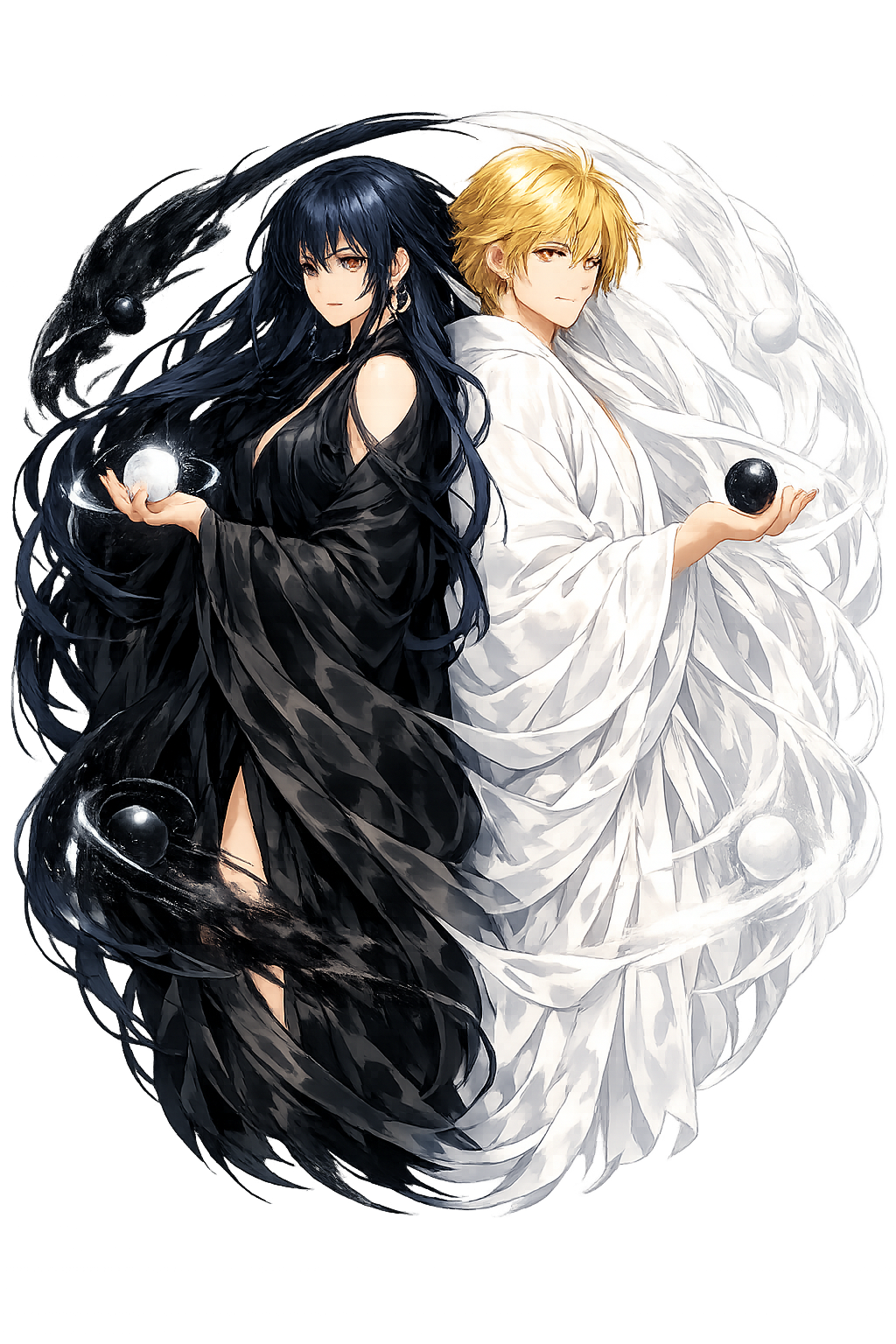
How Yīnyáng was rebuilt, mark by mark
The workshop file for Yīnyáng. Every rejected form is recorded here too — that is the point of keeping notes.
What We Found
The attestation, as Yijing (Book of Changes), Xici zhuan (Appended Statements) and Laozi, Daodejing, ch. 42 record: 陰陽. Meaning: "Interdependence of opposites".
The figure behind the name: Yīnyáng has no origin myth in the usual sense.
What the Name Carried In
One Yin, One Yang. The Xici — the Appended Statements, the philosophical commentary attached to the Yijing by the third century BCE — comes as close to a creed as the tradition allows: 'One yin and one yang: this is called the Dao' (Xici, Part A, §5). The cosmos, in this reading, is not governed by a personal deity but by the alternation of two modes, and the hexagrams of the classic are nothing more than snapshots of that alternation — sixty-four positions in the endless turning.
All Things Carry Yin and Embrace Yang. The Daodejing (ch. 42) compresses the whole cosmogony into nine characters of arithmetic: 'The Dao gives birth to One; the One gives birth to Two; the Two give birth to Three; the Three give birth to the ten thousand things.
A spelling that has to carry stories like these is not a label. It is equipment.
Where It Stood Before Us
The oldest layer of yin-yang thought is embedded in the Yijing itself, transmitted through Warring States bamboo and silk manuscripts such as the Mawangdui silk Yijing (c. 168 BCE) and the Guodian Chu slips (c. 300 BCE). The Zuo Zhuan preserves early medical and astrological uses of yin-yang terminology, while Han dynasty tomb texts and visual art pair the two principles with the Four Spirits and the five phases. The iconic two-tone taijitu diagram is a Song-era visual innovation, though the conceptual pairing it depicts is ancient. The bench inherits all of it — the web temple is the newest site, not the first.
What We Kept
The evidence, mark by mark — 2 features the keyboard form yinyang cannot hold:
- i → ī — Macron: level tone. Kept.
- a → á — Second tone. Kept.
What We Rejected
The plain ASCII yinyang — admissible as a fallback, never as the primary. A wrong accent would have been worse: the rulebook is explicit that a misplaced mark is worse than none.
What We Set Down
Yīnyáng — The restoration preserves more than the ASCII form can express — stress, length, or a letter the Latin keyboard lost — which places it, mechanically, in Tier-1.
For the voice: yIN-YAHNG — first syllable high and level, second syllable rising from mid to high.
The temple stands at /yinyang/ — the notes above are public in its Scholarly Edition, sources and all.
At a Glance
- Restored name: Yīnyáng
- ASCII form: yinyang
- Meaning: "Interdependence of opposites"
- Domain of influence: Cosmic Duality
- Pantheon: Taoist
- Classification: Tier 1
- Original script: 陰陽
- Series: The Restoration Files, No. 539 of 546
The File Continues
The temple's founding dispatch tells the name's story; its Resonance File reads the myths into the industries; the blog index holds the whole archive.
Continue the series — previous file: Yggdrasill (read it here) · next file: Ymir (read it here).
The Restoration Files are written from the same canonical record as the temples themselves: the lexicon, the lore catalog, the pattern atlas, and the cited scholarly sources. If a file ever disagrees with its temple, the temple is right — tell us, and the file will be corrected.