
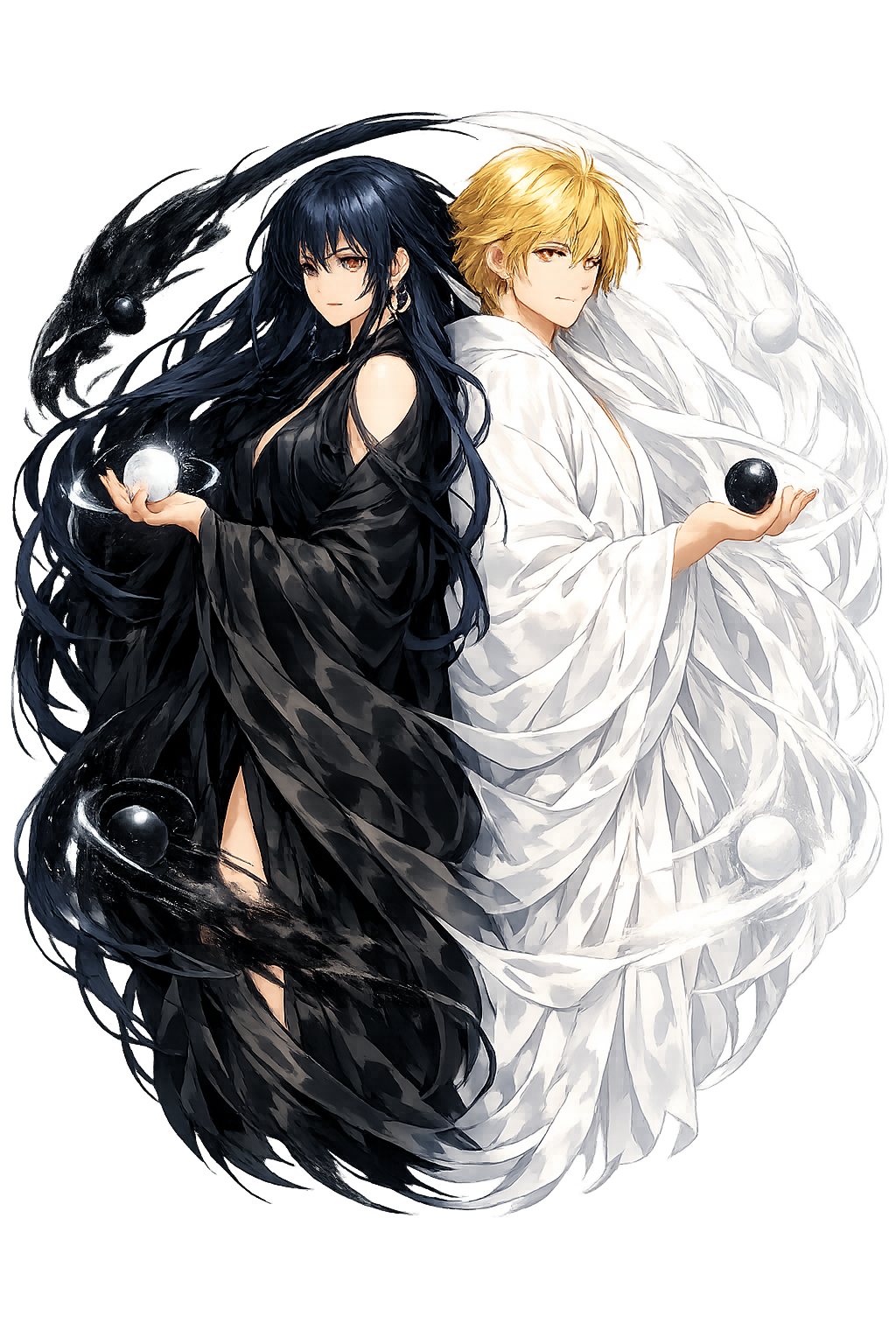
Reading Yīnyáng the way it was meant to be written
Some restorations are cosmetic. Yīnyáng is not — the marks in this name are the difference between reading the sources and guessing at them.
Yīnyáng has no origin myth in the usual sense. It is a lens through which Chinese thinkers read the origin of everything. Its stories are therefore cosmological and medical rather than biographical. The Xici appendices of the Yijing state: 'One yin and one yang, this is called the Dao. ' The cosmos is not governed by a personal deity but by the alternation of these two modes.
That is the figure this file is about — and the temple now standing at its restored name.
At a Glance
- Restored name: Yīnyáng
- ASCII form: yinyang
- Meaning: "Interdependence of opposites"
- Domain of influence: Cosmic Duality
- Pantheon: Taoist
- Classification: Tier 1
- Original script: 陰陽
- Series: The Restoration Files, No. 270 of 271
The Name Before the Marks
The name is attested as 陰陽. On the evidence, it means "Interdependence of opposites".
Strip Yīnyáng to yinyang and 2 pieces of evidence vanish:
- i → ī — Macron: level tone: the vowel length the ASCII form cannot show.
- a → á — Second tone: the stress position the ASCII form cannot show.
These are the small, provable things a restoration is made of: not taste, not branding — attestation.
The Temple That Stands Now
The restored name is not a plaque; it is an address. The temple of Yīnyáng lives at /sites/yinyang/, with its mythology in the lore halls, its peer-reviewed record in the Scholarly Edition, and its place in the pattern atlas on the patterns floor.
The restoration preserves more than the ASCII form can say — stress, length, or a letter the Latin keyboard lost — which places it in Tier-1: mechanically verifiable, information-rich.
Every flagship temple is hand-built to the same standard: the original script displayed with its provenance, the pronunciation reconstructed phoneme by phoneme, the sources named — because a restoration you cannot audit is just a spelling with confidence.
The Archetype at Work
A temple is also a reading of what this figure means — and meanings have addresses in the modern world. The pattern atlas maps Yīnyáng to the industries its archetype genuinely resonates with, each match argued, weighted, and open to challenge:
- Healthcare, Pharma & Medicine — Diagnosis in traditional Chinese medicine begins by sorting yin from yang; the clinic's organizing axis.
- Yoga, Meditation & Holistic Wellness — The balance of opposites; wellness branding’s favorite diagram.
- Architecture & Spatial Design — Yang light and yin shade orient the building; the feng shui compass at the drafting table.
If a match here reads wrong, the atlas says how to challenge it. The patterns are falsifiable — that is what makes them worth publishing.
In the Sacred Texts
The Taoist tradition is not a vibe; it is a library. The Sacred Texts collection holds Tao Te Ching — the primary sources the temple's scholarship is built on, free to read, cross-linked back to the names they mention. The temple is the argument; the texts are the evidence.
The File Continues
This is one of 271 Restoration Files — a second dispatch from every flagship temple in the fleet. The temple's first dispatch tells the founding story of the name; the blog index holds the whole archive.
Continue the series — previous file: Yánluó (read it here) · next file: Zeús (read it here).
The Restoration Files are written from the same canonical record as the temples themselves: the lexicon, the lore catalog, the pattern atlas, and the cited scholarly sources. If a file ever disagrees with its temple, the temple is right — tell us, and the file will be corrected.