The Authentic Orthography
Queen Mother of the West · Queen Mother of the West · Western queen mother
Unicode restoration and ASCII comparison
西王母
The name in its original Taoist form. Xīwángmǔ (西王母) is attested in the source tradition — “Western queen mother”. Its macron-length vowels and acute stress marks carry the full phonetic and orthographic weight of the source tradition.
xiwangmu
Reduced to plain xiwangmu, the name loses everything that made it specific: macron-length vowels and acute stress marks. What remains is an ASCII string that machines can parse but that no longer speaks with its original voice.
Xīwángmǔ
The Unicode restoration recovers what ASCII flattened. Xīwángmǔ restores macron-length vowels and acute stress marks, returning the name to its original written dignity. The domain encodes to Punycode, but the browser displays the truth.
Xīwángmǔ.com → xn--xwngm-yqa03cy7b.com
The non-ASCII characters in Xīwángmǔ are encoded while the ASCII remains visible. To the DNS, it is Punycode. To humanity, it is Xīwángmǔ.
How Xīwángmǔ is preserved in writing
A bespoke provenance study for Xīwángmǔ is being prepared by the PUNICODEX scholarly team.
Contribute scholarly provenance →Owned, ideal, and ASCII forms of Xīwángmǔ
Xīwángmǔ
Restores 西王母. The live temple domain — xīwángmǔ.com.
xiwangmu
Flattens 西王母. The plain ASCII fallback — what DNS and legacy systems see.
How Xīwángmǔ was spoken
The Peaches of Immortality, Mount Kūnlún, and the Taming of a Wilderness Goddess
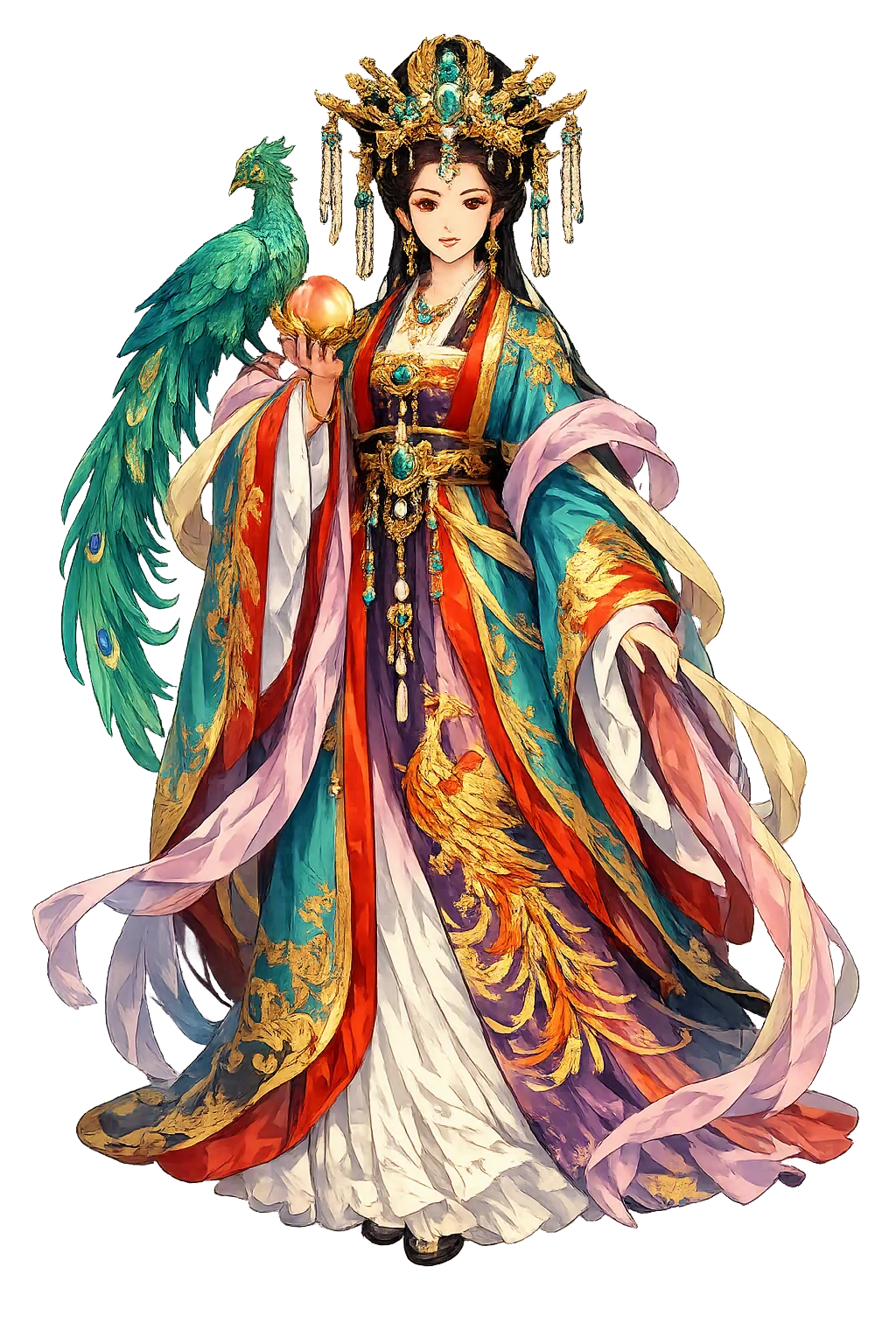
Xīwángmǔ, the Queen Mother of the West, has the strangest biography of any great goddess in the Chinese tradition. Her oldest portrait, in the Classic of Mountains and Seas, is fearsome: a figure with a tiger's teeth and a leopard's tail, her hair wild, wearing the shèng headdress, presiding over plague and calamity from Mount Kūnlún at the western edge of the world. She is not yet the serene sovereign of later ages — she is the numinous power of the untamed west itself.
Across the Han dynasty she was refined, age by age, into the great goddess of the western paradise: keeper of the Peaches of Immortality, which ripen once every three thousand years; host of the Peach Banquet; bestower of the elixir that lifts Cháng'é to the moon; and, in the fullness of Taoist theology, the sovereign of yin and the west, balanced against Dōngwánggōng, the King Father of the East. The wilderness was never banished from her — it was enthroned.
Her paradise stands on Mount Kūnlún at the western edge of the world, the axis where heaven leans down to meet the wild earth.
The pántáo ripen once every three thousand years; to taste one is to step outside death's jurisdiction — which is why the Monkey King could not resist them.
Her archaic form keeps its claws: the Shān Hǎi Jīng gives her a tiger's teeth and a leopard's tail, the regalia of a mistress of plague and calamity.
In mature Taoist theology she rules yin, the west, and all goddesses, balanced against Dōngwánggōng's yang and east — the two poles of a complete cosmos.
Stories of Xīwángmǔ
Xīwángmǔ's myths trace an arc no other Chinese deity matches: from wilderness terror to the most gracious sovereign of the Taoist heavens. Each age kept something of the last, so that the serene hostess of the Peach Banquet still carries the teeth and tail of the mountain power she once was.
In the Classic of Mountains and Seas, the oldest surviving description, the Queen Mother is not a queen at all in the courtly sense. She has a tiger's teeth and a leopard's tail, her hair unbound beneath the shèng headdress, and she presides over plague and calamity from Mount Kūnlún. She is the personified danger of the far west — the lands beyond the pale of the settled world, where the sun goes down into mystery. Later ages would clothe her in silk, but the earliest text keeps her wild.
It is the Queen Mother who holds the elixir of immortality, and it is she who grants it to Hòuyì, the archer who shot down the nine excess suns. The gift does not stay in his hands: it becomes Cháng'é's ascension to the moon. The versions differ — in some tellings Cháng'é takes the elixir unbidden, in others to keep it from unworthy hands — but the constant is the source: immortality flows from the Queen Mother's store, and no one rises to the heavens except through her treasury.
Once every three thousand years the Peaches of Immortality ripen, and the Queen Mother hosts the Peach Banquet for the assembled immortals. In the Journey to the West, Sūn Wùkōng — appointed, with fatal optimism, as guardian of the orchard — eats his way through the finest fruit and crashes the feast he was never invited to. It is one of literature's great heists, and its comedy rests on a real theological point: the peaches are the most tightly held treasure in heaven, and the Queen Mother is their unanswerable custodian.
The Queen Mother was not only a figure of elite texts and palace mirrors. The Book of Han records a genuine millenarian movement in 3 BCE, when crowds across the commanderies carried her tallies, passed them from hand to hand, and awaited the fulfilment of her promise. It is one of the earliest documented popular religious movements in Chinese history — proof that the western goddess had seized the imagination of ordinary people centuries before the novelists found her.
Xīwángmǔ teaches that civilization does not destroy its wilderness; it enthrones it. The tiger-toothed power of the Shān Hǎi Jīng was not replaced by the serene hostess of the Peach Banquet — she was carried forward, wildness and all, into the highest seat of the Taoist heavens. The goddess who once sent plague became the goddess who grants endless life, and the two offices are not as far apart as they seem: both are sovereignty over the boundary between life and death, held by the same unanswerable hand.
Enter Extended Lore