PuniCodex

Extended Lore

西王母 Xīwángmǔ

Etymology · Phonology · Orthography · Cultural Legacy · Primary Sources

Tier 1 Xīwángmǔ.com
Xīwángmǔ — Queen Mother of the West
01

Quick Facts

Essential information about Xīwángmǔ, Queen Mother of the West

Original Script西王母
Unicode RestorationXīwángmǔ
Reconstructed Pronunciation/ɕi˥ waŋ˧˥ mu˨˩˦/
PantheonTaoist
DomainQueen Mother of the West
MeaningWestern queen mother
ClassificationTier 1
Primary DomainXīwángmǔ.com
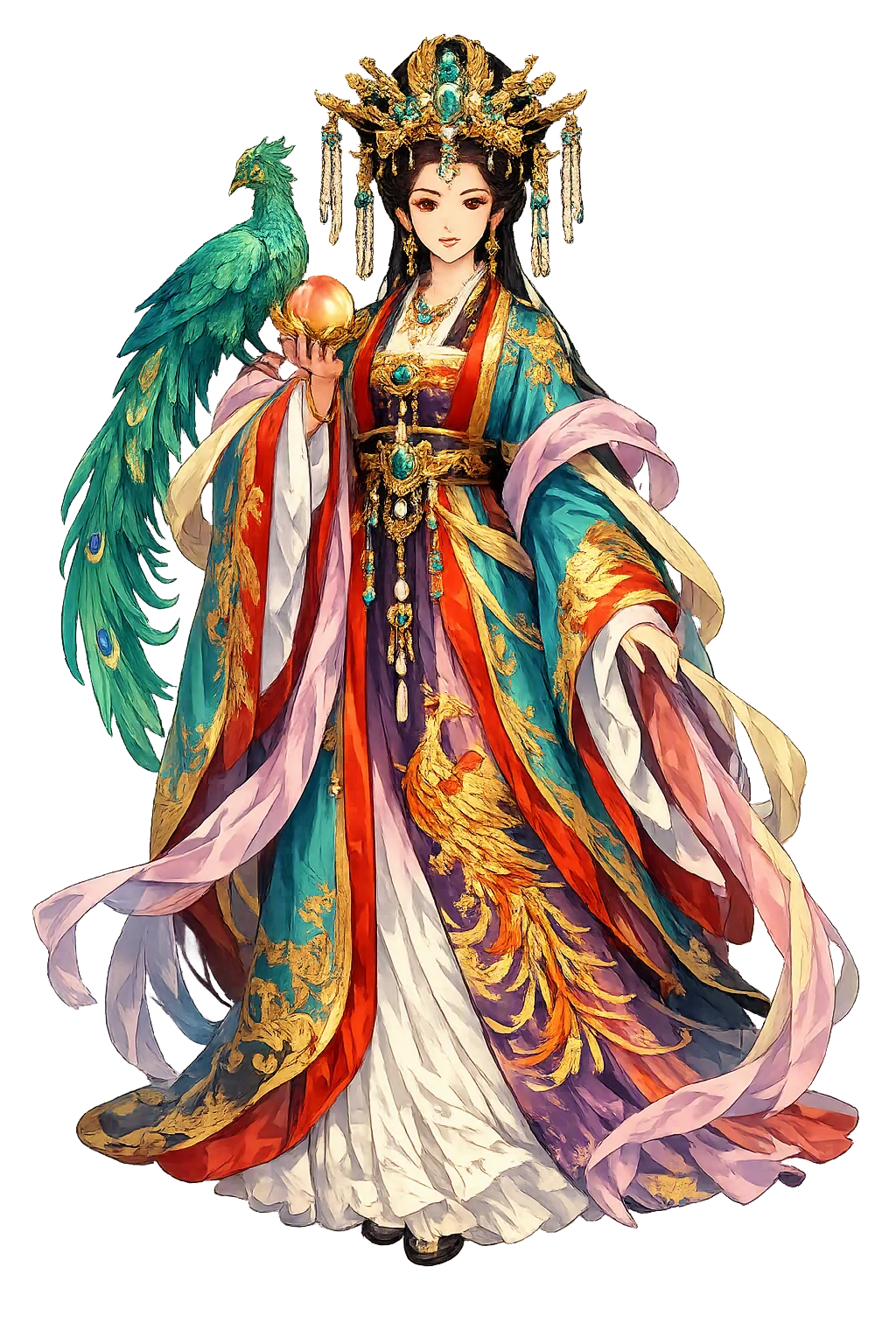
Sacred SymbolsThe shèng headdress, Tiger's teeth and leopard's tail, The Peaches of Immortality, Mount Kūnlún, The tallies
02

Etymology & Word Family

From original script to Unicode restoration

Original Script 西王母 Xīwángmǔ — "Western queen mother"
Unicode Restoration Xīwángmǔ Restored stress, length, and script
Modern ASCII xiwangmu Plain-ASCII fallback

西王母 means 'Queen Mother of the West' — xī (west), wáng (king, sovereign), mǔ (mother). The Modern Standard Mandarin reading is Xīwángmǔ (Tones 1-2-3), as recorded in the Unihan Database (Unicode Consortium, kMandarin) and standard Mandarin dictionaries. The tone-marked Pinyin restoration Xīwángmǔ preserves the citation tones of all three syllables; in connected speech the third tone on mǔ is often realized as a low half-third tone, but the lexical tone remains Tone 3.

03

Unicode Character Breakdown

Character-by-character philological analysis

CharacterUnicodeNameBlockPhonetic Role
XU+0058Latin Capital Letter XBasic LatinSame, capitalized
īU+012BLatin Small Letter I with MacronLatin Extended-ALong vowel
wU+0077Latin Small Letter WBasic LatinSame
áU+00E1Latin Small Letter A with AcuteLatin-1 SupplementStress on a
nU+006ELatin Small Letter NBasic LatinSame
gU+0067Latin Small Letter GBasic LatinSame
mU+006DLatin Small Letter MBasic LatinSame
ǔU+01D4Latin Small Letter U with CaronLatin Extended-BSpecial character

The Tier 1 classification reflects how much of the original phonology this restoration preserves — stress and vowel length for Greek names, distinctive letters and diacritics for every other tradition.

04

Cultural Significance

From ancient cult to modern Unicode

Ancient Domain

Xīwángmǔ, the Queen Mother of the West, has the strangest biography of any great goddess in the Chinese tradition. Her oldest portrait, in the Classic of Mountains and Seas, is fearsome: a figure with a tiger's teeth and a leopard's tail, her hair wild, wearing the shèng headdress, presiding over plague and calamity from Mount Kūnlún at the western edge of the world. She is not yet the serene sovereign of later ages — she is the numinous power of the untamed west itself.

Across the Han dynasty she was refined, age by age, into the great goddess of the western paradise: keeper of the Peaches of Immortality, which ripen once every three thousand years; host of the Peach Banquet; bestower of the elixir that lifts Cháng'é to the moon; and, in the fullness of Taoist theology, the sovereign of yin and the west, balanced against Dōngwánggōng, the King Father of the East. The wilderness was never banished from her — it was enthroned.

Xīwángmǔ in Later Traditions

The Queen Mother travelled with Chinese letters and liturgy across East Asia. In Japan she is read Seiōbo, appearing in painting, garden imagery, and the literary imagination as the hostess of the western orchard; in Korea she is Seowangmo, present in folklore and shamanic song; in Vietnamese she is Tây Vương Mẫu, her name borne into the southern reception of the Taoist pantheon. Within China her deepest transformation was her absorption into organized Taoism, where she rose to the summit of the celestial hierarchy as sovereign of yin and the west, paired with Dōngwánggōng, the King Father of the East, as the balanced poles of the cosmos. Buddhist storytellers did not so much absorb her as borrow her orchard: the immortality peaches and the great banquet pass freely between Taoist and popular-Buddhist narrative worlds, and it is in that shared space that the Journey to the West stages her most famous scene.

Modern Legacy

The Queen Mother never retired from the heavens. In Taoist temples across Taiwan and the diaspora she is venerated still, often under the title Golden Mother of the Jasper Pool, and her birthday is kept with festival observance. In art she rides phoenixes and cranes through centuries of painting, lacquer, and embroidery, and the immortal peach she tends became the standard emblem of longevity, pressed into birthday buns and painted onto porcelain as a wish for long life. The Journey to the West made her banquet immortal in another sense: every screen adaptation of the Monkey King's career — film, television, animation, games — must sooner or later raid her orchard. She remains what she has been since the Han mirrors first invoked her for blessing: the great goddess at the western edge of the world, holding the one treasure every mortal wants and no one may take uninvited.

Unicode Restoration as Cultural Act

Restoring Xīwángmǔ in a domain name is more than orthographic accuracy. It is a statement that the internet should recognize the full range of human writing — not only the ASCII keyboard.

05

Frequently Asked Questions

Common questions about Xīwángmǔ, Queen Mother of the West, and Unicode restoration

01How do you pronounce Xīwángmǔ?

In reconstructed pronunciation, Xīwángmǔ is /ɕi˥ waŋ˧˥ mu˨˩˦/ — approximately shee-WAHNG-moo — Xī held high and level like a sustained note, wáng rising from mid to high as in a question, mǔ dipping low and turning up again..

02What does Xīwángmǔ mean?

Xīwángmǔ means Western queen mother in the taoist tradition.

03What are the symbols of Xīwángmǔ?

Xīwángmǔ is associated with The shèng headdress (Her ancient insignia of authority — the distinctive headdress she wears even in her oldest, wildest images), Tiger's teeth and leopard's tail (The zoomorphic vestiges of her primordial form, marking her dominion over plague and calamity), The Peaches of Immortality (Sovereignty over death itself — fruit that ripens once in three thousand years and frees the eater from mortality), Mount Kūnlún (The western paradise at the edge of the world, where her palace and orchards stand), The tallies (The tokens her Han-era devotees carried from commandery to commandery as pledges of her protection and long life).

04Why restore Xīwángmǔ in Unicode?

Plain ASCII xiwangmu strips the stress, length, and script that make the name specific. Unicode restoration returns the name to its original written dignity.

05What is the most important myth about Xīwángmǔ?

In the Classic of Mountains and Seas, the oldest surviving description, the Queen Mother is not a queen at all in the courtly sense. She has a tiger's teeth and a leopard's tail, her hair unbound beneath the shèng headdress, and she presides over plague and calamity from Mount Kūnlún. She is the personified danger of the far west — the lands beyond the pale of the settled world, where the sun goes down into mystery. Later ages would clothe her in silk, but the earliest text keeps her wild.

06

Scholarly Sources

The philological foundations of this restoration

Every claim on this page is grounded in established scholarship. The orthographic restorations follow disciplinary convention. The etymological chain follows the best available reference works. This is not invention — it is resurrection through scholarship.

Lexicography & Philology

  • Shan Hai Jing
  • Daoist Canon

Primary Texts

  • Primary sources in the taoist tradition for Xīwángmǔ.

Archaeology & Art History

  • Material evidence — iconography, inscriptions, and temple archaeology — for Xīwángmǔ and related cults.
  • The Queen Mother's earliest textual portrait is in the Classic of Mountains and Seas, compiled from Warring States through Han materials (roughly 4th–1st centuries BCE), where she appears with tiger's teeth and a leopard's tail on Mount Kūnlún. Her great material flourishing is Han: bronze mirrors invoke her by name for blessing and long life, and tomb reliefs and murals — most famously the Wu Liang shrine of the 2nd century CE — show her enthroned in the west, increasingly paired with Dōngwánggōng in the east. The Book of Han preserves the documentary trace of her popular cult in the millenarian movement of 3 BCE, when her tallies passed through the commanderies. By the medieval period, Taoist scriptures and liturgical texts had raised her to the summit of the goddess hierarchy, the form in which she has been worshipped ever since.

Religious Studies

  • Shan Hai Jing (Classic of Mountains and Seas)
  • Huainanzi
  • Han Shu (Book of Han)
  • Journey to the West (Xiyouji)
  • Encyclopaedia Britannica: Xiwangmu
  • Birrell, Chinese Mythology: An Introduction
  • Cahill, Transcendence and Divine Passion: The Queen Mother of the West in Medieval China
  • Unihan Database (Unicode Consortium)
Return

The Surface Awaits

You have traced the name from its earliest attestation to its Unicode restoration. Now return to the myth. The story is where the name lives.

Back to Lore
Xīwángmǔ mascot