
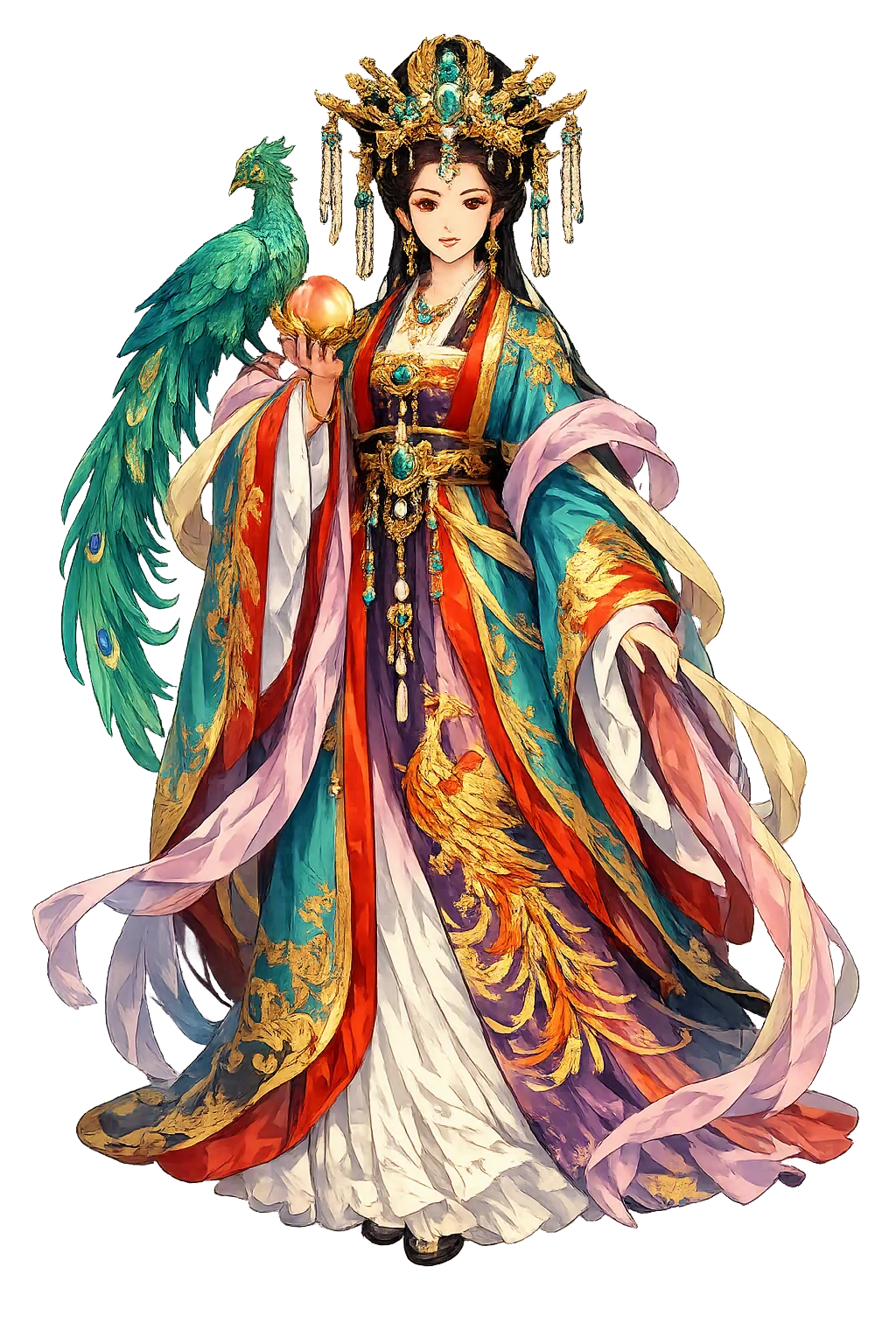
Xīwángmǔ in 2026: why scholars still care
In 2026, names are treated as data points. Xīwángmǔ is a reminder that they are also cultural artifacts — and that the difference matters for search engines, AI training corpora, and anyone who types the name of a Taoist figure into a browser. Scholars never stopped caring about the difference between xiwangmu and Xīwángmǔ; the web simply made that care actionable. What follows is the full scholarly picture — name, script, sound, myth, cult, and legacy — followed by the engineering compromise that lets a restored spelling live at a real address. The question is not whether the name is old. It is whether the digital world is old enough to hold it.
At a Glance
- Restored name: Xīwángmǔ
- ASCII form: xiwangmu
- Meaning: "Western queen mother"
- Domain of influence: Queen Mother of the West
- Pantheon: Taoist
- Classification: Tier 1
- Original script: 西王母 (Chinese characters)
- Live domain: xīwángmǔ.com
Overview
Xīwángmǔ (xiwangmu) — Queen Mother of the West · Western queen mother — belongs to the Daoist tradition, where it is catalogued under the domain "Queen Mother of the West". The name means "Western queen mother".
Xīwángmǔ, the Queen Mother of the West, has the strangest biography of any great goddess in the Chinese tradition. Her oldest portrait, in the Classic of Mountains and Seas, is fearsome: a figure with a tiger's teeth and a leopard's tail, her hair wild, wearing the shèng headdress, presiding over plague and calamity from Mount Kūnlún at the western edge of the world. She is not yet the serene sovereign of later ages — she is the numinous power of the untamed west itself.
Across the Han dynasty she was refined, age by age, into the great goddess of the western paradise: keeper of the Peaches of Immortality, which ripen once every three thousand years; host of the Peach Banquet; bestower of the elixir that lifts Cháng'é to the moon; and, in the fullness of Taoist theology, the sovereign of yin and the west, balanced against Dōngwánggōng, the King Father of the East. The wilderness was never banished from her — it was enthroned.
PuniCodex restores the name as Xīwángmǔ and serves its temple at xīwángmǔ.com. The restoration preserves at least one distinctive feature — a diacritic or a distinctive letter — that the ASCII form loses, and exactly one historically valid Unicode restoration exists, which places the name in Tier 1. The plain ASCII form xiwangmu survives as a modern convenience imposed by the early domain-name system; the restoration, not the fallback, is the form the project defends as philologically complete.
The Name
The name is attested in Chinese characters as 西王母. Etymologically it means "Western queen mother".
The ASCII form xiwangmu survives only because the early domain-name system could not carry diacritics; it is a technological compromise, not an ancient spelling. The Unicode restoration Xīwángmǔ recovers both the stress accent and the vowel length of the original directly in the address bar. The restoration preserves at least one distinctive feature — a diacritic or a distinctive letter — that the ASCII form loses, and exactly one historically valid Unicode restoration exists, which places the name in Tier 1.
The letter-by-letter transformation runs:
- x → X — Same, capitalized
- i → ī — Long vowel
- w → w — Same
- a → á — Stress on a
- n → n — Same
- g → g — Same
- m → m — Same
- u → ǔ — Special character
The project holds the domain xīwángmǔ.com (xn--xwngm-yqa03cy7b.com) as the canonical home of this name.
The Original Script
The name is written in Chinese characters as 西王母. This original script is the form against which the ASCII fallback xiwangmu and the PuniCodex restoration Xīwángmǔ are measured: the restoration preserves both its pitch accent and its vowel quantity of the written form, so that a reader typing the modern address still speaks the ancient name.
The original script is 西王母, written identically in traditional and simplified characters — none of the three graphs was altered in the twentieth-century simplification. Pinyin Xīwángmǔ (Tones 1-2-3) is the Modern Standard Mandarin reading, recorded in the Unihan Database and standard dictionaries: xī (west, Tone 1), wáng (sovereign, Tone 2), mǔ (mother, Tone 3). The registrable Unicode restoration uses the tone-marked Pinyin rather than the hanzi because PUNICODEX renders the original characters in the temple's 'Original Script' card while keeping the domain label pronounceable and internationally registrable; the tone marks ī, á, and ǔ carry the citation tones that plain ASCII drops.
Pronunciation
The reconstructed pronunciation of the name is /ɕi˥ waŋ˧˥ mu˨˩˦/ — Modern Standard Mandarin (Pinyin).
Phoneme by phoneme:
- xī — Voiceless alveolo-palatal fricative [ɕ] followed by high front vowel [i], Tone 1 (high level, ˥). Pinyin 'x' has no English equivalent; it is the 'sh' of 'she' pushed forward toward the teeth.
- wáng — Labial-velar approximant [w] with the final [aŋ] (open central vowel + velar nasal), Tone 2 (rising, ˧˥).
- mǔ — Bilabial nasal [m] with high back rounded vowel [u], Tone 3 (dipping, ˨˩˦) — the low, dipping contour that falls before it rises.
For the modern speaker, the closest approximation is: shee-WAHNG-moo — Xī held high and level like a sustained note, wáng rising from mid to high as in a question, mǔ dipping low and turning up again.
Kindred and historical forms of the name:
- Traditional — 西王母
- Simplified — 西王母
- Wade-Giles — Hsi¹-wang²-mu³
- Her consort — 東王公 Dōngwánggōng (King Father of the East)
- Related terms — 蟠桃 pántáo (Peaches of Immortality); 蟠桃會 pántáohuì (the Peach Banquet); 崑崙 Kūnlún (her western mountain)
西王母 means 'Queen Mother of the West' — xī (west), wáng (king, sovereign), mǔ (mother). The Modern Standard Mandarin reading is Xīwángmǔ (Tones 1-2-3), as recorded in the Unihan Database (Unicode Consortium, kMandarin) and standard Mandarin dictionaries. The tone-marked Pinyin restoration Xīwángmǔ preserves the citation tones of all three syllables; in connected speech the third tone on mǔ is often realized as a low half-third tone, but the lexical tone remains Tone 3.
Mythology
Xīwángmǔ's myths trace an arc no other Chinese deity matches: from wilderness terror to the most gracious sovereign of the Taoist heavens. Each age kept something of the last, so that the serene hostess of the Peach Banquet still carries the teeth and tail of the mountain power she once was.
The Fearsome Portrait (Shan Hai Jing)
In the Classic of Mountains and Seas, the oldest surviving description, the Queen Mother is not a queen at all in the courtly sense. She has a tiger's teeth and a leopard's tail, her hair unbound beneath the shèng headdress, and she presides over plague and calamity from Mount Kūnlún. She is the personified danger of the far west — the lands beyond the pale of the settled world, where the sun goes down into mystery. Later ages would clothe her in silk, but the earliest text keeps her wild.
The Elixir for Hòuyì (Huainanzi)
It is the Queen Mother who holds the elixir of immortality, and it is she who grants it to Hòuyì, the archer who shot down the nine excess suns. The gift does not stay in his hands: it becomes Cháng'é's ascension to the moon. The versions differ — in some tellings Cháng'é takes the elixir unbidden, in others to keep it from unworthy hands — but the constant is the source: immortality flows from the Queen Mother's store, and no one rises to the heavens except through her treasury.
The Theft of the Peaches (Journey to the West)
Once every three thousand years the Peaches of Immortality ripen, and the Queen Mother hosts the Peach Banquet for the assembled immortals. In the Journey to the West, Sūn Wùkōng — appointed, with fatal optimism, as guardian of the orchard — eats his way through the finest fruit and crashes the feast he was never invited to. It is one of literature's great heists, and its comedy rests on a real theological point: the peaches are the most tightly held treasure in heaven, and the Queen Mother is their unanswerable custodian.
The Movement of 3 BCE (Book of Han)
The Queen Mother was not only a figure of elite texts and palace mirrors. The Book of Han records a genuine millenarian movement in 3 BCE, when crowds across the commanderies carried her tallies, passed them from hand to hand, and awaited the fulfilment of her promise. It is one of the earliest documented popular religious movements in Chinese history — proof that the western goddess had seized the imagination of ordinary people centuries before the novelists found her.
Symbols & Iconography
The iconography associated with Xīwángmǔ concentrates in a small set of recurring attributes, each a compressed statement about the name:
- The shèng headdress — Her ancient insignia of authority — the distinctive headdress she wears even in her oldest, wildest images
- Tiger's teeth and leopard's tail — The zoomorphic vestiges of her primordial form, marking her dominion over plague and calamity
- The Peaches of Immortality — Sovereignty over death itself — fruit that ripens once in three thousand years and frees the eater from mortality
- Mount Kūnlún — The western paradise at the edge of the world, where her palace and orchards stand
- The tallies — The tokens her Han-era devotees carried from commandery to commandery as pledges of her protection and long life
Archaeology & Evidence
The Queen Mother's earliest textual portrait is in the Classic of Mountains and Seas, compiled from Warring States through Han materials (roughly 4th–1st centuries BCE), where she appears with tiger's teeth and a leopard's tail on Mount Kūnlún. Her great material flourishing is Han: bronze mirrors invoke her by name for blessing and long life, and tomb reliefs and murals — most famously the Wu Liang shrine of the 2nd century CE — show her enthroned in the west, increasingly paired with Dōngwánggōng in the east. The Book of Han preserves the documentary trace of her popular cult in the millenarian movement of 3 BCE, when her tallies passed through the commanderies. By the medieval period, Taoist scriptures and liturgical texts had raised her to the summit of the goddess hierarchy, the form in which she has been worshipped ever since.
Realm & Domain
Xīwángmǔ, the Queen Mother of the West, has the strangest biography of any great goddess in the Chinese tradition. Her oldest portrait, in the Classic of Mountains and Seas, is fearsome: a figure with a tiger's teeth and a leopard's tail, her hair wild, wearing the shèng headdress, presiding over plague and calamity from Mount Kūnlún at the western edge of the world. She is not yet the serene sovereign of later ages — she is the numinous power of the untamed west itself.
Across the Han dynasty she was refined, age by age, into the great goddess of the western paradise: keeper of the Peaches of Immortality, which ripen once every three thousand years; host of the Peach Banquet; bestower of the elixir that lifts Cháng'é to the moon; and, in the fullness of Taoist theology, the sovereign of yin and the west, balanced against Dōngwánggōng, the King Father of the East. The wilderness was never banished from her — it was enthroned.
Mount Kūnlún
Her paradise stands on Mount Kūnlún at the western edge of the world, the axis where heaven leans down to meet the wild earth.
The Peaches of Immortality
The pántáo ripen once every three thousand years; to taste one is to step outside death's jurisdiction — which is why the Monkey King could not resist them.
Tiger's Teeth, Leopard's Tail
Her archaic form keeps its claws: the Shān Hǎi Jīng gives her a tiger's teeth and a leopard's tail, the regalia of a mistress of plague and calamity.
Sovereign of Yin and the West
In mature Taoist theology she rules yin, the west, and all goddesses, balanced against Dōngwánggōng's yang and east — the two poles of a complete cosmos.
Across Cultures
The Queen Mother travelled with Chinese letters and liturgy across East Asia. In Japan she is read Seiōbo, appearing in painting, garden imagery, and the literary imagination as the hostess of the western orchard; in Korea she is Seowangmo, present in folklore and shamanic song; in Vietnamese she is Tây Vương Mẫu, her name borne into the southern reception of the Taoist pantheon. Within China her deepest transformation was her absorption into organized Taoism, where she rose to the summit of the celestial hierarchy as sovereign of yin and the west, paired with Dōngwánggōng, the King Father of the East, as the balanced poles of the cosmos. Buddhist storytellers did not so much absorb her as borrow her orchard: the immortality peaches and the great banquet pass freely between Taoist and popular-Buddhist narrative worlds, and it is in that shared space that the Journey to the West stages her most famous scene.
Within the Daoist tradition, closely related names in the corpus include Lǎozǐ, Wújí, and Yīnyáng.
Cultural Legacy
The Queen Mother never retired from the heavens. In Taoist temples across Taiwan and the diaspora she is venerated still, often under the title Golden Mother of the Jasper Pool, and her birthday is kept with festival observance. In art she rides phoenixes and cranes through centuries of painting, lacquer, and embroidery, and the immortal peach she tends became the standard emblem of longevity, pressed into birthday buns and painted onto porcelain as a wish for long life. The Journey to the West made her banquet immortal in another sense: every screen adaptation of the Monkey King's career — film, television, animation, games — must sooner or later raid her orchard. She remains what she has been since the Han mirrors first invoked her for blessing: the great goddess at the western edge of the world, holding the one treasure every mortal wants and no one may take uninvited.
The Scholarly Record
The account of Xīwángmǔ given in this edition rests on the witnesses and reference works listed below. Lexica and etymological dictionaries secure the form and meaning of the name; the literary and religious texts supply the narrative evidence.
- Shan Hai Jing (Classic of Mountains and Seas). Full text
- Huainanzi, Liu An; Chinese Text Project, 139 BCE. Full text
- Han Shu (Book of Han). Full text
- Journey to the West (Xiyouji). Full text
- Encyclopaedia Britannica: Xiwangmu. Full text
- Birrell, Chinese Mythology: An Introduction.
- Cahill, Transcendence and Divine Passion: The Queen Mother of the West in Medieval China.
- Unihan Database (Unicode Consortium). Full text
A Meditation
Xīwángmǔ teaches that civilization does not destroy its wilderness; it enthrones it. The tiger-toothed power of the Shān Hǎi Jīng was not replaced by the serene hostess of the Peach Banquet — she was carried forward, wildness and all, into the highest seat of the Taoist heavens. The goddess who once sent plague became the goddess who grants endless life, and the two offices are not as far apart as they seem: both are sovereignty over the boundary between life and death, held by the same unanswerable hand.
To name a domain Xīwángmǔ is to claim that whole arc — the west where the sun descends, the orchard where three thousand years ripen into a single fruit, and the promise whispered from tally to tally through the Han commanderies: that mortality is a border, and someone keeps the gate.
The Unicode Restoration
Xīwángmǔ is classified as Tier 1: the restoration preserves at least one distinctive feature — a diacritic or a distinctive letter — that the ASCII form loses. The ASCII fallback xiwangmu still resolves everywhere, but it is the restored form that carries the name's full information. Across the 8 characters of the name, the restoration adjusts 3: 1 mark of stress (á); 1 mark of length (ī); 1 further adjustment (ǔ). That is the whole thesis of this temple: the marks are the message.
The Domain Name
The restored name is live as a working domain: xīwángmǔ.com, which the DNS carries in punycode form as xn--xwngm-yqa03cy7b.com — an ASCII-compatible encoding that lets a non-ASCII name travel the global network without breaking older infrastructure. The visitor sees Xīwángmǔ; the machines see the encoding. That duality is the engineering compromise on which the entire restoration rests, and it is why a name written the way its own tradition wrote it in Chinese characters can now be typed into any browser on earth.
Why This Restoration Matters
In 2026 the stakes are practical. Search indexes, language models, and localization pipelines all inherit whatever spelling the web normalizes — which means every Unicode domain is also a training signal. Xīwángmǔ teaches the machinery that the restored form exists, that it is used, and that it points to a real place. That is why a project built on philology ends up caring about DNS: the infrastructure decides which names the future sees. This restoration makes sure the future sees the whole name.
Explore Further
This post is one doorway into the temple. The home page carries the full character breakdown and the ambient canvas; the lore page tells the myths in long form; the Scholarly Edition preserves the sources, pronunciation data, and revision history; and the patron wall supports the restoration directly. For the wider map, browse the Lexicon, explore the Pantheon, or return to the PuniCodex blog.
Related Names
Sources
The full scholarly apparatus — every citation, revision, and review — lives in the Scholarly Edition. Key references for this post:
- Shan Hai Jing (Classic of Mountains and Seas).
- Huainanzi, Liu An; Chinese Text Project, 139 BCE.
- Han Shu (Book of Han).
- Journey to the West (Xiyouji).
- Encyclopaedia Britannica: Xiwangmu.
- Unihan Database (Unicode Consortium).
- Birrell, Chinese Mythology: An Introduction.
- Cahill, Transcendence and Divine Passion: The Queen Mother of the West in Medieval China.
- Lexicon authorities for this entry: Shan Hai Jing, Daoist Canon.