
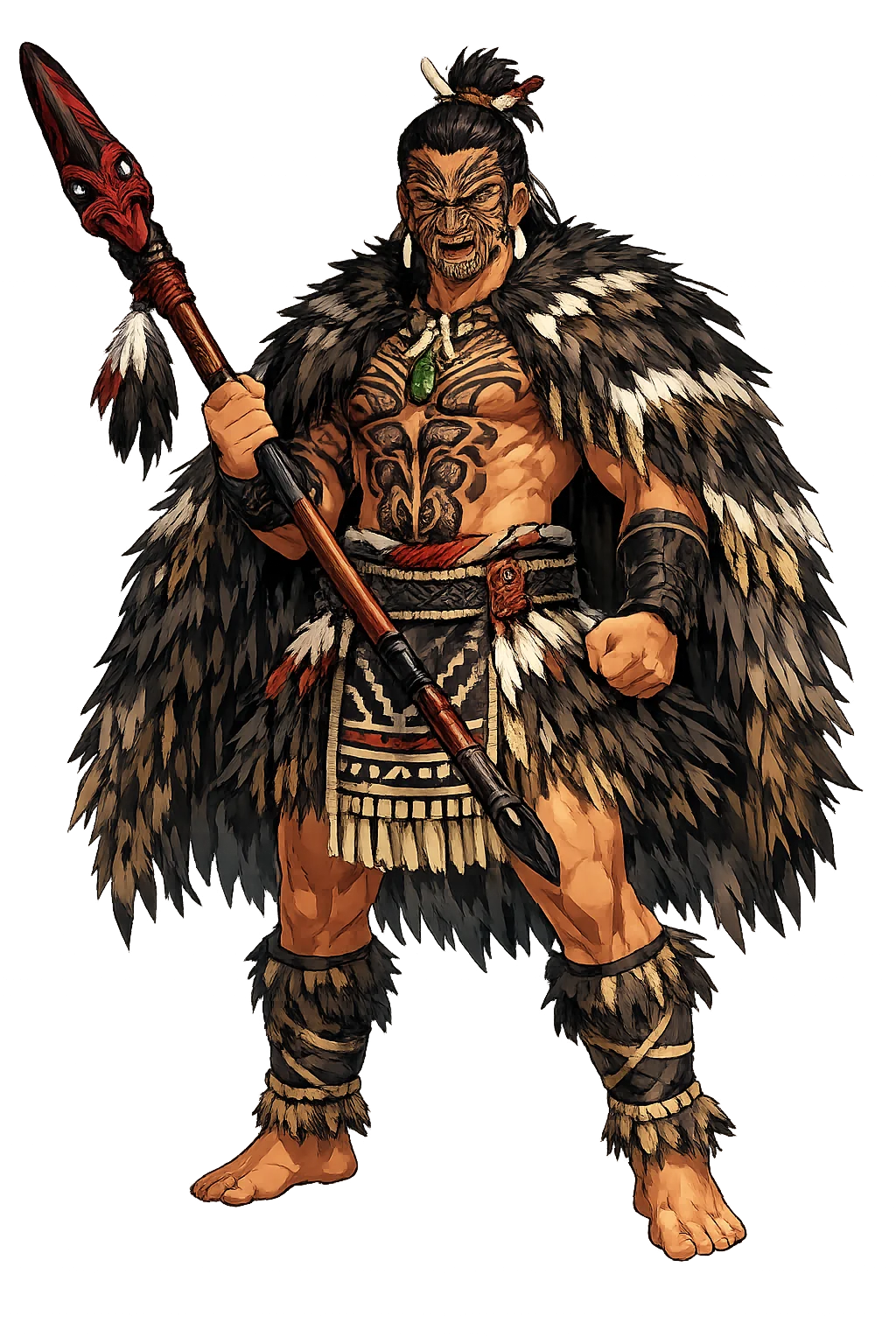
Tūmatauenga: the stories first, then the spelling
The marks in Tūmatauenga make the most sense standing next to the myths they have to carry. So the myths come first.
The Stories That Carry the Name
The Sons of Rangi and Papa. In the beginning the Sky Father (Ranginui) and the Earth Mother (Papatūānuku) lay locked together, and their sons lived crushed in darkness between them. Tūmatauenga, fiercest of the brothers, urged that the parents be killed; the gentler counsel of Tāne prevailed — they would be forced apart. Rongo, Tangaroa, Haumia, and Tāne each tried and failed to push them; then Tāne set his head on the earth, his feet against the sky, and tore the parents open.
The One Who Stood. Tāwhirimātea, god of winds and storms, had opposed the separation, and now he attacked his brothers in revenge: Tangaroa fled to the sea, the gods of food hid in the earth and the forest — but Tūmatauenga alone stood fast against the storm, unbowed on the open plain. When the tempest spent itself, the war-god turned on his fleeing brothers: he made nets and took Tangaroa's fish, snared Tāne's birds, and dug up Rongo's and Haumia's crops. His standing made humanity heir to every domain.
The Arts of War and Peace. By subduing his brothers, Tūmatauenga made their realms noa — common, usable — and so gave humankind its technologies: net and hook for the sea, snare for the forest, the digging-stick for the garden. The karakia of planting, fishing, and war all carry his name; the Māori tradition is explicit that the fierce god is also the culture-bringer. His children — humanity, in the southern traditions — inherited both the standing and the storm.
And Here Is What the Spelling Preserves
The restoration keeps one feature the ASCII form tumatauenga cannot show:
- u → ū — Macron marks the long vowel: how long the vowel is held.
A storyteller pronouncing the name would restore every one of them by instinct. The file only writes down what the voice already knows.
At a Glance
- Restored name: Tūmatauenga
- ASCII form: tumatauenga
- Meaning: "'The man of furious face' (tū + mata + ēngā), god of war and of humankind"
- Domain of influence: War, Humanity, Strength
- Pantheon: Polynesian
- Classification: Tier 1
- Original script: —
- Series: The Restoration Files, No. 248 of 271
The Name Travels
He is one face of a Polynesian-wide god: Hawaiian Kū — the great war-god of the feathered helmets and the luakini temples — Tahitian Tū, and the Cook Islands' war deities share his name and his office, the deepest layer of pan-Polynesian religion. In New Zealand his worship ran through the war-parties and their tohunga; the 19th-century Māori military genius (the gunfighter pa of the New Zealand Wars) applied his standing to musket and trench, and the New Zealand Army today bears his name as its own: Ngāti Tūmatauenga, "the tribe of the war-god.
The Address It Earned
The temple of Tūmatauenga stands at /sites/tumatauenga/ — lore, scholars, patterns — because a name carrying this much story deserves more than a parking page. The restoration preserves more than the ASCII form can express — stress, length, or a letter the Latin keyboard lost — which places it, mechanically, in Tier-1.
The Sources Are Open
The myths above are retold from the temple's record; the primary voices are in the Sacred Texts: Kumulipo and Polynesian Mythology. Nothing in this file outranks them.
The File Continues
Read the founding dispatch for the name's full story, the Resonance File for the archetype at work — or the whole archive in one sitting.
Continue the series — previous file: Troíā (read it here) · next file: Tvaṣṭṛ (read it here).
The Restoration Files are written from the same canonical record as the temples themselves: the lexicon, the lore catalog, the pattern atlas, and the cited scholarly sources. If a file ever disagrees with its temple, the temple is right — tell us, and the file will be corrected.