Unicode restoration and ASCII comparison
Tūmatauenga
The name survives only in scholarly transliteration. Tūmatauenga is the standard Polynesian romanisation, documented in academic sources — “'The man of furious face' (tū + mata + ēngā), god of war and of humankind”. Its macron-length vowels preserve distinctions lost in plain ASCII.
No indigenous writing system is securely attested for individual polynesian names. The form shown is a modern scholarly transliteration.
tumatauenga
Reduced to plain tumatauenga, the name loses everything that made it specific: macron-length vowels. What remains is an ASCII string that machines can parse but that no longer speaks with its original voice.
Tūmatauenga
The Unicode restoration recovers what ASCII flattened. Tūmatauenga restores macron-length vowels, returning the name to its original written dignity. The domain encodes to Punycode, but the browser displays the truth.
Tūmatauenga.com → xn--tmatauenga-5dc.com
The non-ASCII characters in Tūmatauenga are encoded while the ASCII remains visible. To the DNS, it is Punycode. To humanity, it is Tūmatauenga.
How Tūmatauenga is preserved in writing
No indigenous writing system is securely attested for individual polynesian names. The form shown is a modern scholarly transliteration.
Contribute scholarly provenance →How Tūmatauenga was spoken
War, the Angry Face, and the Taming of the Brothers
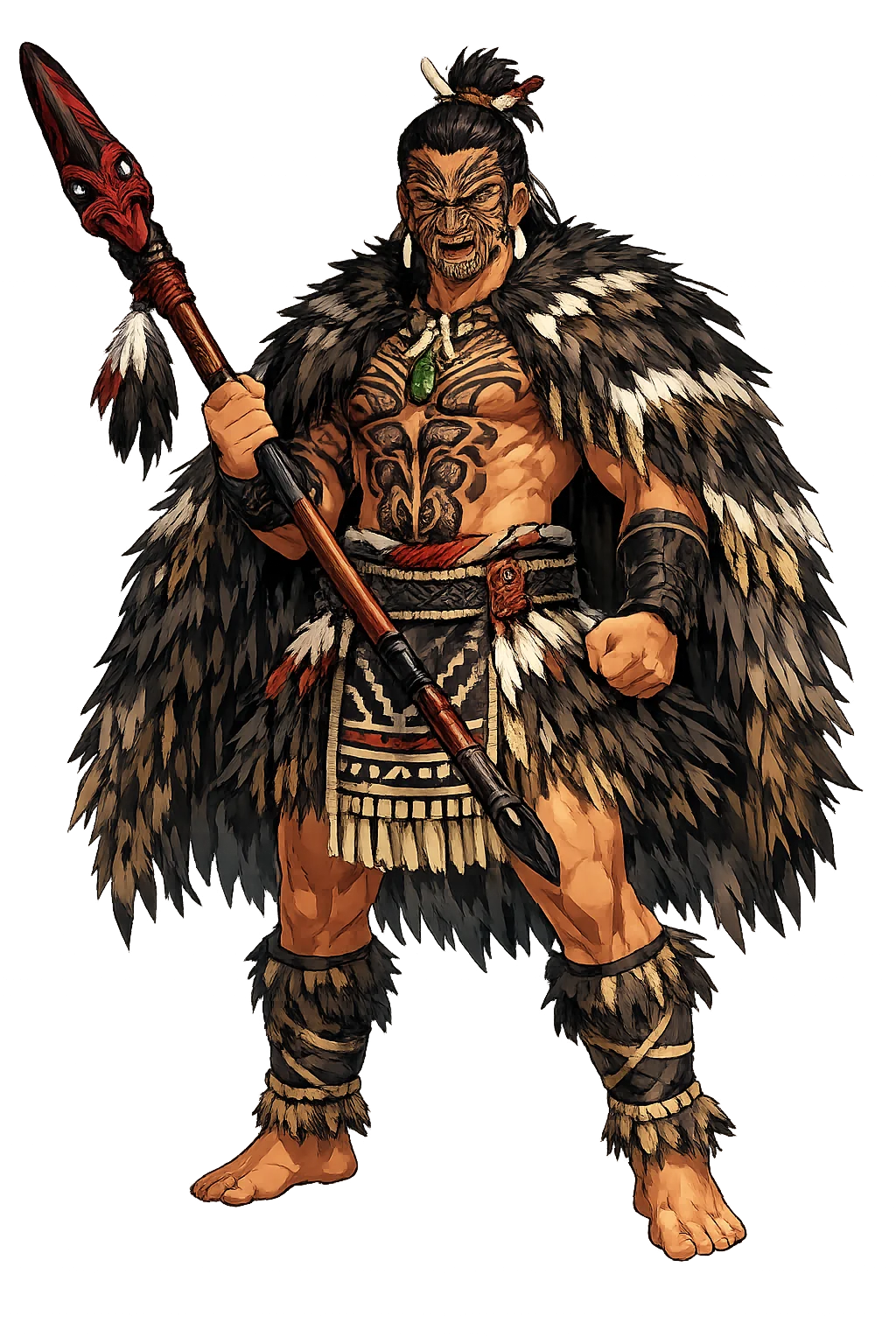
Tūmatauenga is the Māori god of war and of humanity's fierce inheritance: the one son of the Sky Father who stood firm when the storm-god attacked, and who then subdued his own brothers — taking their fishes, their birds, and their crops — to feed the people he had made. War, in his story, is the price of standing.
The flat greenstone club of the chief — the weapon that is also a badge of rank and a gift of state.
His name: the war-face (pūkana) that the haka still performs with widened eyes and out-thrust tongue.
He snared his brother Tangaroa's fish: the arts of fishing, won by war and given to man.
The fortified hill-settlement — his architecture, crowning New Zealand's ridgelines by the thousand.
Stories of Tūmatauenga
Tūmatauenga's cycle is the Polynesian account of how humanity got its arts: not by gift but by conquest — the war-god subduing his elemental brothers and distributing the spoils to his mortal children.
In the beginning the Sky Father (Ranginui) and the Earth Mother (Papatūānuku) lay locked together, and their sons lived crushed in darkness between them. Tūmatauenga, fiercest of the brothers, urged that the parents be killed; the gentler counsel of Tāne prevailed — they would be forced apart. Rongo, Tangaroa, Haumia, and Tāne each tried and failed to push them; then Tāne set his head on the earth, his feet against the sky, and tore the parents open. Light came into the world — and war came with it.
Tāwhirimātea, god of winds and storms, had opposed the separation, and now he attacked his brothers in revenge: Tangaroa fled to the sea, the gods of food hid in the earth and the forest — but Tūmatauenga alone stood fast against the storm, unbowed on the open plain. When the tempest spent itself, the war-god turned on his fleeing brothers: he made nets and took Tangaroa's fish, snared Tāne's birds, and dug up Rongo's and Haumia's crops. His standing made humanity heir to every domain.
By subduing his brothers, Tūmatauenga made their realms noa — common, usable — and so gave humankind its technologies: net and hook for the sea, snare for the forest, the digging-stick for the garden. The karakia of planting, fishing, and war all carry his name; the Māori tradition is explicit that the fierce god is also the culture-bringer. His children — humanity, in the southern traditions — inherited both the standing and the storm.
Tūmatauenga is the god of standing your ground — and of what standing costs. He alone faced the storm, and so he alone could feed the people; but the myth hides nothing: his fierceness proposed killing the parents, and his victories are his brothers' defeats. He asks the hardest question of every defender: what are you standing against — and what, when you have won, will your strength feed?
Enter Extended Lore