
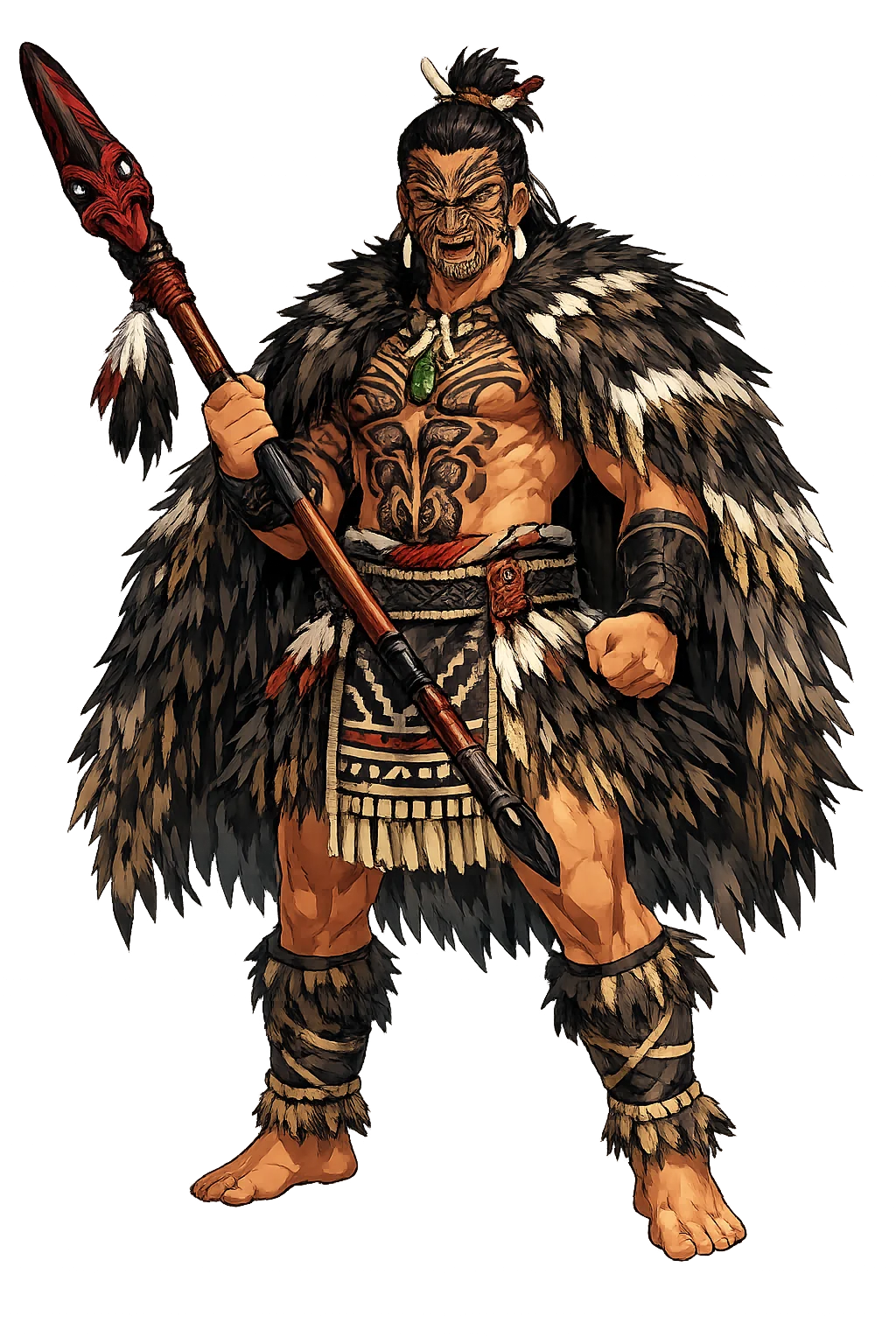
The hidden history behind Tūmatauenga
Behind the modern ASCII form tumatauenga hides a much longer story. Tūmatauenga reaches back through manuscripts, inscriptions, and oral tradition long before it ever touched a keyboard, and every mark in the restored spelling is a receipt from that journey. In what follows we trace the name from its Polynesian transcription attestations through its mythology, its cult, its symbols, and its afterlife in other cultures — and we show how the PuniCodex project turned that philological record into a Unicode domain that resolves today. The history was never lost. It was only waiting for the infrastructure to catch up.
At a Glance
- Restored name: Tūmatauenga
- ASCII form: tumatauenga
- Meaning: "'The man of furious face' (tū + mata + ēngā), god of war and of humankind"
- Domain of influence: War, Humanity, Strength
- Pantheon: Polynesian
- Classification: Tier 2
- Live domain: tūmatauenga.com
Overview
Tūmatauenga (tumatauenga) — The Face of Battle — belongs to the Polynesian tradition, where it is catalogued under the domain "War, Humanity, Strength". The name means "'The man of furious face' (tū + mata + ēngā), god of war and of humankind".
Tūmatauenga is the Māori god of war and of humanity's fierce inheritance: the one son of the Sky Father who stood firm when the storm-god attacked, and who then subdued his own brothers — taking their fishes, their birds, and their crops — to feed the people he had made. War, in his story, is the price of standing.
PuniCodex restores the name as Tūmatauenga and serves its temple at tūmatauenga.com. The original preserves one prosodic feature — stress or vowel length — rather than both, which places the name in Tier 2. The plain ASCII form tumatauenga survives as a modern convenience imposed by the early domain-name system; the restoration, not the fallback, is the form the project defends as philologically complete.
The Name
No indigenous written attestation survives for this name; Tūmatauenga is a scholarly transliteration of the reconstructed spoken form. Etymologically the name means "'The man of furious face' (tū + mata + ēngā), god of war and of humankind".
The ASCII form tumatauenga survives only because the early domain-name system could not carry diacritics; it is a technological compromise, not an ancient spelling. The Unicode restoration Tūmatauenga recovers the vowel length of the original directly in the address bar. The original preserves one prosodic feature — stress or vowel length — rather than both, which places the name in Tier 2.
The letter-by-letter transformation runs:
- t → T — Same letter
- u → ū — Macron marks the long vowel
- m → m — Same letter
- a → a — Same letter
- t → t — Same letter
- a → a — Same letter
- u → u — Same letter
- e → e — Same letter
- n → n — Same letter
- g → g — Same letter
- a → a — Same letter
The project holds the domain tūmatauenga.com (xn--tmatauenga-5dc.com) as the canonical home of this name.
The Original Script
No indigenous writing system is securely attested for individual polynesian names. The form shown is a modern scholarly transliteration.
The form Tūmatauenga is therefore a scholarly transliteration rather than an attested ancient spelling; it encodes the reconstructed sound of the name for modern use, and no mark in it is decorative.
Te reo Māori writes him with the macron as the vowel-length it is: Tūmatauenga. The oral text is the truer scripture — the whakataukī "Ka mate kāinga tahi, ka ora kāinga rua" and the karakia of war and planting carry his name in the living language, and the New Zealand Army's Māori name, Ngāti Tūmatauenga, writes it into the state itself.
Pronunciation
The reconstructed pronunciation of the name is /tuː.ma.taʊ.ˈe.ŋa/ — Māori.
For the modern speaker, the closest approximation is: TOO-mah-tow-ENG-ah, long ū on the first syllable.
Kindred and historical forms of the name:
- Māori — Tūmatauenga
- Hawaiian twin — Kū
- NZ Army — Ngāti Tūmatauenga
- Owned form — Tūmatauenga
Tūmatauenga is pronounced with the long ū of the first syllable — the macron the restoration keeps — and the name means "Tū of the angry face": tū (to stand, and the god's name) plus mata (face) plus anga (the -ing of appearance). He is the Māori war-god, and his name is a face set for war.
Mythology
Tūmatauenga's cycle is the Polynesian account of how humanity got its arts: not by gift but by conquest — the war-god subduing his elemental brothers and distributing the spoils to his mortal children.
The Sons of Rangi and Papa (The Separation)
In the beginning the Sky Father (Ranginui) and the Earth Mother (Papatūānuku) lay locked together, and their sons lived crushed in darkness between them. Tūmatauenga, fiercest of the brothers, urged that the parents be killed; the gentler counsel of Tāne prevailed — they would be forced apart. Rongo, Tangaroa, Haumia, and Tāne each tried and failed to push them; then Tāne set his head on the earth, his feet against the sky, and tore the parents open. Light came into the world — and war came with it.
The One Who Stood (The Storm)
Tāwhirimātea, god of winds and storms, had opposed the separation, and now he attacked his brothers in revenge: Tangaroa fled to the sea, the gods of food hid in the earth and the forest — but Tūmatauenga alone stood fast against the storm, unbowed on the open plain. When the tempest spent itself, the war-god turned on his fleeing brothers: he made nets and took Tangaroa's fish, snared Tāne's birds, and dug up Rongo's and Haumia's crops. His standing made humanity heir to every domain.
The Arts of War and Peace (The Inheritance)
By subduing his brothers, Tūmatauenga made their realms noa — common, usable — and so gave humankind its technologies: net and hook for the sea, snare for the forest, the digging-stick for the garden. The karakia of planting, fishing, and war all carry his name; the Māori tradition is explicit that the fierce god is also the culture-bringer. His children — humanity, in the southern traditions — inherited both the standing and the storm.
Symbols & Iconography
The iconography associated with Tūmatauenga concentrates in a small set of recurring attributes, each a compressed statement about the name:
- The taiaha — The long staff-weapon of chiefly combat — spear and club in one lineage
- The haka — The war-dance: the body made into the angry face of the god
- The feather cloak — The kahu huruhuru of the war-chief — honour worn on the shoulders
Archaeology & Evidence
New Zealand's ridgelines keep his monuments: thousands of pa — terraced, ditched, and palisaded hill-forts — from the classic period, with sites like Maungakiekie (One Tree Hill) among the largest earthworks of the Pacific. The greenstone mere and the carved taiaha of the museum collections (Te Papa's among them) are his regalia; the Auckland War Memorial Museum — itself a cenotaph to the fallen — houses the war-canoes and the martial taonga of his people. The kumara storage-pits beside every pa tie his war-and-garden cycle into the ground itself.
Realm & Domain
Tūmatauenga is the Māori god of war and of humanity's fierce inheritance: the one son of the Sky Father who stood firm when the storm-god attacked, and who then subdued his own brothers — taking their fishes, their birds, and their crops — to feed the people he had made. War, in his story, is the price of standing.
The Mere
The flat greenstone club of the chief — the weapon that is also a badge of rank and a gift of state.
The Angry Face
His name: the war-face (pūkana) that the haka still performs with widened eyes and out-thrust tongue.
The Nets and Hooks
He snared his brother Tangaroa's fish: the arts of fishing, won by war and given to man.
The Pa
The fortified hill-settlement — his architecture, crowning New Zealand's ridgelines by the thousand.
Across Cultures
He is one face of a Polynesian-wide god: Hawaiian Kū — the great war-god of the feathered helmets and the luakini temples — Tahitian Tū, and the Cook Islands' war deities share his name and his office, the deepest layer of pan-Polynesian religion. In New Zealand his worship ran through the war-parties and their tohunga; the 19th-century Māori military genius (the gunfighter pa of the New Zealand Wars) applied his standing to musket and trench, and the New Zealand Army today bears his name as its own: Ngāti Tūmatauenga, "the tribe of the war-god."
Within the Polynesian tradition, closely related names in the corpus include [[kanaloa|Kānāloa]], [[papatuanuku|Papatūānuku]], [[tane|Tāne]], [[achilleus|Achilleús]], [[anat|ꜥAnat]], and [[ares|Árēs]].
Cultural Legacy
The haka — performed by the All Blacks before every match and by the army at every farewell — is his face in modern life: the widened eyes and out-thrust tongue are the literal mata anga of his name. Ngāti Tūmatauenga, the army's Māori designation, makes him the only ancient god officially patron of a modern state's armed forces. His cycle — the standing against the storm, the conquest that feeds the people — remains the charter myth of Māori resilience, quoted in land-march speeches and waiata alike.
The Scholarly Record
The account of Tūmatauenga given in this edition rests on the witnesses and reference works listed below. Lexica and etymological dictionaries secure the form and meaning of the name; the literary and religious texts supply the narrative evidence.
- Sir George Grey, Polynesian Mythology, John Murray, London; New Zealand Electronic Text Centre, 1855. Full text
- The Maori-Polynesian Comparative Dictionary, Lyon and Blair, 1891. Full text
- George Grey, Polynesian Mythology and Ancient Traditional History of the New Zealand Race, Brett, Auckland, 1855. Full text
- E. S. Craighill Handy, Polynesian Religion, Bishop Museum Bulletin 34, 1927.
- R. I. Best, Bibliography of Irish Philology and Manuscript Literature, Dublin Institute for Advanced Studies / Royal Irish Academy, 1913. Full text
- Cambridge Ancient History, Multiple volumes, 1970. Full text
A Meditation
Tūmatauenga is the god of standing your ground — and of what standing costs. He alone faced the storm, and so he alone could feed the people; but the myth hides nothing: his fierceness proposed killing the parents, and his victories are his brothers' defeats. He asks the hardest question of every defender: what are you standing against — and what, when you have won, will your strength feed?
The Unicode Restoration
Tūmatauenga is classified as Tier 2: the original preserves at least one philological feature that ASCII cannot encode. The ASCII fallback tumatauenga still resolves everywhere, but it is the restored form that carries the name's full information. Across the 11 characters of the name, the restoration adjusts 1: 1 mark of length (ū). That is the whole thesis of this temple: the marks are the message.
Character by Character
The journey from tumatauenga to Tūmatauenga, one character at a time:
- t → T — Same letter
- u → ū — Macron marks the long vowel
- m → m — Same letter
- a → a — Same letter
- t → t — Same letter
- a → a — Same letter
- u → u — Same letter
- e → e — Same letter
- n → n — Same letter
- g → g — Same letter
- a → a — Same letter
The Domain Name
The restored name is live as a working domain: tūmatauenga.com, which the DNS carries in punycode form as xn--tmatauenga-5dc.com — an ASCII-compatible encoding that lets a non-ASCII name travel the global network without breaking older infrastructure. The visitor sees Tūmatauenga; the machines see the encoding. That duality is the engineering compromise on which the entire restoration rests, and it is why a name written the way its own tradition wrote it in Polynesian transcription can now be typed into any browser on earth.
The Polynesian Pantheon
Tūmatauenga is one of 23 entries the PuniCodex lexicon catalogues under the Polynesian pantheon. The Pantheon page gathers the tradition's major figures in one place, and the Lexicon lets you filter all 915 restorations by tradition, tier, or script — the fastest way to see where this name sits among its kin.
Frequently Asked Questions
What does Tūmatauenga mean? The traditional gloss is "'The man of furious face' (tū + mata + ēngā), god of war and of humankind."
Which tradition does Tūmatauenga belong to? Tūmatauenga is catalogued in the Polynesian pantheon of the PuniCodex lexicon.
Why is Tūmatauenga classified as Tier 2? Because the original preserves at least one philological feature that ASCII cannot encode — and the marks in the restored spelling preserve exactly that evidence.
Is Tūmatauenga a working domain? Yes — tūmatauenga.com resolves today and routes to this temple.
What is the punycode for tūmatauenga.com? The DNS encoding is xn--tmatauenga-5dc.com; browsers perform the translation automatically, so visitors only ever see the restored name.
Typing Tūmatauenga
You do not need a special keyboard to use this restoration. The PuniCodex Type Tool converts the ASCII form tumatauenga into Tūmatauenga as you type, and the browser extension offers the same conversion inside any text field. Copy the restored form, paste it into the address bar, and the DNS does the rest.
Sister Temples
Other temples in the Polynesian pantheon include Tū, and Māui — each with its own restoration story, its own scholarly record, and its own place in the lexicon.
Why This Restoration Matters
The story of Tūmatauenga did not end in antiquity; it changed medium. Names that survive for millennia do so because each generation finds a new carrier for them — clay, papyrus, print, and now DNS. The PuniCodex restoration simply makes the carrier honest: the spelling that resolves is the spelling the evidence supports. If this post showed anything, it is that tumatauenga and Tūmatauenga are not the same name with different styling. They are a summary and the text it summarizes. The web can now serve the text.
Explore Further
This post is one doorway into the temple. The home page carries the full character breakdown and the ambient canvas; the lore page tells the myths in long form; the Scholarly Edition preserves the sources, pronunciation data, and revision history; and the patron wall supports the restoration directly. For the wider map, browse the Lexicon, explore the Pantheon, or return to the PuniCodex blog.
Related Names
Sources
The full scholarly apparatus — every citation, revision, and review — lives in the Scholarly Edition. Key references for this post:
- Sir George Grey, Polynesian Mythology, John Murray, London; New Zealand Electronic Text Centre, 1855.
- R. I. Best, Bibliography of Irish Philology and Manuscript Literature, Dublin Institute for Advanced Studies / Royal Irish Academy, 1913.
- Cambridge Ancient History, Multiple volumes, 1970.
- E. S. Craighill Handy, Polynesian Religion, Bishop Museum Bulletin 34, 1927.
- Grey, Polynesian Mythology (Tū cycle); Tregear, Maori Dictionary.
- Grey, Polynesian Mythology; Best, Māori Religion; Handy, Polynesian Religion.
- Lexicon authorities for this entry: Grey, Polynesian Mythology, Best, Tregear.