
Why Þórr is spelled that way — and what it costs to get it right
There is a version of this name the early internet had to settle for: thor. This is the file on how Þórr replaced it.
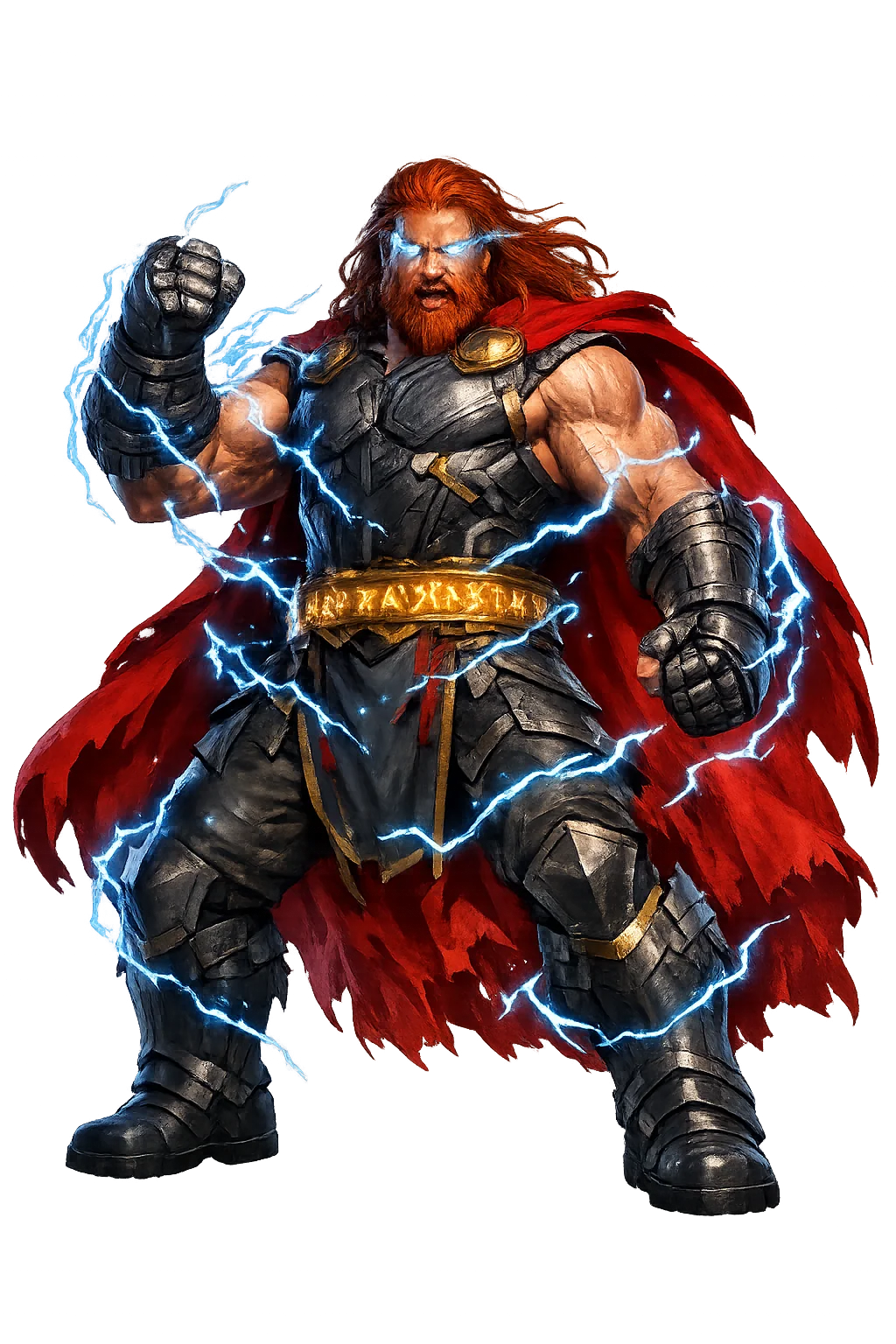
Þórr is the thunder-god, the defender of Ásgarðr and the strongest of the Æsir. Where Óðinn seeks wisdom through sacrifice and stratagem, Þórr meets threats with his hammer Mjölnir and his belt of strength Megingjörð. Giants fear him, fishermen invoke him, and farmers bless their fields in his name. His chariot, drawn by the goats Tanngnjóstr and Tanngrisnir, rumbles across the sky as thunder, while Mjölnir returns to his hand after every throw, making him the unstoppable guardian of cosmic order. Þórr's popularity continued into the Viking Age and Christianization, when Mjǫllnir amulets were worn alongside crosses as protective symbols. His cult left place-names across Scandinavia and influenced the Anglo-Saxon thunder-god Thunor, whose name survives in Thursday. Medieval and modern revivals have made him a global icon of Norse strength.
At a Glance
- Restored name: Þórr
- ASCII form: thor
- Meaning: "Thunder (from *þunraz)"
- Domain of influence: Thunder, Storms, Oak
- Pantheon: Norse
- Classification: Tier 1
- Original script: ᚦᚢᚱ
- Series: The Restoration Files, No. 239 of 271
The Name Before the Marks
Strip Þórr to thor and 2 pieces of evidence vanish:
- o → ó — Acute on o: the stress position the ASCII form cannot show.
- r → rr — Geminate: double r in Old Norse: the vowel length the ASCII form cannot show.
A reader who knows the marks hears the name correctly on the first try. A reader who never sees them never gets the chance.
Spoken, the name runs `/ˈθɔːrː/` — 'THORR' — begin with the breathy 'th' of 'thin', hold the 'o' long like 'awe', and trill the final r slightly longer than usual.
The Temple That Stands Now
The restored name is not a plaque; it is an address. The temple of Þórr lives at /sites/thor/, with its mythology in the lore halls, its peer-reviewed record in the Scholarly Edition, and its place in the pattern atlas on the patterns floor.
Tier-1 is not a compliment; it is a measurement. This restoration keeps something the ASCII form provably loses, and the measurement is repeatable.
Where the Name Stood First
The Altuna runestone in Uppland (U 1161) depicts Þórr fishing for the Miðgarðsormr, the most direct pictorial attestation of his myth. Mjölnir pendants are found by the thousand from Birka, Hedeby, and across the Norse diaspora; the Eyrarland bronze statuette from Iceland may represent the thunder-god with his hammer. The Jelling stones and runestones such as the Glavendrup stone invoke his protection. The temple on the web is the newest of these addresses — the first one that fits in a pocket.
The Archetype at Work
The pattern atlas seats this temple in 5 industries, each match argued and weighted: Defense, Military & Security (defender of Ásgarðr and Miðgarðr; the hammer is the shield-wall of the worlds.); Meteorology & Weather Intelligence (his name is the Norse word for thunder itself; the sky’s hammer and the oak-splitting storm are his.); Agriculture, Food & Harvest (farmers blessed their fields in his name; the working god of hall and harvest.). The Resonance File reads those seats through the myths themselves.
In the Sacred Texts
The Norse tradition is not a vibe; it is a library. The Sacred Texts collection holds Poetic Edda and Prose Edda — the primary sources the temple's scholarship is built on. The temple is the argument; the texts are the evidence.
The File Continues
The temple's founding dispatch tells the name's story; its Resonance File reads the myths into the industries; the blog index holds the whole archive.
Continue the series — previous file: Théia (read it here) · next file: Ḏḥwty (read it here).
The Restoration Files are written from the same canonical record as the temples themselves: the lexicon, the lore catalog, the pattern atlas, and the cited scholarly sources. If a file ever disagrees with its temple, the temple is right — tell us, and the file will be corrected.