Unicode restoration and ASCII comparison
ᚦᚢᚱ
The name in its original Norse form. Þórr (ᚦᚢᚱ) is attested in the source tradition — “Thunder (from *þunraz)”. Its acute stress marks carry the full phonetic and orthographic weight of the source tradition.
thor
Reduced to plain thor, the name loses everything that made it specific: acute stress marks. What remains is an ASCII string that machines can parse but that no longer speaks with its original voice.
Þórr
The Unicode restoration recovers what ASCII flattened. Þórr restores acute stress marks, returning the name to its original written dignity. The domain encodes to Punycode, but the browser displays the truth.
Þórr.com → xn--rr-4ja7b.com
The non-ASCII characters in Þórr are encoded while the ASCII remains visible. To the DNS, it is Punycode. To humanity, it is Þórr.
How Þórr travels from ancient script to the modern URL
From Proto-Germanic *Þunraz, 'thunder'. Cognates: Old English Þunor, Old High German Donar, Continental Germanic *Thunaraz.
God of thunder, lightning, storms, oak trees, and the protection of mankind.
The Unicode restoration Þórr uses Thorn (Þ) and acute-accented o, both registrable in .com. The runic form is not used as the primary domain because runic TLD support and keyboard input are impractical.
How Þórr was spoken
The domain of Þórr
In the norse tradition, Þórr governed thunder, storms, oak. The name encodes a sphere of power that shaped ritual, narrative, and social order.
The returning hammer shatters giants and hallows brides; without it, the gods cannot defend cosmic order.
Disguised as Freyja, Þórr recovered Mjölnir from the giant Þrymr and slew every jotunn in the wedding hall.
Using an ox-head for bait, Þórr hooked the Miðgarðsormr and dragged the world serpent to the surface.
Farmers and sailors invoked Þórr for protection; his name survives in Thursday and in the Anglo-Saxon Thunor.
Stories of Þórr
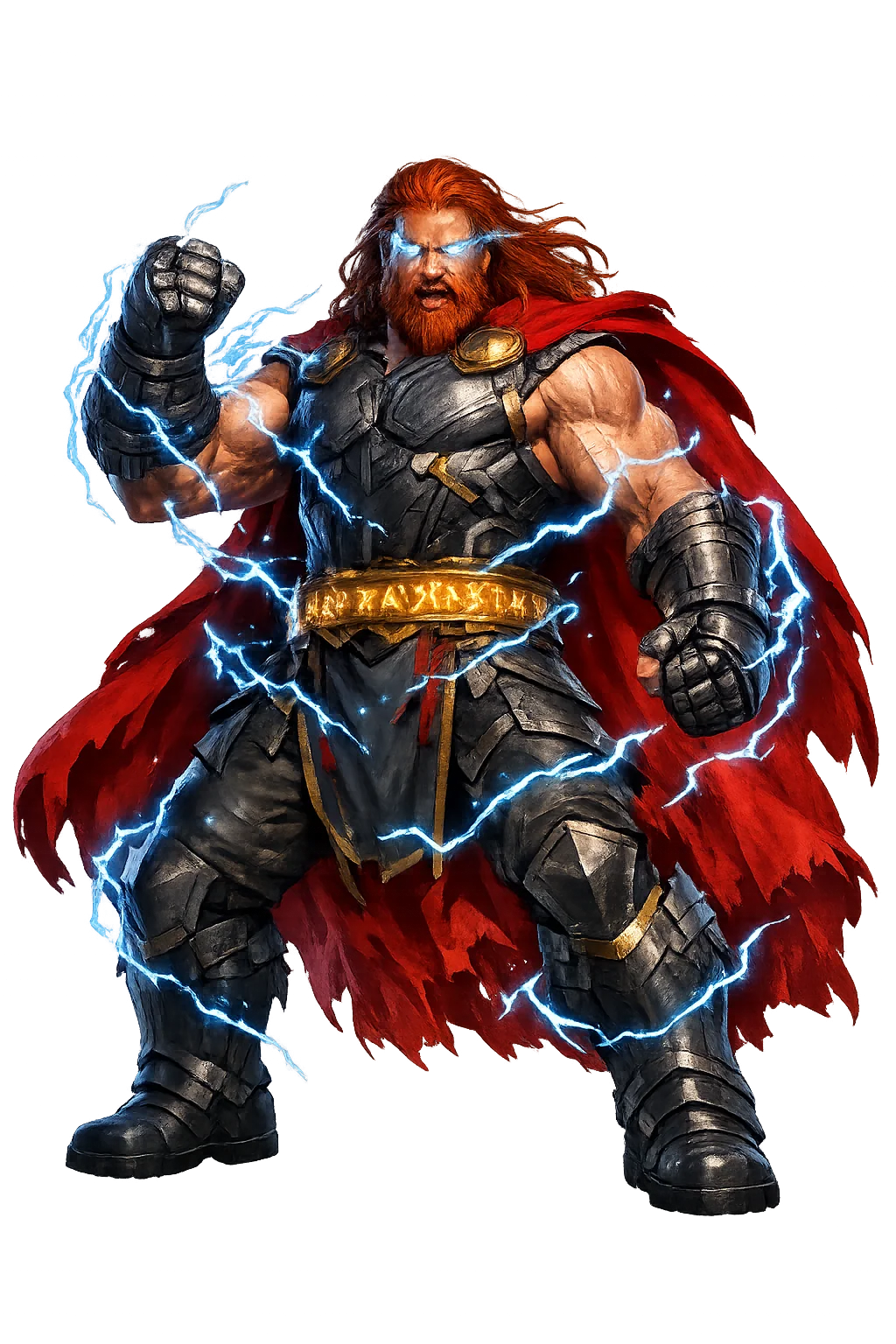
Þórr is the thunder-god, the defender of Ásgarðr and the strongest of the Æsir. Where Óðinn seeks wisdom through sacrifice and stratagem, Þórr meets threats with his hammer Mjölnir and his belt of strength Megingjörð. Giants fear him, fishermen invoke him, and farmers bless their fields in his name. His chariot, drawn by the goats Tanngnjóstr and Tanngrisnir, rumbles across the sky as thunder, while Mjölnir returns to his hand after every throw, making him the unstoppable guardian of cosmic order. Þórr's popularity continued into the Viking Age and Christianization, when Mjǫllnir amulets were worn alongside crosses as protective symbols. His cult left place-names across Scandinavia and influenced the Anglo-Saxon thunder-god Thunor, whose name survives in Thursday. Medieval and modern revivals have made him a global icon of Norse strength.
When the giant Þrymr steals Mjölnir and demands Freyja as ransom, the gods cannot pay. Instead, they dress Þórr as the bride, veil his beard, and send him to Jötunheimr with Loki as his maidservant. At the wedding feast, Þrymr places the hammer in the bride's lap to hallow her, and Þórr seizes it, slays every giant in the hall, and returns to Ásgarðr.
The myth is comic, but its premise is serious: without Mjölnir, the gods cannot defend the order of the world. Þórr's willingness to wear women's clothing underscores that his masculinity is secure enough to be performed as disguise, and the hammer's return restores cosmic equilibrium.
Þórr goes fishing with the giant Hymir, using the head of the giant's finest ox as bait. He hooks the Miðgarðsormr, the World Serpent that encircles Miðgarðr, and pulls it up until the venom drips and the sea boils. Hymir, terrified, cuts the line, and the serpent sinks back into the deep.
The episode foreshadows the final battle of Ragnarǫk, when Þórr and the serpent will kill one another. It also shows Þórr's role as the god who tests the boundaries of the world: he alone dares to drag the creature that holds Miðgarðr together to the surface of its own sea.
The giant Geirröðr stole a pair of iron gloves, a belt, and a staff that belonged to the giantess Gríðr, who warned Þórr of the danger. He crossed the Vimur river, which rose to his shoulders, and broke into Geirröðr's hall. The giant hurled a glowing iron at him; Þórr caught it and threw it back through Geirröðr and the wall behind him, killing every giant in the room. The tale reinforces Þórr's identity as the god who survives traps and returns violence to its sender.
Names are not merely labels; they are compressed worlds. Þórr carries within it a norse understanding of thunder (from *þunraz). Unicode restoration returns that world to readable form.
Enter Extended Lore