
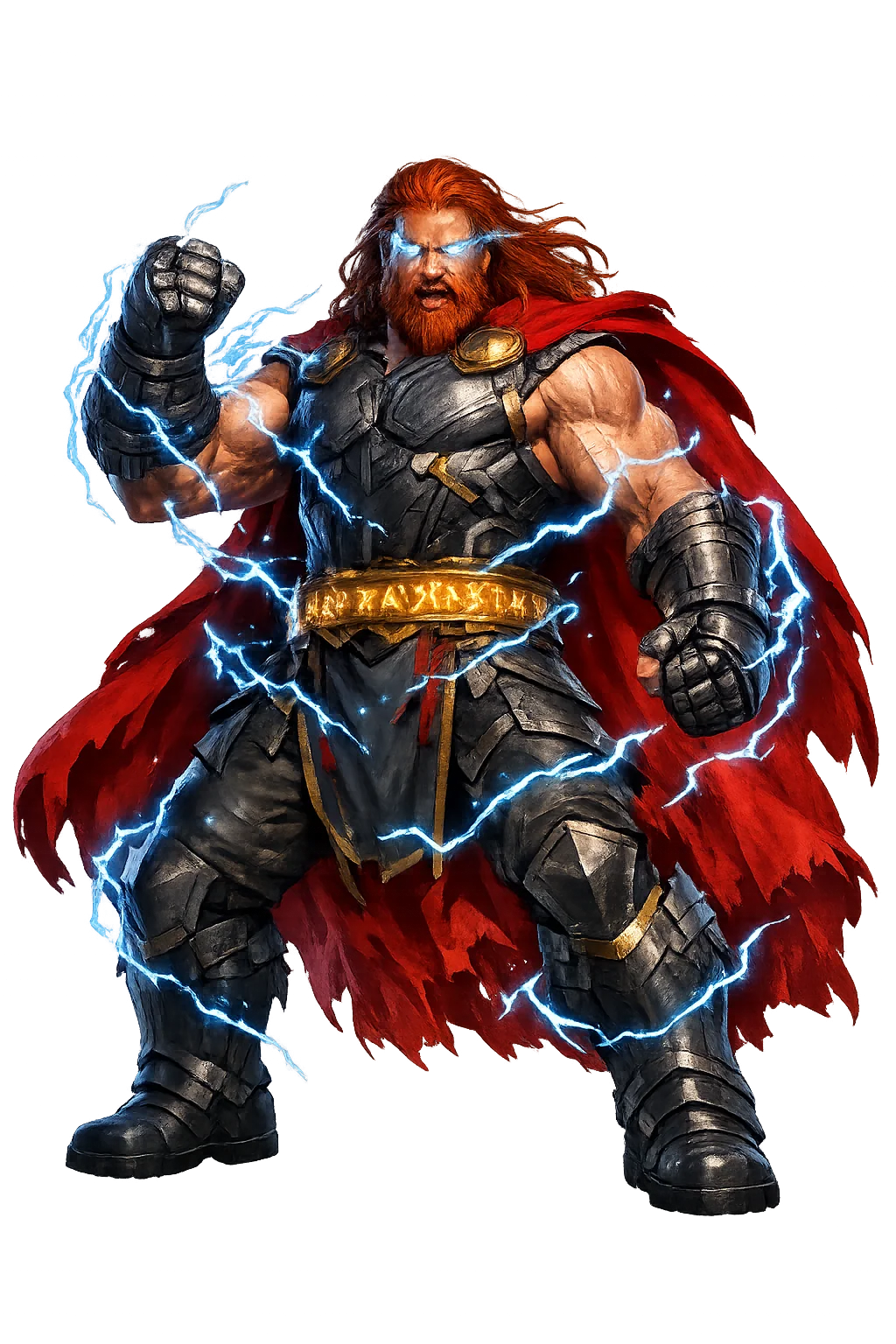
Why Þórr belongs in your address bar
Every address bar is a choice. When you type Þórr, you are not typing a novelty; you are restoring a name that the early DNS, built for English typewriters, could not carry. The plain ASCII form thor is a leftover of that constraint, not the name itself. This post is the long version of the restoration: where the name comes from, how the Younger Futhark tradition wrote it, how it is pronounced, what the myths and the material record preserve, and why its Unicode form now lives as a working domain. The claim throughout is simple — the original spelling is not decoration. It is the name.
At a Glance
- Restored name: Þórr
- ASCII form: thor
- Meaning: "Thunder (from *þunraz)"
- Domain of influence: Thunder, Storms, Oak
- Pantheon: Norse
- Classification: Tier 2
- Original script: ᚦᚢᚱ (Younger Futhark)
- Live domain: þórr.com
Overview
Þórr (thor) is the thunder-god of the Norse pantheon, defender of Ásgarðr and Miðgarðr, catalogued in this edition under the domain "Thunder, Storms, Oak". The name is the Old Norse reflex of Proto-Germanic \Þunraz 'thunder', built on the Indo-European root (s)tenh₂-* 'to thunder'; it is among the most widely attested divine names in Germanic, continuing in Old English Þunor and Old High German Donar.
Snorri numbers Þórr foremost of the gods after Óðinn, the strongest of gods and men and the sworn enemy of the giants; writing in the 1070s, Adam of Bremen reports that the Swedes of Uppsala credited Thor with rule over thunder and lightning, wind and rain.
PuniCodex restores the name as Þórr and serves its temple at þórr.com. The acute accent on ó marks the long vowel of the normalized spelling, placing the name in Tier 2; the plain ASCII form thor is a modern convenience of the domain-name system, not an ancient spelling.
The Name
The name is attested in Younger Futhark as ᚦᚢᚱ (þur), the three-rune skeleton under which the god's name appears in Viking-Age epigraphy, as in the runic coin graffiti from Gotland.
The name descends from Proto-Germanic \Þunraz 'thunder', from the Indo-European root (s)tenh₂- 'to thunder'. Old Norse lost the medial nasal and contracted the form to Þórr, while the cognates Old English Þunor and Old High German Donar preserve the older shape; the Alemannic Nordendorf fibula already names the god as wigiþonar* beside Wodan.
Cognate forms across related languages:
- Þunor (Old English) — the Anglo-Saxon thunder god
- Donar (Old High German) — the continental thunder god, named on the Nordendorf fibula
- tonāre (Latin) — 'to thunder', from the same Indo-European root
The ASCII form thor survives only because the early domain-name system could not carry the thorn or the accent; it is a technological compromise, not an ancient spelling. The Unicode restoration Þórr recovers the thorn and the long, accented vowel of the normalized Old Norse spelling directly in the address bar; the name preserves one marked feature (the acute ó) and is classified Tier 2.
The letter-by-letter transformation runs:
- t → Þ — Thorn: voiceless dental fricative
- h → — — Dropped: merged with t into thorn
- o → ó — Acute on o
- r → rr — Geminate: double r in Old Norse
Attested and derived spellings of the name:
- Thorr — alternate scholarly spelling keeping the geminate r without the thorn, recorded in the project's cited witnesses (Cleasby–Vigfusson; Etymological Dictionary of Proto-Germanic)
The project holds the domain þórr.com (xn--rr-4ja7b.com) as the canonical home of this name.
Etymology & Roots
The recorded derivation reads: PGmc Þunraz "thunder", from PIE (s)tenh₂- "to thunder". The thunder god.
The reconstructed proto-form is *Þunraz (proto-indo-european), glossed as "thunder".
The reconstruction is classed as attested.
Kindred forms recorded in the lexicon:
- Þunor (old-english) — Anglo-Saxon thunder god
- tonāre (latin) — To thunder
The Original Script
The name is preserved in Younger Futhark as ᚦᚢᚱ — Germanic runic, attested Viking Age, c. 800–1100 CE, in Scandinavia. The script is written left-to-right, top-to-bottom.
The scholarly transliteration is Þórr (normalized Old Norse), giving the normalized reading /ˈθoːrː/.
The rendering proceeds step by step:
- The Viking-Age runic form ᚦᚢᚱ (þur) is attested on artefacts such as the Mannegårde coin graffiti.
- The normalized Old Norse name is Þórr, with long /oː/ and geminate /rː/.
- The name continues Proto-Germanic *Þunraz ('thunder'), with loss of the medial nasal and contraction.
- Younger Futhark does not distinguish short/long vowels or voiced/voiceless stops, so ᚦᚢᚱ is a minimal phonetic skeleton.
Pronunciation
The reconstructed pronunciation of the name is /ˈθɔːrː/ — Old Norse Reconstruction.
Phoneme by phoneme:
- Þ — Voiceless dental fricative [θ], the thorn; it is the hard 'th' of 'thin', not the voiced 'th' of 'this'
- ó — Long open-mid back [ɔː] with acute marking stress and length
- rr — Long or geminated alveolar trill [rː], written double in Old Norse to show length
For the modern speaker, the closest approximation is: 'THORR' — begin with the breathy 'th' of 'thin', hold the 'o' long like 'awe', and trill the final r slightly longer than usual.
Kindred and historical forms of the name:
- Old English — Þunor, the Anglo-Saxon thunder god, cognate with Norse Þórr
- Old High German — Donar, the continental Germanic thunder god
- Proto-Germanic — *Þunraz, 'thunder', the common ancestor of all Germanic thunder-god names
Þórr is accent-preserving Tier 2: the acute on ó marks stress and length on the first syllable, while the geminate rr preserves the Old Norse long consonant. The English name Thor has lost both the thorn sound and the long rolled r.
Mythology
Þórr is the thunder-god, the defender of Ásgarðr and the strongest of the Æsir. Where Óðinn seeks wisdom through sacrifice and stratagem, Þórr meets threats with his hammer Mjǫllnir and his belt of strength Megingjǫrð. Giants fear him, fishermen invoke him, and farmers bless their fields in his name. His chariot, drawn by the goats Tanngnjóstr and Tanngrisnir, rumbles across the sky as thunder, while Mjǫllnir returns to his hand after every throw, making him the unstoppable guardian of cosmic order. Þórr's popularity continued into the Viking Age and Christianization, when Mjǫllnir amulets were worn alongside crosses as protective symbols. His cult left place-names across Scandinavia and influenced the Anglo-Saxon thunder-god Thunor, whose name survives in Thursday.
The Recovery of Mjǫllnir (Þrymskviða)
When the giant Þrymr steals Mjǫllnir and demands Freyja as ransom, the gods cannot pay. Instead, they dress Þórr as the bride, veil his beard, and send him to Jötunheimr with Loki as his maidservant. At the wedding feast, Þrymr places the hammer in the bride's lap to hallow her, and Þórr seizes it, slays every giant in the hall, and returns to Ásgarðr.
The myth is comic, but its premise is serious: without Mjǫllnir, the gods cannot defend the order of the world. Þórr's willingness to wear women's clothing underscores that his masculinity is secure enough to be performed as disguise, and the hammer's return restores cosmic equilibrium.
Fishing for the Miðgarðsormr (Hymiskviða)
Þórr goes fishing with the giant Hymir, using the head of the giant's finest ox as bait. He hooks the Miðgarðsormr, the World Serpent that encircles Miðgarðr, and pulls it up until the venom drips and the sea boils. Hymir, terrified, cuts the line, and the serpent sinks back into the deep.
The episode foreshadows the final battle of Ragnarǫk, when Þórr and the serpent will kill one another. It also shows Þórr's role as the god who tests the boundaries of the world: he alone dares to drag the creature that holds Miðgarðr together to the surface of its own sea.
The Journey to Geirröðr (Skáldskaparmál)
Loki, captured by the giant Geirröðr, bought his freedom by promising to bring Þórr to the giant's courts without hammer, belt, or gloves. On the road Þórr lodged with the giantess Gríðr, mother of Víðarr, who warned him of the trap and lent him her own belt of strength, her iron gloves, and her staff Gríðarvǫlr. He waded the flooded Vimur river, which rose to his shoulders, and reached Geirröðr's hall. The giant hurled a lump of glowing iron at him; Þórr caught it in the borrowed gloves and threw it back through the pillar behind which Geirröðr crouched, through the giant, and through the wall. The tale reinforces Þórr's identity as the god who survives traps and returns violence to its sender.
The Recovery of Mjölnir (Þrymskviða)
When the giant Þrymr steals Mjölnir and demands Freyja as ransom, the gods cannot pay. Instead, they dress Þórr as the bride, veil his beard, and send him to Jötunheimr with Loki as his maidservant. At the wedding feast, Þrymr places the hammer in the bride's lap to hallow her, and Þórr seizes it, slays every giant in the hall, and returns to Ásgarðr.
The myth is comic, but its premise is serious: without Mjölnir, the gods cannot defend the order of the world. Þórr's willingness to wear women's clothing underscores that his masculinity is secure enough to be performed as disguise, and the hammer's return restores cosmic equilibrium.
Symbols & Iconography
The iconography associated with Þórr concentrates in a small set of recurring attributes, each a compressed statement about the god:
- Mjǫllnir — the short-handled hammer that returns to his hand and strikes down giants; its shortened haft is the scar of Loki's sabotage at the dwarfs' forge (Skáldskaparmál).
- Megingjǫrð (strength belt) — the belt that doubles his already formidable strength (Gylfaginning 21).
- Járngreipr (iron gloves) — the gloves that let him grasp the hammer's glowing haft.
- Goat-drawn chariot — Tanngrisnir and Tanngnjóstr, the goats who pull his thundering cart and whom he can slaughter at night and resurrect whole from their bones in the morning (Gylfaginning 44).
- Oak tree — the tree of the thunder-god in continental tradition: at Geismar in 723 Boniface felled the sacred oak of Donar before a watching crowd, and the unstruck missionary made his point.
Archaeology & Evidence
The Altuna runestone in Uppland (U 1161) carves Þórr fishing for the Miðgarðsormr, the most direct pictorial attestation of the Hymiskviða myth; the Gosforth 'fishing stone' in Cumbria shows the same episode on English soil, with Hymir beside him in the boat. Mjǫllnir pendants are the commonest divine emblem of the Viking Age: thousands are known from graves and hoards from Birka and Hedeby across the diaspora, and the Købelev hammer from Lolland, whose runes read 'this is a hammer', is the only example that names itself. The seated bronze statuette from Eyrarland in Iceland (c. 1000) is conventionally identified as Þórr grasping his hammer, and the Jelling and Glavendrup monuments mark the world in which his hallowing was still invoked against the new faith.
Realm & Domain
Þórr's sphere is the storm made serviceable: thunder as the weapon that keeps the giants outside the fence of the world, rain as the blessing on the field, the oak as the tree the lightning seeks. The Eddic poems and Snorri distribute that power across one weapon, two famous journeys, and an unbroken line of invocations by farmers and sailors.
Mjǫllnir
The returning hammer that shatters giants and hallows brides, births, and the dead; without it the gods cannot hold the order of the world.
Þrymskviða
Disguised as Freyja, Þórr recovered Mjǫllnir from the giant Þrymr and slew every giant in the wedding hall.
Hymiskviða
Using an ox-head for bait, Þórr hooked the Miðgarðsormr and dragged the world-serpent to the surface before the terrified Hymir cut the line.
Oak and Storm
Farmers and sailors invoked Þórr for protection; his name survives in Thursday (Old Norse þórsdagr) and in the Anglo-Saxon Thunor.
Across Cultures
Þórr's most durable ancient translation is the weekday itself: when the Germanic peoples rendered the Roman week, dies Iovis — Jupiter's day — became þórsdagr, Thursday, because Jupiter the thunderer was the natural counterpart of the Germanic thunder-god. The equation ran through older cult vocabulary as well: the sixth-century Nordendorf fibula invokes wigiþonar beside Wodan, and Roman-period altars to Hercules in Germania have sometimes been linked to Donar, though that identification remains disputed. Christianization absorbed rather than erased him: Mjǫllnir amulets were worn beside crosses in tenth-century Scandinavia, and medieval learned authors such as Saxo euhemerized the thunder-god into prehistory.
Kindred figures in the PuniCodex cross-tradition index include [[zeus|Zeús]] (thunder sovereignty), [[baal|Baꜥal]] (thunder / storm sovereignty), [[enlil|Enlīl]] (thunder / storm sovereignty), [[oya|Ọya]] (thunder / storm sovereignty), [[perkunas|Perkūnas]] (thunder / storm sovereignty), and [[shango|Ṣàngó]] (thunder / storm sovereignty).
Cultural Legacy
Þórr's afterlife is the longest of any Norse god. His weekday, Thursday, is spoken daily; his hammer, revived as an emblem by nineteenth-century Scandinavian romanticism, is worn today by Heathens much as the cross is worn by Christians — in 2013 the United States Department of Veterans Affairs added Mjǫllnir to the emblems of belief permitted on government headstones. Wagner translated the god into Donner, the storm-voice of Das Rheingold (1869), while twentieth- and twenty-first-century comics and film have made the unadorned form 'Thor' a global household name. The restored spelling Þórr, with its thorn and accented vowel, keeps the medieval god distinguishable from his pop-culture descendant.
The Scholarly Record
The account of Þórr given in this edition rests on the witnesses and reference works listed below. Lexica and etymological dictionaries secure the form and meaning of the name; the Eddic poems, Snorri's prose, and the Latin testimony of Adam of Bremen supply the narrative and cultic evidence.
- Poetic Edda, Þrymskviða (the hammer's theft and recovery), trans. Larrington (2014).
- Poetic Edda, Hymiskviða (the cauldron quest and the fishing).
- Poetic Edda, Hárbarðsljóð and Alvíssmál (the flyting; the dwarf out-talked until sunrise).
- Poetic Edda, Völuspá 56 (Þórr's death at Ragnarǫk).
- Snorri Sturluson, Edda, Gylfaginning 21, 44–45 and Skáldskaparmál (attributes; Útgarða-Loki; Hrungnir; Geirröðr), trans. Faulkes.
- Adam of Bremen, Gesta Hammaburgensis IV.26–27 (Thor in the Uppsala cult), trans. Tschan.
- Kroonen, Guus, Etymological Dictionary of Proto-Germanic (Brill, 2013), s.v. *þunraz.
- Cleasby & Vigfusson, An Icelandic-English Dictionary (1874), s.v. Þórr.
- Simek, Rudolf, Dictionary of Northern Mythology (1993), s.v. Þórr, Mjǫllnir.
- Lindow, John, Norse Mythology: A Guide to the Gods, Heroes, Rituals, and Beliefs (Oxford, 2001).
A Meditation
Þórr is the most human-shaped of the gods: he eats enormously, loses his temper, is tricked as often as he tricks, and never stops walking toward the fight. His name is simply the word for thunder — no epithet, no abstraction — as if the storm itself had been asked its name and answered. The thorn and the accented ó are small marks for so large a noise, but they are the difference between a god and a brand: Þórr is the name the runestones asked to hallow and the farmers called on at sea; thor is what remains when the sound is gone. The Eddas never let him speak of this gap, but every Mjǫllnir pendant dug from a tenth-century grave says it for him: the thunder-god was the god ordinary people actually kept.
The Unicode Restoration
Þórr is classified as Tier 2: the original preserves at least one philological feature that ASCII cannot encode. The ASCII fallback thor still resolves everywhere, but it is the restored form that carries the name's full information. Across the 4 characters of the name, the restoration adjusts 4: 1 mark of stress (ó); 1 mark of length (rr); 2 further adjustments (Þ, h). That is the whole thesis of this temple: the marks are the message.
The Domain Name
The restored name is live as a working domain: þórr.com, which the DNS carries in punycode form as xn--rr-4ja7b.com — an ASCII-compatible encoding that lets a non-ASCII name travel the global network without breaking older infrastructure. The visitor sees Þórr; the machines see the encoding. That duality is the engineering compromise on which the entire restoration rests, and it is why a name written the way its own tradition wrote it in Younger Futhark can now be typed into any browser on earth.
Why This Restoration Matters
Restoring Þórr is part of a larger effort to make the web multilingual by default. The PuniCodex project does not ask users to learn a new alphabet; it asks the infrastructure to respect the alphabets that already exist. Every section of this post — the script, the sound, the myths, the evidence — converges on the same point: the marks in Þórr are information, and information deserves an address of its own. A single Unicode domain is a small proof, but it is a proof that scales: every name restored makes the next one easier, and every visit to þórr.com is a vote for the restored form.
Explore Further
This post is one doorway into the temple. The home page carries the full character breakdown and the ambient canvas; the lore page tells the myths in long form; the Scholarly Edition preserves the sources, pronunciation data, and revision history; and the patron wall supports the restoration directly. For the wider map, browse the Lexicon, explore the Pantheon, or return to the PuniCodex blog.
Related Names
Sources
The full scholarly apparatus — every citation, revision, and review — lives in the Scholarly Edition. Key references for this post:
- Poetic Edda, Þrymskviða (the hammer's theft and recovery), trans. Larrington (2014).
- Snorri Sturluson, Edda, Gylfaginning 21, 44–45 and Skáldskaparmál, trans. Faulkes.
- Kroonen, Guus, Etymological Dictionary of Proto-Germanic (Brill, 2013), s.v. þunraz.
- Snorri Sturluson, Edda, Gylfaginning 21; Adam of Bremen, Gesta Hammaburgensis IV.26.
- Cleasby & Vigfusson, An Icelandic-English Dictionary (1874), s.v. Þórr.
- Barnes, Michael P., Runes: A Handbook (Boydell, 2012).
- Lexicon authorities for this entry: Cleasby-Vigfusson, Zoëga.