
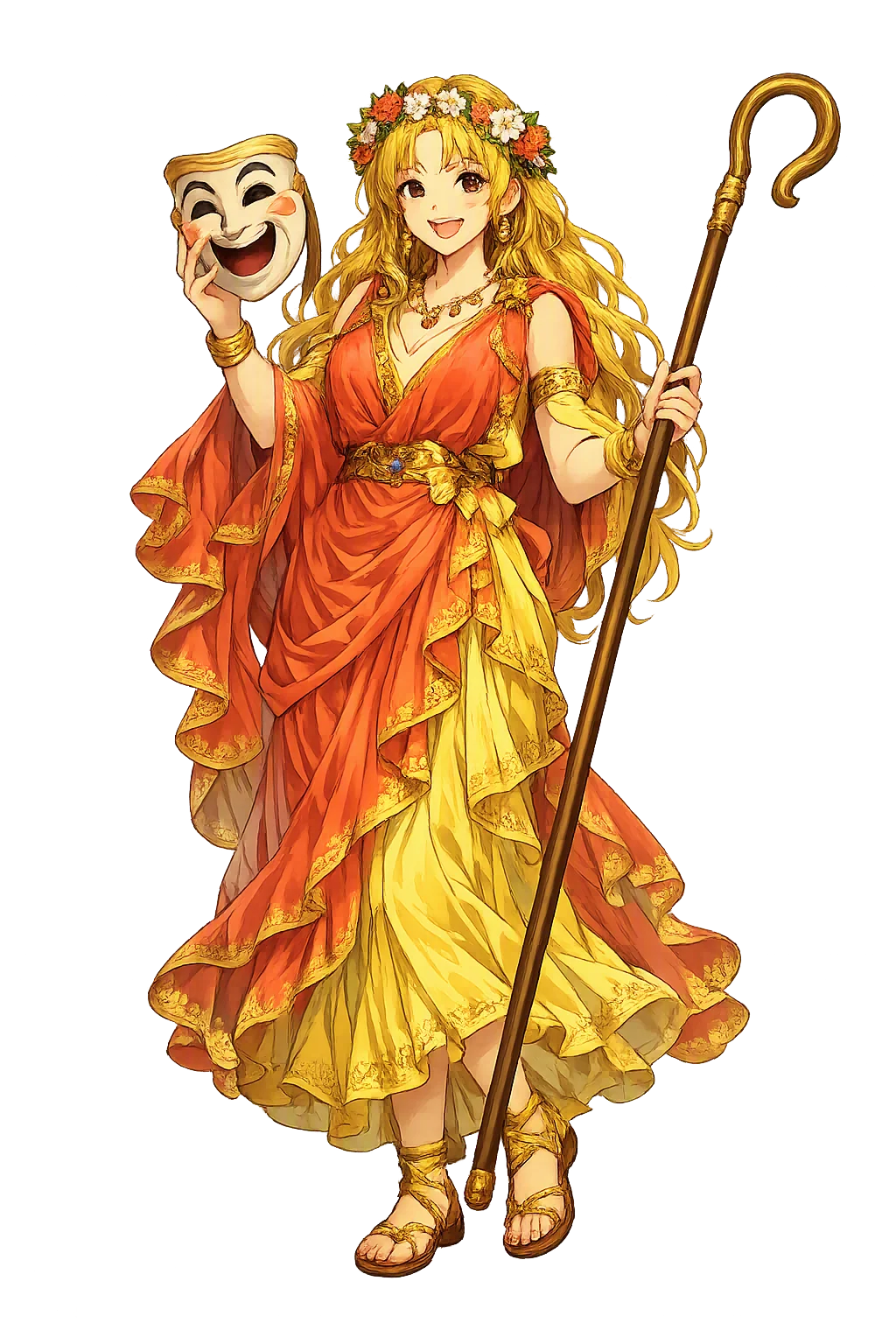
Tháleia: the stories first, then the spelling
You cannot weigh an accent without knowing what it carries. Here is what Tháleia has been carrying.
The Stories That Carry the Name
Nine Nights, Nine Daughters. Hesiod tells how Mnémosynē, Memory herself, lay with Zeus for nine nights and bore the nine Muses 'to be a forgetting of evils and a rest from cares' (Theogony 53–62). When he names them, Tháleia stands third: 'Kleiṓ and Eutérpē and Tháleia and Melpoménē' (Theogony 76–79). From the beginning, then, laughter and festivity are numbered among the daughters of Memory — comedy is not beneath remembrance but one of its gifts.
The Silencing of Thamyris. In Iliad 2 (594–600), the Catalogue of Ships pauses at Dōrion, where the Thracian singer Thamyris was stopped on his way from Oichalia. He had boasted he would outsing the Muses themselves; in their anger they maimed him, 'took away his divine song, and made him forget his lyre-playing. ' The Muses act here as one undivided power — Tháleia among them — and their punishment is the precise opposite of their gift: not forgetting of cares, but forgetting of song.
Mother of the Corybantes. Apollodorus records that 'from Thaleia and Apollo were born the Corybantes' (Bibliotheca 1. 3. 4) — the ecstatic, armed dancers who clash their shields around the mountain mother.
And Here Is What the Spelling Preserves
Against those stories, the attestation: Θάλεια, as LSJ and Beekes record. The name means "Flourishing, blooming".
The restoration keeps one feature the ASCII form thaleia cannot show:
- a → á — Acute on a: where the voice peaks.
A storyteller pronouncing the name would restore every one of them by instinct. The file only writes down what the voice already knows.
At a Glance
- Restored name: Tháleia
- ASCII form: thaleia
- Meaning: "Flourishing, blooming"
- Domain of influence: Comedy, Idyll
- Pantheon: Greek
- Classification: Tier 1
- Original script: Θάλεια
- Series: The Restoration Files, No. 246 of 282
The Name Travels
Rome adopted the nine Musae almost without translation, and Thalia kept her Greek name; it was in late antique and Renaissance iconography that she was fixed once and for all as comedy's patron, mask in hand, one of the paired faces of the theater. Her namesake the Charis lived a parallel afterlife as one of the three Graces of Western art — Aglaia, Euphrosyne, and Thalia, the dancers of Botticelli's Primavera.
The Address It Earned
The temple of Tháleia stands at /sites/thaleia/ — lore, scholars, patterns — because a name carrying this much story deserves more than a parking page. What survives here cannot be shown in ASCII: a feature of the original that the fallback alphabet flattens. That is the Tier-1 test, and this name passes it without argument.
The Sources Are Open
The myths above are retold from the temple's record; the primary voices are in the Sacred Texts: Theogony, Homeric Hymns, and Works and Days. Nothing in this file outranks them.
The File Continues
Read the founding dispatch for the name's full story, the Resonance File for the archetype at work — or the whole archive in one sitting.
Continue the series — previous file: Tēzcatlīpōca (read it here) · next file: Thánatos (read it here).
The Restoration Files are written from the same canonical record as the temples themselves: the lexicon, the lore catalog, the pattern atlas, and the cited scholarly sources. If a file ever disagrees with its temple, the temple is right — tell us, and the file will be corrected.