
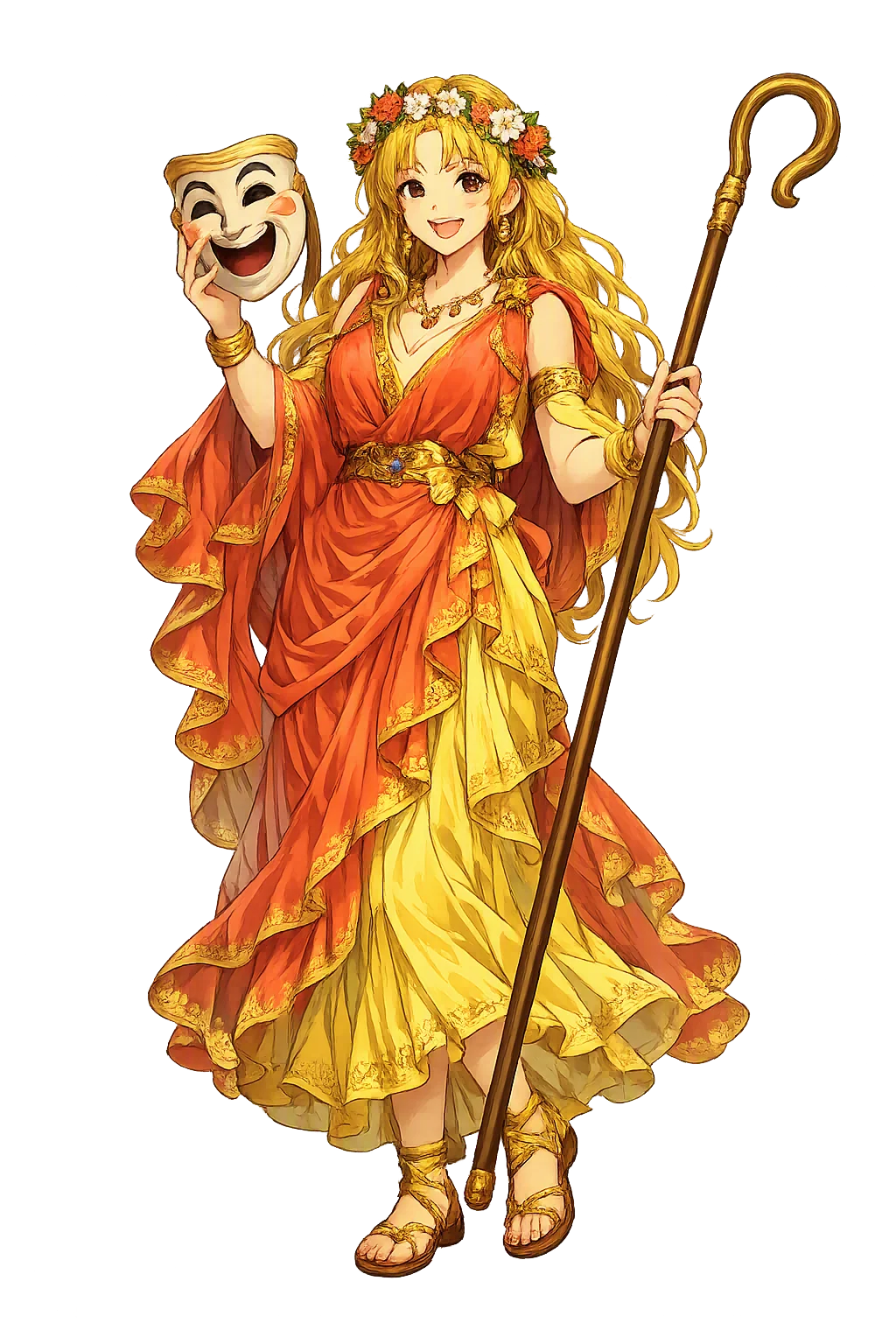
Tháleia walks into a music, arts & performance firm
The music, arts & performance world does not cite Tháleia in its documentation. It does not need to — it performs the archetype daily, unbilled.
Before the Office, the Story
Nine Nights, Nine Daughters. Hesiod tells how Mnémosynē, Memory herself, lay with Zeus for nine nights and bore the nine Muses 'to be a forgetting of evils and a rest from cares' (Theogony 53–62). When he names them, Tháleia stands third: 'Kleiṓ and Eutérpē and Tháleia and Melpoménē' (Theogony 76–79). From the beginning, then, laughter and festivity are numbered among the daughters of Memory — comedy is not beneath remembrance but one of its gifts.
The Silencing of Thamyris. In Iliad 2 (594–600), the Catalogue of Ships pauses at Dōrion, where the Thracian singer Thamyris was stopped on his way from Oichalia. He had boasted he would outsing the Muses themselves; in their anger they maimed him, 'took away his divine song, and made him forget his lyre-playing. ' The Muses act here as one undivided power — Tháleia among them — and their punishment is the precise opposite of their gift: not forgetting of cares, but forgetting of song.
At a Glance
- Temple: Tháleia
- Pantheon: Greek
- Domain of influence: Comedy, Idyll
- Pattern seats: 3
- Sectors touched: Culture & Entertainment
- Strongest seat: Music, Arts & Performance
- Series: The Resonance Files, No. 246 of 282
The Reveal, Seat by Seat
Music, Arts & Performance
The Muse of Comedy — comic mask and shepherd's staff; the blooming of laughter into art. Nobody in that trade worships at this temple. They just keep its hours.
Gaming, Fantasy & Entertainment IP
Now read the why-line with the office in mind: Idyll and play — the comic register the entertainment economy performs nightly. The people doing this work did not borrow the archetype. They re-derived it — the way Tháleia was always going to be re-derived wherever comedy, idyll matters.
Writing, Publishing & Media
Idyllic poetry is her brief; the light essay and the pastoral sketch. Nobody in that trade worships at this temple. They just keep its hours.
Not the First Rebrand
Rome adopted the nine Musae almost without translation, and Thalia kept her Greek name; it was in late antique and Renaissance iconography that she was fixed once and for all as comedy's patron, mask in hand, one of the paired faces of the theater. Her namesake the Charis lived a parallel afterlife as one of the three Graces of Western art — Aglaia, Euphrosyne, and Thalia, the dancers of Botticelli's Primavera. The office is only the latest translation.
The Method, Stated Plainly
The atlas is not a horoscope. Seats are earned from the sources — argued, weighted, published — and every one of them can be challenged at the methodology page. A match that cannot survive an argument does not survive review. That is the whole trick: the patterns are claims, and claims can be tested.
For the Ones Who Work There
For a sponsor in music, arts & performance, the fit here is not adjacency — it is inheritance. Your trade already tells this story every working day; the temple simply holds the original. The patron tier and the advertising terms carry the mechanics; the myths above carry the reason.
The File Continues
This is one of 282 Resonance Files — the third dispatch from every flagship temple, where the myths meet the markets. The temple's founding dispatch tells the name's story; its Restoration File tells the spelling's; the blog index holds the whole archive.
Continue the series — previous: Tēzcatlīpōca (read it) · next: Thánatos (read it).
The Resonance Files are argued from the same canonical record as the pattern atlas itself: the lexicon, the lore catalog, and the cited sources. Every seat can be challenged at the methodology page — and the challenge is the point.