
Tháleia — the one true spelling, and the forms that fail it
Evidence dossier 246 — Tháleia. Every exhibit catalogued, every ruling stated with its grounds.
At a Glance
- Canonical form: Tháleia
- Original script: Θάλεια
- Pantheon: Greek
- Convention: the restored-stress convention: acute and circumflex for pitch, macrons for vowel quantity, exactly as the sources write
- False forms on record: 3
- Contested forms: none attested
- Series: The Canonical Register, No. 246 of 282
The Evidence
Exhibit 1 — the attestation. The name is attested as Θάλεια, as LSJ and Beekes record. On the evidence, it means "Flourishing, blooming". The canonical transliteration is Tháleia.
Exhibit 2 — the preserved marks. a → á (Acute on a). Each is verifiable against the sources named in the attestation.
Exhibit 3 — the flattened form. The plain form thaleia is not false — it is a fallback, and the register is exact about what that means. In systems that cannot carry diacritics (legacy databases, older tooling, parts of the address-bar pipeline) the flattened form is the accepted vehicle, and the rulebook names it explicitly as the final rung of the fallback hierarchy: full restoration first, circumflex where attested, macron-only by the academic standard, an attested variant, and only then plain ASCII.
What the fallback status forbids is promotion: thaleia may carry the name where marks are impossible, but it may not represent the name where marks are possible. Every mark it drops — a → á — is a fact the sources recorded. A fallback is a vehicle, never the primary.
Exhibit 4 — struck from the record: Thá́leia. Origin: the English ear — English speakers slam the first syllable of every borrowed name (DEL-fi, MY-cene), so the accent drifts forward online. Grounds: moves the stress from a (where the Greek puts it) to Á — a different word with a different rhythm; the sources stress a and nothing else.
Exhibit 5 — struck from the record: Thâleia. Origin: the circumflex habit — writers who learned that "the little hat means Greek" and apply it wherever an acute belongs. Grounds: the source carries an acute (oxeia, a rising tone), not a circumflex (perispomene, a rise-fall): the two marks are different facts about pitch, and only the acute is attested on a.
Exhibit 6 — struck from the record: taleia. Origin: the anglicized respelling — the name written the way English guesses it sounds. Grounds: rewrites the consonants of the attested form to fit English spelling habits; every cluster simplified this way erases a letter the sources write.
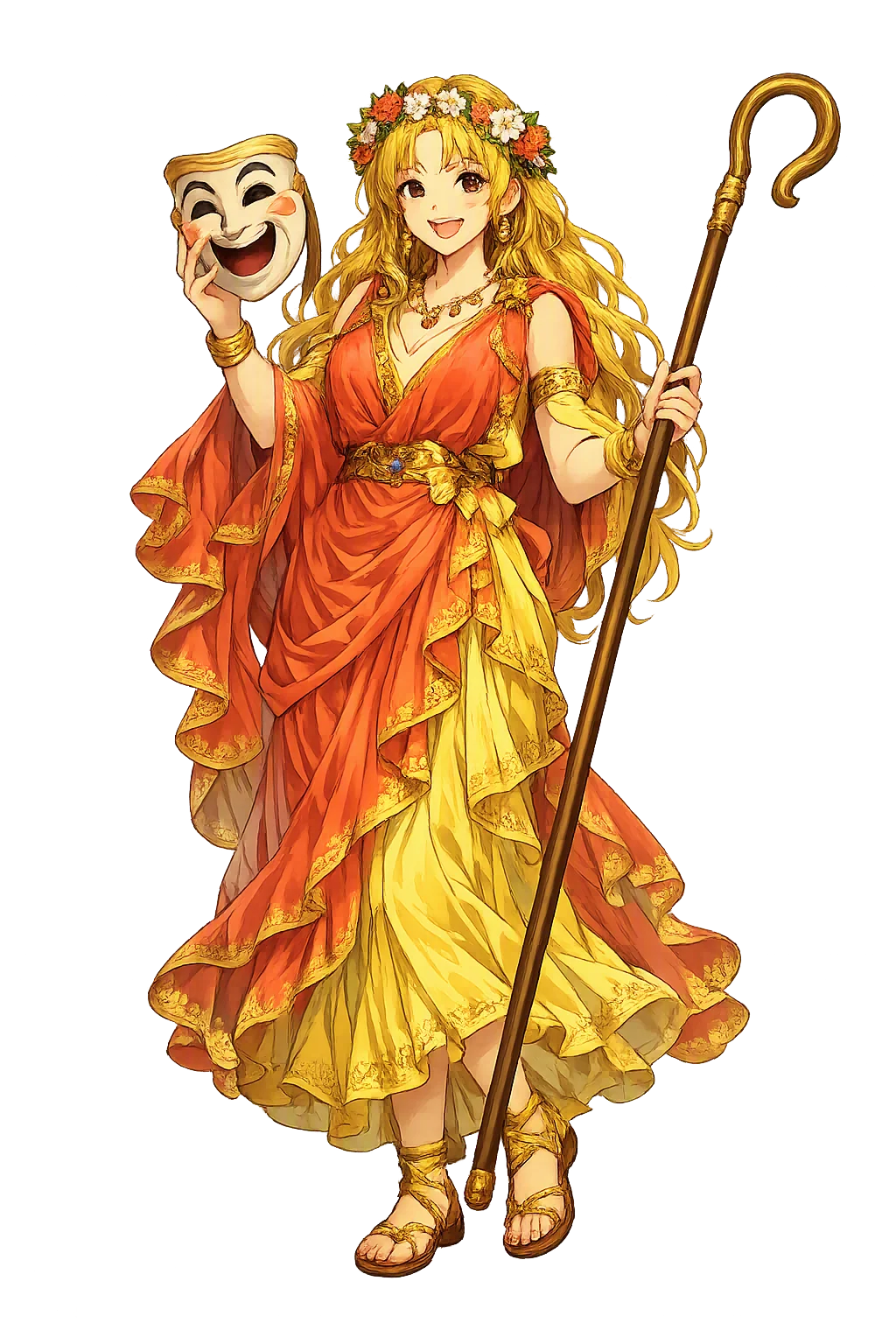
Exhibit 7 — the physical record. The great cult center of the Muses stood in the Valley of the Muses below Mount Helicon, near Thespiai, with its grove, its statues, and the Mouseia festival games; Pausanias (9.29–30) describes the sanctuary and the nearby spring Hippocrene at length. Tháleia herself survives visually on Roman-era Muses sarcophagi and mosaics, where she sits with the comic mask and shepherd's staff that became her invariable attributes. Comic masks further appear throughout theater-related dedications and Pompeian wall painting, the material trace of the genre she was believed to rule.
Exhibit 8 — the continuing record. No common English noun descends from Tháleia's name alone — her legacy travels under other flags. She presides in spirit over Theocritus's Idylls, the bucolic poems that gave English the word 'idyll' for every scene of pastoral peace.
The Convention's Own History
The marks this register defends were not invented for typesetting. Ancient Greek carried a melodic pitch accent, and the acute and circumflex were added by Alexandrian scholars — Aristophanes of Byzantium, tradition holds — precisely to preserve it when the spoken language began to level. Vowel quantity (the macron's concern) is older still: it changes meter, meaning, and grammar, and the poets of the Theogony depend on it. To drop either class of mark is to drop two millennia of deliberate preservation. The restored-stress convention simply continues the oldest documented project in European scholarship: keeping the sound of Greek alive in its letters.
The Protocol's Position
Can the canonical form live in the address bar? Almost always, yes. IDNA 2008 admits every mark this register defends — the DNS stores them as `xn--` punycode and modern browsers render them natively. The real frictions are practical, not legal: some registrars stock only part of the IDN space, so a theoretically valid name can be temporarily unbuyable; and stacked combinations (an acute riding a macron) remain awkward to type on mobile keyboards even where the protocol accepts them.
The project's answer is a ranked ladder, not a compromise: the full restoration first, then attested fallbacks in descending order of completeness. The ladder's lowest rung, plain ASCII, is a vehicle for legacy systems — sanctioned, but never presented as the scholarly form.
The Verdict
Case closed on Tháleia: canonical, cited, and defended. The keyboard form thaleia rides as the sanctioned fallback — and stays in that lane. The register's files remain open: if a source surfaces that changes any line of this entry, the entry changes. Until then, the temple at /sites/thaleia/ holds the canonical form.
The docket for this ruling: 3 false forms ruled against, Thá́leia first on the docket; 1 preserved mark verified: a → á; no contested forms attested; the attestation rests on 6 cited sources — LSJ, Beekes, Hesiod, Theogony.
The Register Continues
The register holds 282 entries like this one — each temple with its own ruling. Read the temple's founding dispatch for the story, its Restoration File for the philology, its Resonance File for the industries, or the whole archive end to end.
Continue the register — previous entry: Tēzcatlīpōca (read it) · next entry: Thánatos (read it).
The Canonical Register is written from the same canonical record as the lexicon itself. If a false form is missing from this page, it is because the evidence does not support calling it false — or because we have not seen it yet. Show us, with a citation, and the register will answer.