
The name Tháleia and the world it opens
A name is a door. Tháleia opens onto an entire world: the domain of comedy, idyll, a Greek tradition, and centuries of storytelling, worship, and scholarship. This post walks through that world room by room — the name and its roots, the original script, the sound of it, the myths, the symbols, the sites, the afterlife across cultures — and ends at the newest room of all: a Unicode domain that makes the whole structure addressable. thaleia gets you to the same building, but only the restored form tells you why it was built.
At a Glance
- Restored name: Tháleia
- ASCII form: thaleia
- Meaning: "Flourishing, blooming"
- Domain of influence: Comedy, Idyll
- Pantheon: Greek
- Classification: Tier 1
- Original script: Θάλεια (Greek)
- Live domain: tháleia.com
Overview
Tháleia (thaleia) — Comedy, Idyll · Flourishing, blooming — belongs to the Greek tradition, where it is catalogued under the domain "Comedy, Idyll". The name means "Flourishing, blooming".
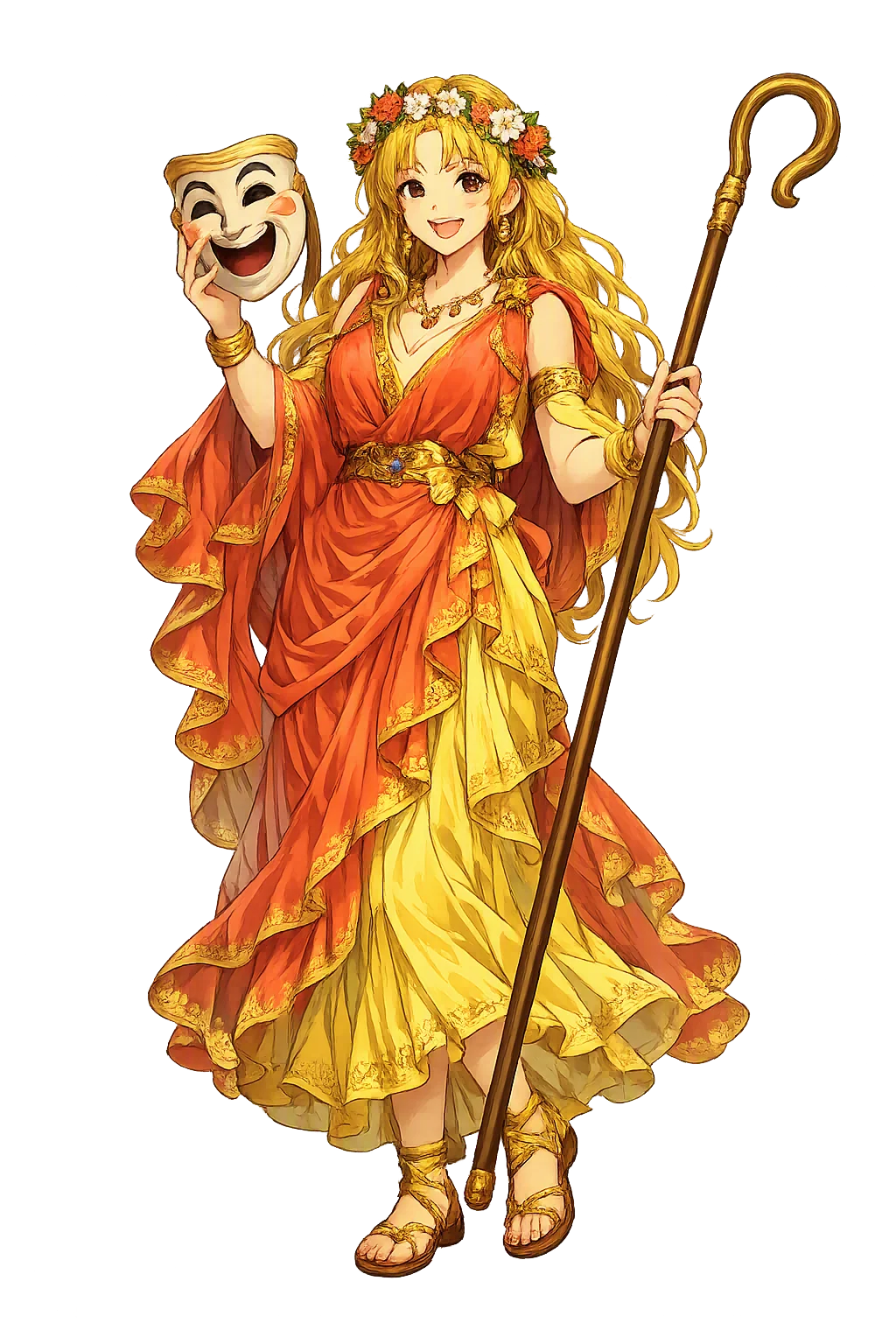
Tháleia is the Muse of comedy and idyllic poetry, one of the nine daughters Zeus fathered on Mnémosynē. Her name is the Greek word for flourishing — from θάλλω, 'to bloom' — and in the plural, θαλίαι, it means nothing less than festivities: the good cheer of the feast. The Greeks gave laughter a Muse, and they named her Blooming.
PuniCodex restores the name as Tháleia and serves its temple at tháleia.com. The original carries both stress and vowel length, and exactly one historically valid Unicode restoration exists, which places the name in Tier 1. The plain ASCII form thaleia survives as a modern convenience imposed by the early domain-name system; the restoration, not the fallback, is the form the project defends as philologically complete.
The Name
The name is attested in Greek as Θάλεια. Etymologically it means "Flourishing, blooming".
The ASCII form thaleia survives only because the early domain-name system could not carry diacritics; it is a technological compromise, not an ancient spelling. The Unicode restoration Tháleia recovers the stress accent of the original directly in the address bar. The original carries both stress and vowel length, and exactly one historically valid Unicode restoration exists, which places the name in Tier 1.
The letter-by-letter transformation runs:
- t → T — T uppercase
- h → h — h same
- a → á — Acute on a
- l → l — l same
- e → e — e same
- i → i — i same
- a → a — a same
The project holds the domain tháleia.com (xn--thleia-qta.com) as the canonical home of this name.
The Original Script
The name is written in Greek as Θάλεια. This original script is the form against which the ASCII fallback thaleia and the PuniCodex restoration Tháleia are measured: the restoration preserves its pitch accent of the written form, so that a reader typing the modern address still speaks the ancient name.
Pronunciation
The reconstructed pronunciation of the name is /ˈtʰa.leː.a/ — Attic Greek Reconstruction.
Phoneme by phoneme:
- Thá- — Theta was an aspirated t [tʰ] in classical Attic — a t with a puff of breath, never the English 'th' fricative; the acute marks the stress on this first syllable.
- -lei- — The digraph ει, a long closing diphthong shading toward [eː] — the sound the ASCII form 'Thalia' flattens into a bare 'ia'.
- -a — Final short alpha, light and open, a breath rather than a beat.
For the modern speaker, the closest approximation is: 'TAH-lay-ah' — begin with a breathy t as in 'top', lean on the first syllable, and let the 'ei' glide long; the English 'th' of Thalia has no place in the Greek.
Kindred and historical forms of the name:
- Greek — θάλλω (thállō), 'to bloom, sprout, abound'; θαλλός, the young green shoot; θαλίαι, 'festivities, banquets' — one root for green growth and good cheer
- PIE — likely from *dʰh₂l- 'to sprout, bloom' (Beekes); the wider cognate family remains debated
Tháleia is Tier 1 because the Greek Θάλεια carries both stress (the acute on the initial alpha) and length (the long diphthong ει). The restoration preserves both: the acute on the á marks the accent, and the digraph -ei- keeps the long diphthong that plain ASCII Thalia erases.
Mythology
Tháleia rarely acts alone: her myths are the myths of the Muses as a body. What the sources give us is her birth, her name, and one startling marriage — to Apollo, father of her dancing sons.
Nine Nights, Nine Daughters (Theogony)
Hesiod tells how Mnémosynē, Memory herself, lay with Zeus for nine nights and bore the nine Muses 'to be a forgetting of evils and a rest from cares' (Theogony 53–62). When he names them, Tháleia stands third: 'Kleiṓ and Eutérpē and Tháleia and Melpoménē' (Theogony 76–79). From the beginning, then, laughter and festivity are numbered among the daughters of Memory — comedy is not beneath remembrance but one of its gifts.
The Silencing of Thamyris (Iliad)
In Iliad 2 (594–600), the Catalogue of Ships pauses at Dōrion, where the Thracian singer Thamyris was stopped on his way from Oichalia. He had boasted he would outsing the Muses themselves; in their anger they maimed him, 'took away his divine song, and made him forget his lyre-playing.' The Muses act here as one undivided power — Tháleia among them — and their punishment is the precise opposite of their gift: not forgetting of cares, but forgetting of song.
Mother of the Corybantes (Apollodorus)
Apollodorus records that 'from Thaleia and Apollo were born the Corybantes' (Bibliotheca 1.3.4) — the ecstatic, armed dancers who clash their shields around the mountain mother. The notice is late and quietly astonishing: the Muse of comedy wed to the god of measure and the lyre, and their children are wild percussion and dance. Perhaps the genealogy knows something true — that laughter, music, and ecstatic motion are nearer kin than the genres pretend.
A Grace of the Same Name (The Other Tháleia)
The name flowers twice in Hesiod. A few hundred lines after the Muses, he names the Chárites born to Zeus and the Oceanid Eurýnomē: 'Aglaía and Euphrosýnē and lovely Thaleía' (Theogony 907–911). Pausanias (9.35) confirms that the cities of Greece disagreed about the Graces' names and number, and that Thaleia's place among them was old. The duplication is no scribal error: blooming belongs both to song and to grace, and Greek theology let one word keep both houses.
Symbols & Iconography
The iconography associated with Tháleia concentrates in a small set of recurring attributes, each a compressed statement about the name:
- Comic mask — Her defining attribute in ancient iconography — laughter given a face
- Shepherd's staff (pedum) — The bucolic world of idyllic poetry: flocks, shade, and song
- Ivy wreath — The plant of Dionysos, god of the theater where comedy was performed
- Comic slipper (soccus) — The low shoe of comic actors, set against tragedy's high cothurnus
- Frame drum — The tambourine of the Corybantes, the ecstatic dancers said to be her sons
Archaeology & Evidence
The great cult center of the Muses stood in the Valley of the Muses below Mount Helicon, near Thespiai, with its grove, its statues, and the Mouseia festival games; Pausanias (9.29–30) describes the sanctuary and the nearby spring Hippocrene at length. Tháleia herself survives visually on Roman-era Muses sarcophagi and mosaics, where she sits with the comic mask and shepherd's staff that became her invariable attributes. Comic masks further appear throughout theater-related dedications and Pompeian wall painting, the material trace of the genre she was believed to rule.
Realm & Domain
Tháleia is the Muse of comedy and idyllic poetry, one of the nine daughters Zeus fathered on Mnémosynē. Her name is the Greek word for flourishing — from θάλλω, 'to bloom' — and in the plural, θαλίαι, it means nothing less than festivities: the good cheer of the feast. The Greeks gave laughter a Muse, and they named her Blooming.
The Comic Mask
Her standing attribute in ancient art — the laughing face of the theater, held lightly in one hand.
The Shepherd's Staff
The crook of bucolic song, the green world of shepherds and idylls she was said to guard.
The Green Shoot
The θαλλός her name proclaims: fresh growth, festivity, the year turning toward abundance.
Across Cultures
Rome adopted the nine Musae almost without translation, and Thalia kept her Greek name; it was in late antique and Renaissance iconography that she was fixed once and for all as comedy's patron, mask in hand, one of the paired faces of the theater. Her namesake the Charis lived a parallel afterlife as one of the three Graces of Western art — Aglaia, Euphrosyne, and Thalia, the dancers of Botticelli's Primavera. Through her collective she passes into the very words 'music' and 'museum,' both children of the Greek Mousa.
Within the Greek tradition, closely related names in the corpus include Achérōn, Achilleús, Adámas, Aḗr, Aithḗr, and Anánkē.
Cultural Legacy
No common English noun descends from Tháleia's name alone — her legacy travels under other flags. She presides in spirit over Theocritus's Idylls, the bucolic poems that gave English the word 'idyll' for every scene of pastoral peace. Theaters bear her name — Hamburg's Thalia Theater most famously — and the paired masks of comedy and tragedy that still sign for the stage are, by long convention, hers and Melpoménē's. As a given name, Thalia has never gone out of use; the Muse of laughter is one of the few Greek deities people still name their daughters after.
The Scholarly Record
The account of Tháleia given in this edition rests on the witnesses and reference works listed below. Lexica and etymological dictionaries secure the form and meaning of the name; the literary and religious texts supply the narrative evidence.
- Liddell-Scott-Jones Greek-English Lexicon, 9th ed. with 1996 supplement, 1940. Full text
- Etymological Dictionary of Greek, 2 vols., Brill, 2010. Full text
- Hesiod, Theogony, Loeb Classical Library No. 57, 700 BCE. Full text
- Homer, Iliad.
- Apollodorus, Bibliotheca, Loeb Classical Library (Frazer), 150.
- Pausanias, Description of Greece, Loeb Classical Library, 180. Full text
A Meditation
Honesty requires a caveat: Hesiod assigns no spheres to the Muses. The tidy division — Tháleia for comedy, Melpoménē for tragedy, Kalliṓpē for epic — is a Hellenistic and Roman codification, unknown to the archaic sources, which treat the nine as one undivided choir. Yet the later assignment is not arbitrary decoration. That comedy receives a Muse at all is the telling fact: the Greeks did not rank laughter beneath song but placed both in the care of Memory's daughters, performed together at the festivals of Dionysos.
Her name carries the argument further. Θάλλω is what the green world does in spring — and in the plural, θαλίαι is what the feast does in winter. One root holds vegetation and celebration together, as if the Greeks suspected that festivity is simply abundance made audible. A Muse named Blooming says that comedy is not escape from the serious world but its renewal: the year, and the city, flowering again.
The Unicode Restoration
Tháleia is classified as Tier 1: the original carries both stress and length, and only one valid Unicode restoration exists. The ASCII fallback thaleia still resolves everywhere, but it is the restored form that carries the name's full information. Across the 7 characters of the name, the restoration adjusts 1: 1 mark of stress (á). That is the whole thesis of this temple: the marks are the message.
Character by Character
The journey from thaleia to Tháleia, one character at a time:
- t → T — T uppercase
- h → h — h same
- a → á — Acute on a
- l → l — l same
- e → e — e same
- i → i — i same
- a → a — a same
The Domain Name
The restored name is live as a working domain: tháleia.com, which the DNS carries in punycode form as xn--thleia-qta.com — an ASCII-compatible encoding that lets a non-ASCII name travel the global network without breaking older infrastructure. The visitor sees Tháleia; the machines see the encoding. That duality is the engineering compromise on which the entire restoration rests, and it is why a name written the way its own tradition wrote it in Greek can now be typed into any browser on earth.
The Greek Pantheon
Tháleia is one of 266 entries the PuniCodex lexicon catalogues under the Greek pantheon. The Pantheon page gathers the tradition's major figures in one place, and the Lexicon lets you filter all 925 restorations by tradition, tier, or script — the fastest way to see where this name sits among its kin.
Frequently Asked Questions
What does Tháleia mean? The traditional gloss is "Flourishing, blooming."
Which tradition does Tháleia belong to? Tháleia is catalogued in the Greek pantheon of the PuniCodex lexicon.
Why is Tháleia classified as Tier 1? Because the original carries both stress and length, and only one valid Unicode restoration exists — and the marks in the restored spelling preserve exactly that evidence.
Is Tháleia a working domain? Yes — tháleia.com resolves today and routes to this temple.
What is the punycode for tháleia.com? The DNS encoding is xn--thleia-qta.com; browsers perform the translation automatically, so visitors only ever see the restored name.
Typing Tháleia
You do not need a special keyboard to use this restoration. The PuniCodex Type Tool converts the ASCII form thaleia into Tháleia as you type, and the browser extension offers the same conversion inside any text field. Copy the restored form, paste it into the address bar, and the DNS does the rest.
Sister Temples
Other temples in the Greek pantheon include Phoînix, Podalírius, and Pónos — each with its own restoration story, its own scholarly record, and its own place in the lexicon.
Why This Restoration Matters
A door only matters if people walk through it. tháleia.com is open, and everything behind it — the myths, the scholarship, the canvas, the patrons — hangs on the restored spelling. The PuniCodex project bets that the web will make room for names as they were actually written, and Tháleia is one of its standing proofs. Visit, share, cite, type it yourself: each use is a small rehearsal for a web where no name has to hide its marks to be found.
Explore Further
This post is one doorway into the temple. The home page carries the full character breakdown and the ambient canvas; the lore page tells the myths in long form; the Scholarly Edition preserves the sources, pronunciation data, and revision history; and the patron wall supports the restoration directly. For the wider map, browse the Lexicon, explore the Pantheon, or return to the PuniCodex blog.
Related Names
Sources
The full scholarly apparatus — every citation, revision, and review — lives in the Scholarly Edition. Key references for this post:
- Liddell-Scott-Jones Greek-English Lexicon, 9th ed. with 1996 supplement, 1940.
- Etymological Dictionary of Greek, 2 vols., Brill, 2010.
- Hesiod, Theogony, Loeb Classical Library No. 57, 700 BCE.
- Pausanias, Description of Greece, Loeb Classical Library, 180.
- Homer, Iliad.
- Apollodorus, Bibliotheca, Loeb Classical Library (Frazer), 150.
- Lexicon authorities for this entry: Hesiod, LSJ.