
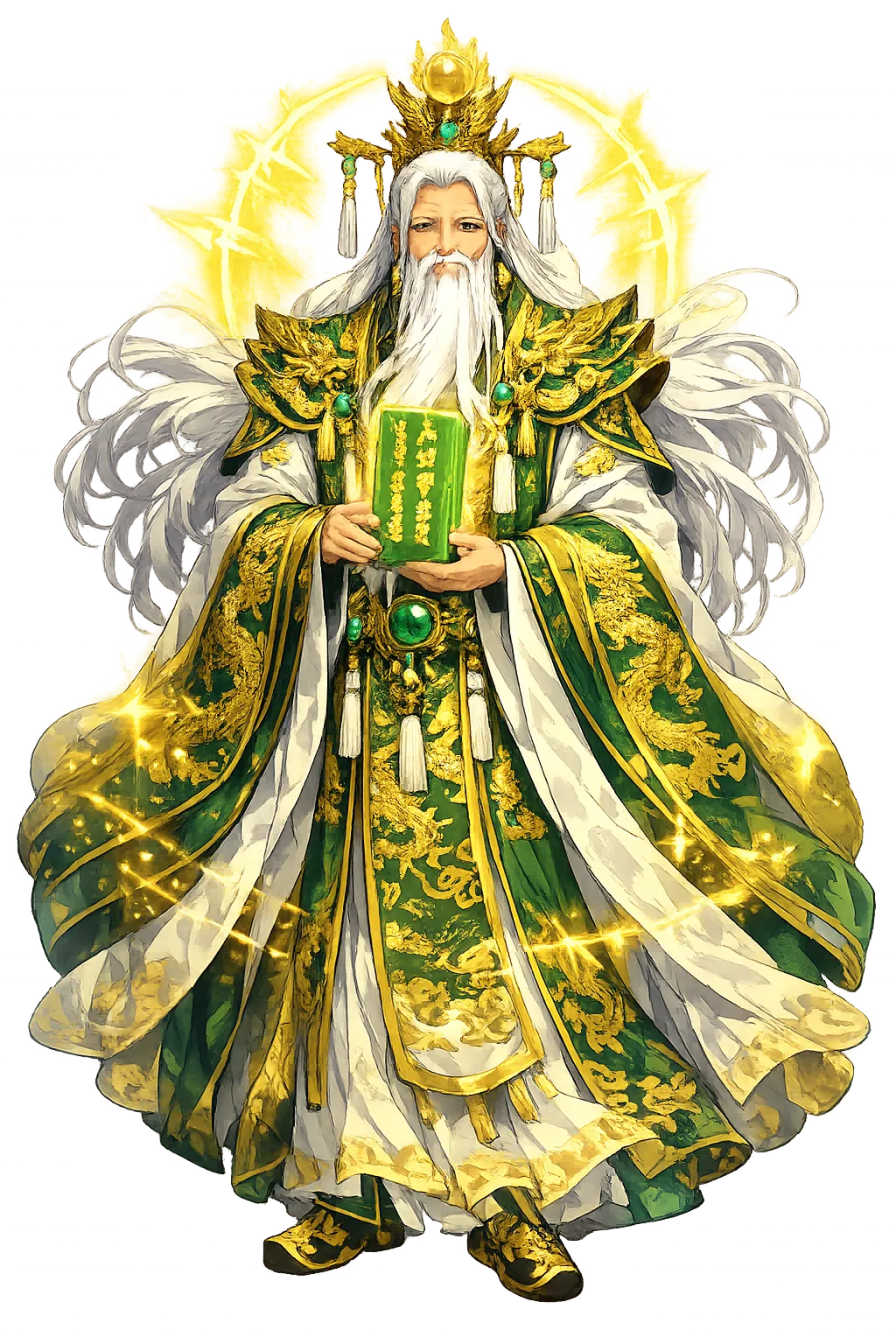
From Chinese characters to Unicode: the journey of Tàishàng
Long before it was a domain, this name traveled through scripts. Tàishàng begins in Chinese characters, passes through scholarly transliteration, and ends — for now — inside the punycode machinery of the global DNS. Each stage of that journey preserves some information and loses some, and the craft of restoration is knowing exactly which marks matter. This post follows the name stage by stage: the original script, the reconstructed pronunciation, the mythological record, the material evidence, and finally the Unicode form that carries all of it into the address bar. Think of it as a biography of a name, told through its spelling.
At a Glance
- Restored name: Tàishàng
- ASCII form: taishang
- Meaning: "Supreme, great"
- Domain of influence: Supreme Lord, Dao
- Pantheon: Chinese
- Classification: Tier 1
- Original script: 太上 (Chinese characters)
- Live domain: tàishàng.com
Overview
Tàishàng (taishang) — Supreme Lord, Dao · Supreme, great — belongs to the Chinese tradition, where it is catalogued under the domain "Supreme Lord, Dao". The name means "Supreme, great".
Tàishàng names the supreme station in Daoist cosmology. In its fullest form, Tàishàng Lǎojūn (Supreme Lord Lao) is the deified Laozi, the legendary author of the Dàodéjīng, elevated into one of the Three Pure Ones who stand at the summit of the Daoist pantheon. Where the historical Laozi taught wordless wisdom, the celestial Tàishàng Lǎojūn dispenses scriptures, elixirs, and revelations.
He is not a creator god in the Western sense. He is the personification of the Dao in its highest, most hidden aspect — the origin that cannot be named, named.
PuniCodex restores the name as Tàishàng and serves its temple at tàishàng.com. The original carries both stress and vowel length, and exactly one historically valid Unicode restoration exists, which places the name in Tier 1. The plain ASCII form taishang survives as a modern convenience imposed by the early domain-name system; the restoration, not the fallback, is the form the project defends as philologically complete.
The Name
The name is attested in Chinese characters as 太上. Etymologically it means "Supreme, great".
The ASCII form taishang survives only because the early domain-name system could not carry diacritics; it is a technological compromise, not an ancient spelling. The Unicode restoration Tàishàng recovers the stress accent of the original directly in the address bar. The original carries both stress and vowel length, and exactly one historically valid Unicode restoration exists, which places the name in Tier 1.
The letter-by-letter transformation runs:
- t → T — Same, capitalized
- a → à — Stress on a
- i → i — Same
- s → s — Same
- h → h — Same
- a → à — Stress on a
- n → n — Same
- g → g — Same
The project holds the domain tàishàng.com (xn--tishng-itad.com) as the canonical home of this name.
The Original Script
The name is preserved in Chinese characters as 太上 — Hanzi (Sino-Tibetan), a script tradition attested from the oracle bones (c. 1200 BCE) to the present; both graphs are identical in traditional and simplified forms. The script is written left-to-right in modern usage, top-to-bottom in traditional layout.
The scholarly transliteration is Tàishàng (Hanyu Pinyin with tone marks), giving the normalized reading /tʰaɪ̯˥˩ ʂɑŋ˥˩/.
The rendering proceeds step by step:
- 太 'utmost, supreme' is 大 'great' — the drawing of a spread-limbed person — with one added stroke marking the superlative; early manuscripts commonly write the word with plain 大, as the Guodian text Tàiyī shēng shuǐ writes 太一 as 大一.
- 上 'above, on high' is one of the script's pure ideographs: a short stroke set over a long baseline, 'that which is on top'. The Shuowen Jiezi glosses it 高也 'high' and classes it as an indicative (指事) graph.
- Hanyu Pinyin with tone marks preserves the Modern Standard Mandarin reading, Tàishàng (Tone 4 + Tone 4); the ASCII form taishang loses the tones.
- The registrable Unicode restoration Tàishàng keeps the tone marks so the domain label remains pronounceable and unambiguous, while the temple's Original Script card displays the characters themselves.
Baxter & Sagart (2014) reconstruct the Old Chinese reading of 太 as *l̥a[t]-s, preserving a final consonant cluster that modern Mandarin has long since shed.
Pronunciation
The reconstructed pronunciation of the name is /tʰaɪ̯˥˩ ʂɑŋ˥˩/ — Modern Standard Mandarin (Pinyin).
Phoneme by phoneme:
- tài — Aspirated alveolar stop [tʰ], diphthong [aɪ̯], and Tone 4 (falling, ˥˩). Pinyin 't' before front vowels is aspirated [tʰ].
- shàng — Voiceless retroflex fricative [ʂ], open back vowel [ɑ] with velar nasal [ŋ], and Tone 4 (falling, ˥˩). Mandarin 'sh' is a retroflex, the tongue curled back, not the English palato-alveolar 'sh'.
For the modern speaker, the closest approximation is: TIE-SHUHNG — 'tai' like 'tie' with a sharp falling tone, 'shang' with a retroflex 'sh' and a falling tone.
Kindred and historical forms of the name:
- Traditional — 太上
- Full title — 太上老君 Tàishàng Lǎojūn, the deified Laozi and Lord of the Dao.
- Wade-Giles — t'ai⁴-shang⁴
- Related terms — 道教 Dàojiào (Daoism); 三清 Sānqīng (Three Pure Ones)
太上 means 'Supreme, Most Exalted.' In Daoist theology it is the title of the deified Laozi as Tàishàng Lǎojūn, one of the Sānqīng (Three Pure Ones). The Modern Standard Mandarin reading, tài (Tone 4) + shàng (Tone 4), is recorded in the Unihan Database (kMandarin); the Pinyin restoration Tàishàng preserves both citation tones.
Mythology
Tàishàng's mythology moves between history and cosmology: the shadowy philosopher Laozi becomes the celestial teacher who reveals the Dao to emperors, hermits, and alchemists.
Laozi Leaves the Pass (Hagiography)
According to tradition, Laozi grew weary of the Zhou court and rode west on a black ox. At the Hangu Pass the guard Yīn Xī recognised him and asked for a teaching. Laozi wrote the five thousand characters of the Dàodéjīng, then disappeared into the west. Later Daoism transformed this departure into an ascension: Laozi became Tàishàng Lǎojūn, the supreme immortal.
The Conversion of the Barbarians (Revelation)
Medieval Daoist apocrypha claimed that Tàishàng Lǎojūn travelled west and transformed himself into the Buddha in order to convert the barbarians. The myth was a polemical attempt to place Daoism above Buddhism by making the Buddha a manifestation of Laozi. Though historically tendentious, it reveals the prestige Tàishàng held in medieval Chinese religion.
One of the Three Pure Ones (Cosmology)
In formal Daoist theology, the Three Pure Ones (Sānqīng) personify the three stages of cosmic emanation. Tàishàng Lǎojūn corresponds to the third, the manifested Dao, the teacher who brings the formless principle into human language. Above him are YUánshǐ Tiānzūn and Língbǎo Tiānzūn, the even more primordial personifications of the Dao itself.
Symbols & Iconography
The iconography of Tàishàng concentrates in a small set of recurring attributes, each a compressed statement about the deity. In the standard Ming-and-later image, Tàishàng Lǎojūn appears as a white-bearded elder enthroned in the Heaven of Great Clarity:
- Palm-leaf fan — The plain fan with which he stirs the alchemical fire; his constant attribute in painting and temple statuary.
- Eight-trigram furnace — The bāguà crucible in which elixirs are refined; in the Journey to the West Sun Wukong survives forty-nine days sealed inside it and emerges with fiery, golden eyes.
- Gourd of elixir — The bottle that holds the medicine of immortality and the hidden medicine of the Dao.
- Crane — Longevity and the celestial mount that carries the immortal to heaven.
- Tàijí disc — The supreme polarity from which yin and yang unfold, enthroned behind the Three Pure Ones.
The ruyi sceptre that appears in some images is the shared badge of divine authority among the Sānqīng rather than his exclusive sign: among the Three Pure Ones it is Yuánshǐ Tiānzūn who characteristically holds the ruyi or a pearl, while Tàishàng Lǎojūn holds the fan.
Archaeology & Evidence
The deification of Laozi is a documented process rather than a legendary blur. The oldest extant manuscripts of his book are the Guodian bamboo slips, excavated in 1993 from a Chu tomb closed around 300 BCE — three short bundles matching parts of the received Dàodéjīng; the Mawangdui silk texts (tomb sealed 168 BCE) give the full text twice, with the Dé half preceding the Dào. The imperial cult is epigraphic and dated: Han inscriptions already honour Lǎojūn, and in 666 CE the Táng emperor Gāozōng — whose house claimed Laozi (Lǐ Ěr) as its ancestor — granted him the title Xuányuán Huángdì 玄元皇帝, 'August Emperor of the Mysterious Origin'. Temples dedicated to Tàishàng Lǎojūn survive across China and the diaspora: Lóuguāntái in the Zhōngnán mountains, traditionally the place where Laozi taught Yīn Xǐ, and the Qīngyáng Gōng in Chengdu are the best known.
Realm & Domain
Tàishàng names the supreme station in Daoist cosmology. In its fullest form, Tàishàng Lǎojūn (Supreme Lord Lao) is the deified Laozi, the legendary author of the Dàodéjīng, elevated into one of the Three Pure Ones who stand at the summit of the Daoist pantheon. Where the historical Laozi taught wordless wisdom, the celestial Tàishàng Lǎojūn dispenses scriptures, elixirs, and revelations.
He is not a creator god in the Western sense. He is the personification of the Dao in its highest, most hidden aspect — the origin that cannot be named, named.
The Dao Itself
He embodies the nameless source from which heaven and earth arise.
Lord of Scriptures
Revealer of the Dàodéjīng and countless Daoist texts and talismans.
Alchemy and Elixirs
Patron of internal and external alchemy, longevity, and the pursuit of immortality.
Teacher of Emperors
Legendary instructor of sage-kings and source of imperial legitimacy.
Across Cultures
Tàishàng Lǎojūn is the Daoist answer to the question of how a philosophy becomes a religion. The historical Laozi, if he existed, was a thinker; Tàishàng Lǎojūn is a god. This transition mirrors the broader Chinese pattern of deifying sages, from Confucius to Guān Yǔ. Buddhism influenced the structure of his cult — the Three Pure Ones parallel Buddhist trikāya theology — while popular religion absorbed him into a vast pantheon of immortals, city gods, and celestial bureaucrats. In the West, Laozi is often read as a purely philosophical figure, but in Chinese temples he is honoured with incense, images, and prayers for longevity.
Within the Chinese tradition, closely related names in the corpus include [[bagua|Bāguà]], [[long|Lóng]], [[taichi|Tàijí]], [[tian|Tiān]], [[tiandi|Tiāndì]], and [[wuxing|Wǔxíng]].
Cultural Legacy
Tàishàng's legacy is inseparable from the Dàodéjīng, one of the most translated books in world literature. As Tàishàng Lǎojūn, he presides over Daoist temples, alchemical traditions, and popular practices of longevity and exorcism. His image appears in countless paintings, statues, and New Year prints, often riding a crane or holding a ruyi. Modern Daoist movements, martial-arts lineages, and global wellness culture all claim some connection to Laozi, though the sage would likely smile at the irony. The name Tàishàng has also become an adjective of highest rank, applied to emperors, elders, and even video-game bosses.
The Scholarly Record
The account of Tàishàng given in this edition rests on the witnesses and reference works listed below. Lexica and reference databases secure the form and reading of the name; the literary and religious texts supply the narrative and theological evidence.
- Laozi, Daodejing (Tao Te Ching).
- Daozang (Daoist Canon).
- Sima Qian, Shiji (Records of the Grand Historian), Laozi biography.
- Laozi Xiang'er zhu (Xiang'er commentary on the Daodejing).
- Taishang Ganying Pian (Treatise of the Most Exalted on Action and Response).
- Laozi Huahu Jing (Scripture of the Conversion of the Barbarians).
- Bokenkamp, Early Daoist Scriptures.
- Kohn, Daoism and Chinese Culture.
- Zürcher, The Buddhist Conquest of China.
- Allan & Williams (eds.), The Guodian Laozi (2000).
- Pregadio, The Encyclopedia of Taoism.
- Unihan Database (Unicode Consortium). Full text
A Meditation
Tàishàng is the teaching that cannot be taught. The Dàodéjīng opens by saying that the Dao that can be spoken is not the eternal Dao, and yet the text goes on to speak of it for eighty-one brief chapters. Tàishàng Lǎojūn is the figure who resolves this paradox by embodying it: he is the sage who became a god by disappearing into the teaching he left behind.
To sit with Tàishàng is to practice not-knowing. It is to recognise that the more names we give to the ultimate, the further we stray from it, and yet that naming is itself a kind of devotion. The gourd, the ruyi, the crane — these are not idols but reminders. The real Tàishàng is the silence between the words of the Dàodéjīng, the emptiness that makes the vessel useful.
The Unicode Restoration
Tàishàng is classified as Tier 1: the original carries both stress and length, and only one valid Unicode restoration exists. The ASCII fallback taishang still resolves everywhere, but it is the restored form that carries the name's full information. Across the 8 characters of the name, the restoration adjusts 2: 2 marks of stress (à, à). That is the whole thesis of this temple: the marks are the message.
Character by Character
The journey from taishang to Tàishàng, one character at a time:
- t → T — Same, capitalized
- a → à — Stress on a
- i → i — Same
- s → s — Same
- h → h — Same
- a → à — Stress on a
- n → n — Same
- g → g — Same
The Domain Name
The restored name is live as a working domain: tàishàng.com, which the DNS carries in punycode form as xn--tishng-itad.com — an ASCII-compatible encoding that lets a non-ASCII name travel the global network without breaking older infrastructure. The visitor sees Tàishàng; the machines see the encoding. That duality is the engineering compromise on which the entire restoration rests, and it is why a name written the way its own tradition wrote it in Chinese characters can now be typed into any browser on earth.
The Chinese Pantheon
Tàishàng is one of 43 entries the PuniCodex lexicon catalogues under the Chinese pantheon. The Pantheon page gathers the tradition's major figures in one place, and the Lexicon lets you filter all 895 restorations by tradition, tier, or script — the fastest way to see where this name sits among its kin.
Frequently Asked Questions
What does Tàishàng mean? The traditional gloss is "Supreme, great."
Which tradition does Tàishàng belong to? Tàishàng is catalogued in the Chinese pantheon of the PuniCodex lexicon.
Why is Tàishàng classified as Tier 1? Because the original carries both stress and length, and only one valid Unicode restoration exists — and the marks in the restored spelling preserve exactly that evidence.
Is Tàishàng a working domain? Yes — tàishàng.com resolves today and routes to this temple.
What is the punycode for tàishàng.com? The DNS encoding is xn--tishng-itad.com; browsers perform the translation automatically, so visitors only ever see the restored name.
Typing Tàishàng
You do not need a special keyboard to use this restoration. The PuniCodex Type Tool converts the ASCII form taishang into Tàishàng as you type, and the browser extension offers the same conversion inside any text field. Copy the restored form, paste it into the address bar, and the DNS does the rest.
Sister Temples
Other temples in the Chinese pantheon include Bodhidharma, and Kǒngzǐ — each with its own restoration story, its own scholarly record, and its own place in the lexicon.
Why This Restoration Matters
Every stage of the journey from Chinese characters to Unicode was an act of care: the scribe who first wrote the name, the lexicographer who glossed it, the engineer who taught the DNS to carry it. The PuniCodex restoration is the latest stage, not the last word — the Scholarly Edition is revised as the evidence improves. What does not change is the principle: a name deserves to be written the way its own tradition wrote it. Tàishàng in the address bar is that principle, made routable.
Explore Further
This post is one doorway into the temple. The home page carries the full character breakdown and the ambient canvas; the lore page tells the myths in long form; the Scholarly Edition preserves the sources, pronunciation data, and revision history; and the patron wall supports the restoration directly. For the wider map, browse the Lexicon, explore the Pantheon, or return to the PuniCodex blog.
Related Names
Sources
The full scholarly apparatus — every citation, revision, and review — lives in the Scholarly Edition. Key references for this post:
- Unihan Database (Unicode Consortium), kMandarin readings for U+592A 太 and U+4E0A 上.
- Baxter & Sagart, Old Chinese: A New Reconstruction (2014).
- Zuozhuan (Chunqiu Zuozhuan), Duke Xiang 24.
- Laozi, Daodejing, chapter 17.
- Laozi, Daodejing (Tao Te Ching).
- Daozang (Daoist Canon).
- Sima Qian, Shiji (Records of the Grand Historian), Laozi biography.
- Xu Shen, Shuowen Jiezi.
- Lexicon authorities for this entry: Dao De Jing, Daoist Canon.