
Reading Ragnarǫk the way it was meant to be written
There is a version of this name the early internet had to settle for: ragnarok. This is the file on how Ragnarǫk replaced it.
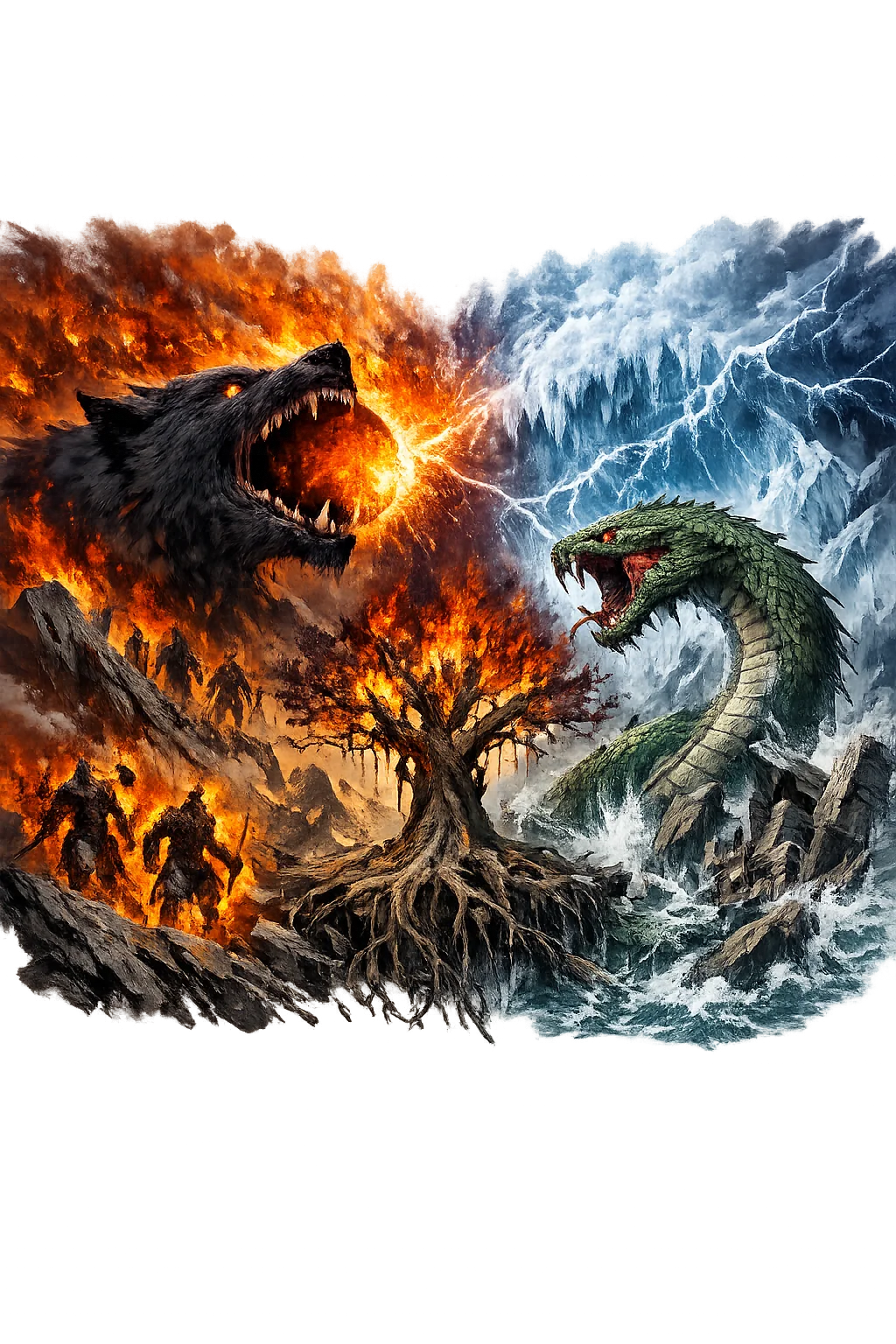
Ragnarǫk is the doom of the gods, the final destruction and renewal of the cosmos foretold in the Poetic Edda and elaborated by Snorri. It begins with fimbulvetr, three winters with no summer, followed by the breaking of bonds: the wolf Fenrir slips his chains, the serpent rises from the sea, and Loki sails a ship of nails from the dead. The gods gather on Vígríðr, but even their courage cannot prevent the sun from darkening, the stars from falling, and the world-tree from trembling. Ragnarǫk is not pure annihilation; after the destruction, the earth rises again, green and fertile. Baldr and Hǫðr return, a human pair named Líf and Lífþrasir repopulate the world, and the sun's daughter takes her mother's place. The myth therefore encodes a Norse theology of cosmic renewal as well as ending. On the plain Vígríðr, the forces of chaos meet the Æsir in the last battle. Fenrir swallows Óðinn, who is avenged by his son Víðarr; Þórr slays the Miðgarðsormr but staggers nine paces and dies of its venom.
That is the figure this file is about — and the temple now standing at its restored name.
At a Glance
- Restored name: Ragnarǫk
- ASCII form: ragnarok
- Meaning: "Twilight of the gods (from ragna + rǫk)"
- Domain of influence: Doom of the Gods
- Pantheon: Norse
- Classification: Tier 1
- Original script: ᚱᛅᚴᚾᛅᚱᚢᚴ
- Series: The Restoration Files, No. 207 of 271
The Name Before the Marks
Ragnarǫk preserves its form without added diacritics: the restoration here is the exactness of the spelling itself, the form the tradition's own sources record. ragnarok and Ragnarǫk may look interchangeable to a search box; they are not interchangeable to a philologist.
The Temple That Stands Now
The restored name is not a plaque; it is an address. The temple of Ragnarǫk lives at /sites/ragnarok/, with its mythology in the lore halls, its peer-reviewed record in the Scholarly Edition, and its place in the pattern atlas on the patterns floor.
The restoration preserves more than the ASCII form can say — stress, length, or a letter the Latin keyboard lost — which places it in Tier-1: mechanically verifiable, information-rich.
Every flagship temple is hand-built to the same standard: the original script displayed with its provenance, the pronunciation reconstructed phoneme by phoneme, the sources named — because a restoration you cannot audit is just a spelling with confidence.
The Archetype at Work
A temple is also a reading of what this figure means — and meanings have addresses in the modern world. The pattern atlas maps Ragnarǫk to the industries its archetype genuinely resonates with, each match argued, weighted, and open to challenge:
- Disaster Resilience & Recovery — The world destroyed and risen green from the sea; recovery as cosmic doctrine.
- Gaming, Fantasy & Entertainment IP — God of War Ragnarök and Thor: Ragnarok made the doom of the gods a franchise event.
- AI, Data & Predictive Intelligence — A doom foretold with watchable warning signs; Völuspá is prediction's oldest text.
If a match here reads wrong, the atlas says how to challenge it. The patterns are falsifiable — that is what makes them worth publishing.
In the Sacred Texts
The Norse tradition is not a vibe; it is a library. The Sacred Texts collection holds Poetic Edda and Prose Edda — the primary sources the temple's scholarship is built on, free to read, cross-linked back to the names they mention. The temple is the argument; the texts are the evidence.
The File Continues
This is one of 271 Restoration Files — a second dispatch from every flagship temple in the fleet. The temple's first dispatch tells the founding story of the name; the blog index holds the whole archive.
Continue the series — previous file: Rādhā (read it here) · next file: Rāma (read it here).
The Restoration Files are written from the same canonical record as the temples themselves: the lexicon, the lore catalog, the pattern atlas, and the cited scholarly sources. If a file ever disagrees with its temple, the temple is right — tell us, and the file will be corrected.