
Ancient Domain
In the norse tradition, Ragnarǫk governed doom of the gods. The name encodes a sphere of power that shaped ritual, narrative, and social order.
Extended Lore
Etymology · Phonology · Orthography · Cultural Legacy · Primary Sources
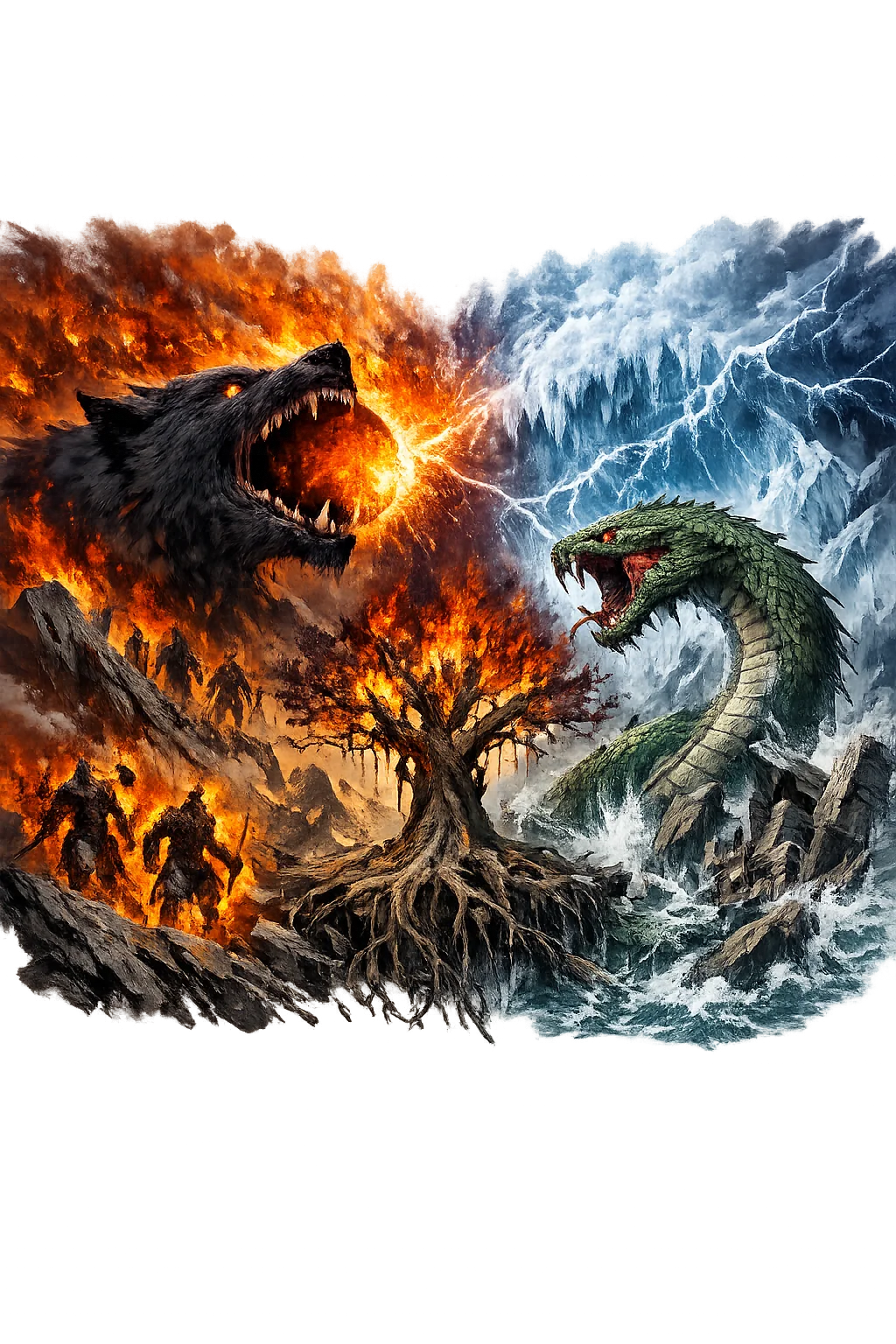
Essential information about Ragnarǫk, Doom of the Gods
From original script to Unicode restoration
Ragnarǫk is Tier 2: the o-hook (ǫ) preserves a distinct Old Norse rounded vowel, but there is no length or stress mark. The popular modern form Ragnarök normalises the ǫ to ö; both are registrable, but ǫ is the more conservative medieval spelling.
Character-by-character philological analysis
| Character | Unicode | Name | Block | Phonetic Role |
|---|---|---|---|---|
| R | U+0052 | Latin Capital Letter R | Basic Latin | Same |
| a | U+0061 | Latin Small Letter A | Basic Latin | Same |
| g | U+0067 | Latin Small Letter G | Basic Latin | Same |
| n | U+006E | Latin Small Letter N | Basic Latin | Same |
| a | U+0061 | Latin Small Letter A | Basic Latin | Same |
| r | U+0072 | Latin Small Letter R | Basic Latin | Same |
| ǫ | U+01EB | Latin Small Letter O with Ogonek | Latin Extended-B | O-hook: short /ɔ/ vowel |
| k | U+006B | Latin Small Letter K | Basic Latin | Same |
The Tier 2 classification reflects which ancient features stress, length, or script are preserved in this restoration.
From ancient cult to modern Unicode
In the norse tradition, Ragnarǫk governed doom of the gods. The name encodes a sphere of power that shaped ritual, narrative, and social order.
Norse tradition absorbed and reworked Germanic, Celtic, and Christian influences; medieval Icelandic compilers preserved the myths while Christian frameworks shaped their presentation.
The name lives on in modern fantasy, Neopagan practice, Scandinavian heritage, and the global reception of Viking-Age literature. Restoring Ragnarǫk in Unicode preserves the name's cultural specificity against the flattening force of plain ASCII. Ragnarǫk has become shorthand for any apocalyptic scenario, from environmental collapse to nuclear war. The Old Norse form with its technical spelling reminds us that the myth was also a theology of renewal, not merely an end.
Restoring Ragnarǫk in a domain name is more than orthographic accuracy. It is a statement that the internet should recognize the full range of human writing — not only the ASCII keyboard.
Common questions about Ragnarǫk, Doom of the Gods, and Unicode restoration
In reconstructed pronunciation, Ragnarǫk is /ˈraɣ.naˌrɔk/ — approximately 'RAGH-na-rok' — the middle consonant is a throaty 'gh', and the final vowel is a short, rounded 'o' like 'hot'..
Ragnarǫk means Twilight of the gods (from ragna + rǫk) in the norse tradition.
Ragnarǫk is associated with Gjallarhorn (Heimdallr's horn whose blast announces the beginning of the end), Fenrir's jaws (The bound wolf that breaks free and devours Odin), Mjöllnir and Leviathan (The final blows exchanged by Þórr and Miðgarðsormr), World-ash in flames (Yggdrasil shaken and burned as the cosmos collapses), Dawn of the new sun (The reborn world rising after the flood and fire have passed).
Plain ASCII ragnarok strips the stress, length, and script that make the name specific. Unicode restoration returns the name to its original written dignity.
On the plain Vígríðr, the forces of chaos meet the Æsir in the last battle. Fenrir swallows Óðinn, who is avenged by his son Víðarr; Þórr slays the Miðgarðsormr but staggers nine paces and dies of its venom. Surtr's fire spreads across the world, and the earth sinks into the sea.The battle is not a simple victory of good over evil but the collapse of an entire cosmic order. Every pairing of enemies is also a pairing of fated kin: gods and giants are descended from the same primordial matter, and their mutual destruction clears the ground for whatever comes next.
The philological foundations of this restoration
Every claim on this page is grounded in established scholarship. The orthographic restorations follow disciplinary convention. The etymological chain follows the best available reference works. This is not invention — it is resurrection through scholarship.
You have traced the name from its earliest attestation to its Unicode restoration. Now return to the myth. The story is where the name lives.
Back to Lore