
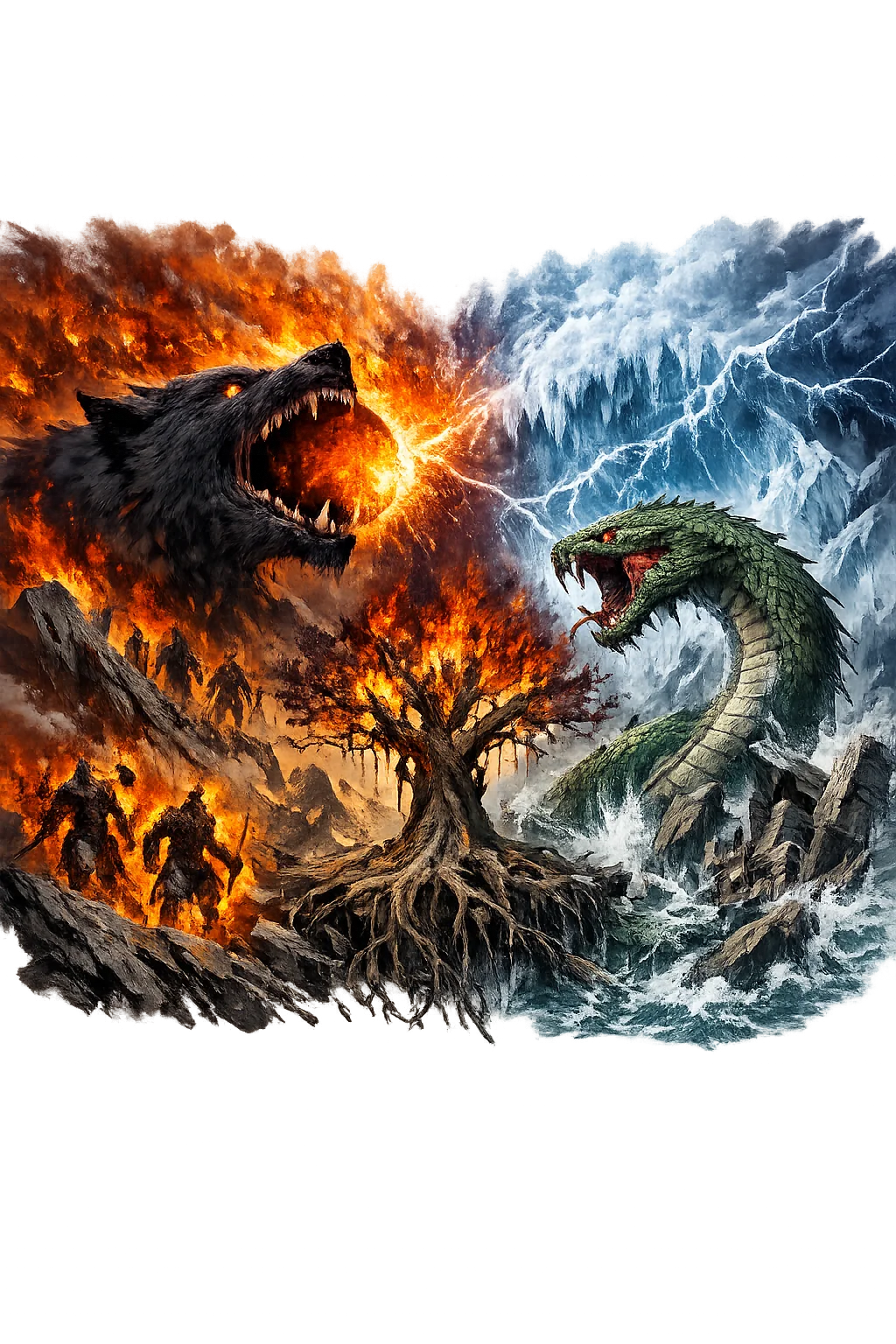
Ragnarǫk at work: disaster resilience & recovery, gaming, fantasy & entertainment ip, and the myths that got there first
The myths did not retire. They moved offices. This is the file on where Ragnarǫk works now.
Ragnarǫk is the doom of the gods, the final destruction and renewal of the cosmos foretold in the Poetic Edda and elaborated by Snorri. It begins with fimbulvetr, three winters with no summer, followed by the breaking of bonds: the wolf Fenrir slips his chains, the serpent rises from the sea, and Loki sails a ship of nails from the dead. The gods gather on Vígríðr, but even their courage cannot prevent the sun from darkening, the stars from falling, and the world-tree from trembling. Ragnarǫk is not pure annihilation; after the destruction, the earth rises again, green and fertile. Baldr and Hǫðr return, a human pair named Líf and Lífþrasir repopulate the world, and the sun's daughter takes her mother's place. The myth therefore encodes a Norse theology of cosmic renewal as well as ending.
The pattern atlas — which maps every flagship temple to the industries its archetype demonstrably resonates with, each match argued and open to challenge — seats this temple in 4 industries. This file reads those seats the way they were earned: through the myths.
At a Glance
- Temple: Ragnarǫk
- Pantheon: Norse
- Domain of influence: Doom of the Gods
- Pattern seats: 4
- Sectors touched: Commerce & Governance · Culture & Entertainment · Technology & Innovation · Energy & Natural World
- Strongest seat: Disaster Resilience & Recovery
- Series: The Resonance Files, No. 207 of 271
The Myth at Work
The Battle of Vígríðr. On the plain Vígríðr, the forces of chaos meet the Æsir in the last battle. Fenrir swallows Óðinn, who is avenged by his son Víðarr; Þórr slays the Miðgarðsormr but staggers nine paces and dies of its venom. — that is not just a story. It is a business model, four thousand years early.
The Renewal. After the fire subsides, the earth rises again from the sea, green and fertile. The surviving gods Höðr and Baldr return from Helheimr, and a few gods gather at Iðavöllr where Ásgarðr once stood. — hold that image; the industries below are where it goes to work.
The Seats
Each of these is argued in the atlas with a weight and a why-line. What the atlas cannot fit in one line is the whole myth — so here is each seat with its story restored.
Disaster Resilience & Recovery
Emergency management, recovery, and business continuity. (Sector: Commerce & Governance)
The why-line says it in one breath: The world destroyed and risen green from the sea; recovery as cosmic doctrine. That is not a resemblance; it is the same act, performed in a newer building.
Gaming, Fantasy & Entertainment IP
Video games, streaming franchises, and fantasy worlds. (Sector: Culture & Entertainment)
God of War Ragnarök and Thor: Ragnarok made the doom of the gods a franchise event. Swap the costume and the sentence is indistinguishable from the myth. That is what a resonance seat means.
AI, Data & Predictive Intelligence
Machine intelligence, analytics, and prediction markets. (Sector: Technology & Innovation)
A doom foretold with watchable warning signs; Völuspá is prediction's oldest text. — the atlas stops there, out of discipline. The myth keeps going: the function Ragnarǫk performs in the stories is precisely the function this industry sells.
Environmental & Climate Services
Climate science, ecology, and sustainability consulting. (Sector: Energy & Natural World)
Modern shorthand for environmental collapse — the apocalypse with a renewal clause. — the atlas stops there, out of discipline. The myth keeps going: the function Ragnarǫk performs in the stories is precisely the function this industry sells.
Read the myth again after the seats and it stops sounding ancient: Ragnarǫk is the doom of the gods, the final destruction and renewal of the cosmos foretold in the Poetic Edda and elaborated by Snorri. The age changed. The work did not.
The Method, Stated Plainly
None of this is numerology. A seat exists only where the match can be argued from the deity's documented domains and deeds — weighted, published, and falsifiable. The full derivation, the weights, and the challenge process are public on the methodology page. If a seat in this file reads wrong, the atlas itself tells you how to prove it — and the correction becomes part of the record.
For the Ones Who Work There
If you work in disaster resilience & recovery, gaming, fantasy & entertainment ip, or any trade this temple holds a seat in, this is the honest version of what a placement means: your industry beside the story it has been re-telling all along — on the temple floor itself, before an audience that came specifically to read it. The patron tier and the advertising terms describe the mechanics; the resonance above describes the fit. The story is the pitch; the seats are just where it already works.
The File Continues
This is one of 271 Resonance Files — the third dispatch from every flagship temple, where the myths meet the markets. The temple's founding dispatch tells the name's story; its Restoration File tells the spelling's; the blog index holds the whole archive.
Continue the series — previous: Rādhā (read it) · next: Rāma (read it).
The Resonance Files are argued from the same canonical record as the pattern atlas itself: the lexicon, the lore catalog, and the cited sources. Every seat can be challenged at the methodology page — and the challenge is the point.