
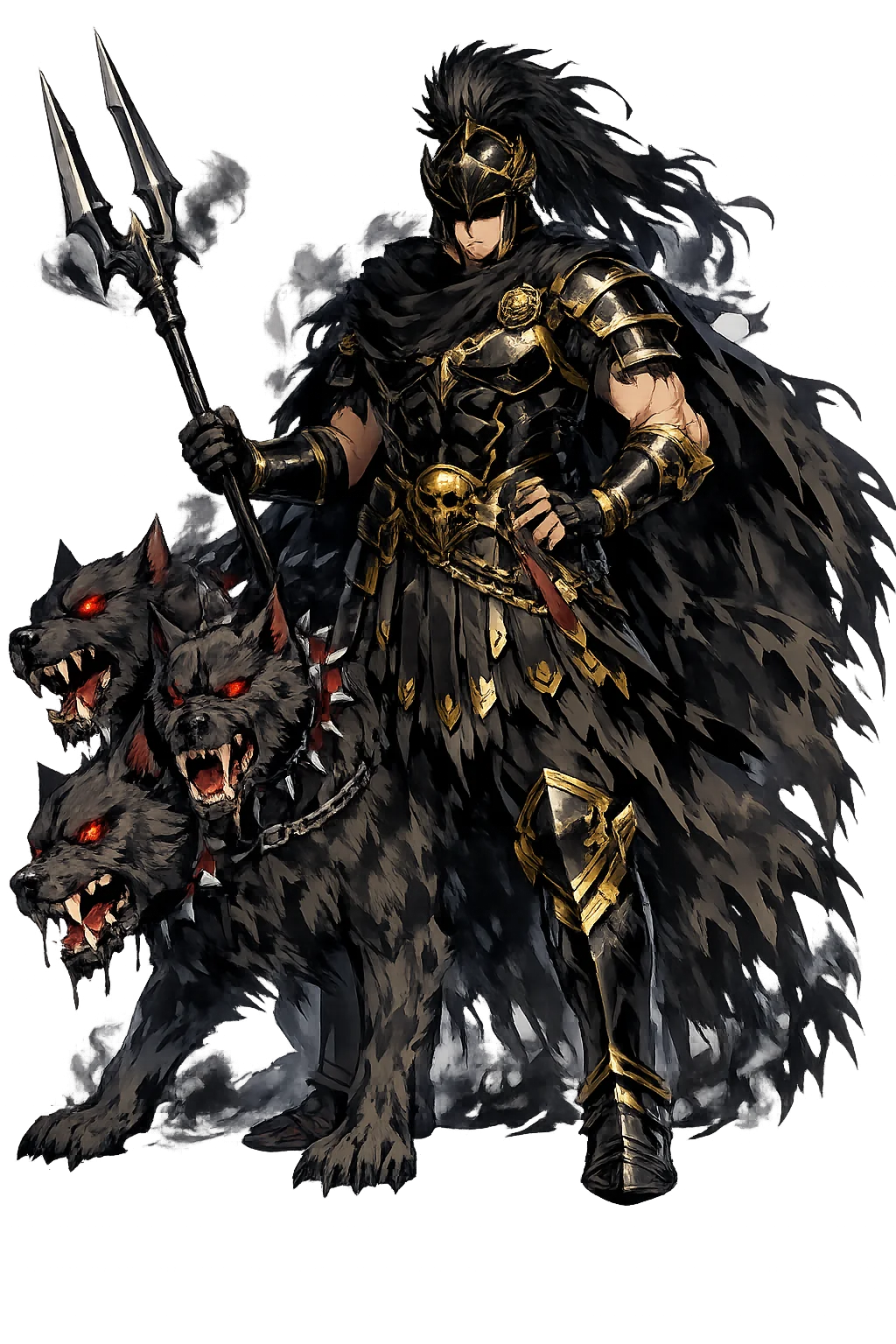
Plūtō walks into a funerary & memorial services firm
The funerary & memorial services world does not cite Plūtō in its documentation. It does not need to — it performs the archetype daily, unbilled.
Before the Office, the Story
Proserpina in the Meadow. Ovid tells the Roman version of the oldest underworld story: Plūtō rose through the earth of Henna's meadow as Proserpina gathered flowers, and carried her down through the lake's opening to be his queen. Cerēs searched the world with torches; the famine followed her grief; and the settlement — half the year above, half below — made the seasons. Rome read it as agriculture's charter-myth: seed descends, grain returns.
Plūtus the Giver. Under the name Plūtus he was the benign twin: the wealth that comes from under the earth — grain, metal, the harvest itself. Aristophanes' comedy made him a blind old man who, healed, gives riches to the just; Rome's poets used him for the moral that wealth, like the grave, is no respecter of persons. The two names stayed one god: the Rich One below is also the Giver below.
At a Glance
- Temple: Plūtō
- Pantheon: Roman
- Domain of influence: Underworld, Wealth, the Dead
- Pattern seats: 3
- Sectors touched: Society & Spirit · Energy & Natural World · Commerce & Governance
- Strongest seat: Funerary & Memorial Services
- Series: The Resonance Files, No. 195 of 271
The Reveal, Seat by Seat
Funerary & Memorial Services
The underworld itself; the oldest address of the dead. Nobody in that trade worships at this temple. They just keep its hours.
Mining & Natural Resources
The Rich One below — ore, wealth, and the deep. The match is not poetic license. Strip the trade to its function and the function is the myth.
Finance, Wealth & Commerce
Plutus the giver; wealth from the earth personified. The match is not poetic license. Strip the trade to its function and the function is the myth.
Not the First Rebrand
His Greek equation with Hádēs was total and early, but Rome kept the distinction of names: Hádēs the Unseen, Plūtō the Rich — the wealth-emphasis Roman. Etruria's Aita stood behind him on the Piacenza liver; Gaul's Dis Pater, claimed by Caesar as the Gauls' ancestor, absorbed his worship northward; and the alchemists kept "plutonic" for all deep-earth fire, whence the element plutonium takes its name from his planet. The office is only the latest translation.
The Method, Stated Plainly
The atlas is not a horoscope. Seats are earned from the sources — argued, weighted, published — and every one of them can be challenged at the methodology page. A match that cannot survive an argument does not survive review. That is the whole trick: the patterns are claims, and claims can be tested.
For the Ones Who Work There
For a sponsor in funerary & memorial services, the fit here is not adjacency — it is inheritance. Your trade already tells this story every working day; the temple simply holds the original. The patron tier and the advertising terms carry the mechanics; the myths above carry the reason.
The File Continues
This is one of 271 Resonance Files — the third dispatch from every flagship temple, where the myths meet the markets. The temple's founding dispatch tells the name's story; its Restoration File tells the spelling's; the blog index holds the whole archive.
Continue the series — previous: Phoînix (read it) · next: Póntos (read it).
The Resonance Files are argued from the same canonical record as the pattern atlas itself: the lexicon, the lore catalog, and the cited sources. Every seat can be challenged at the methodology page — and the challenge is the point.