
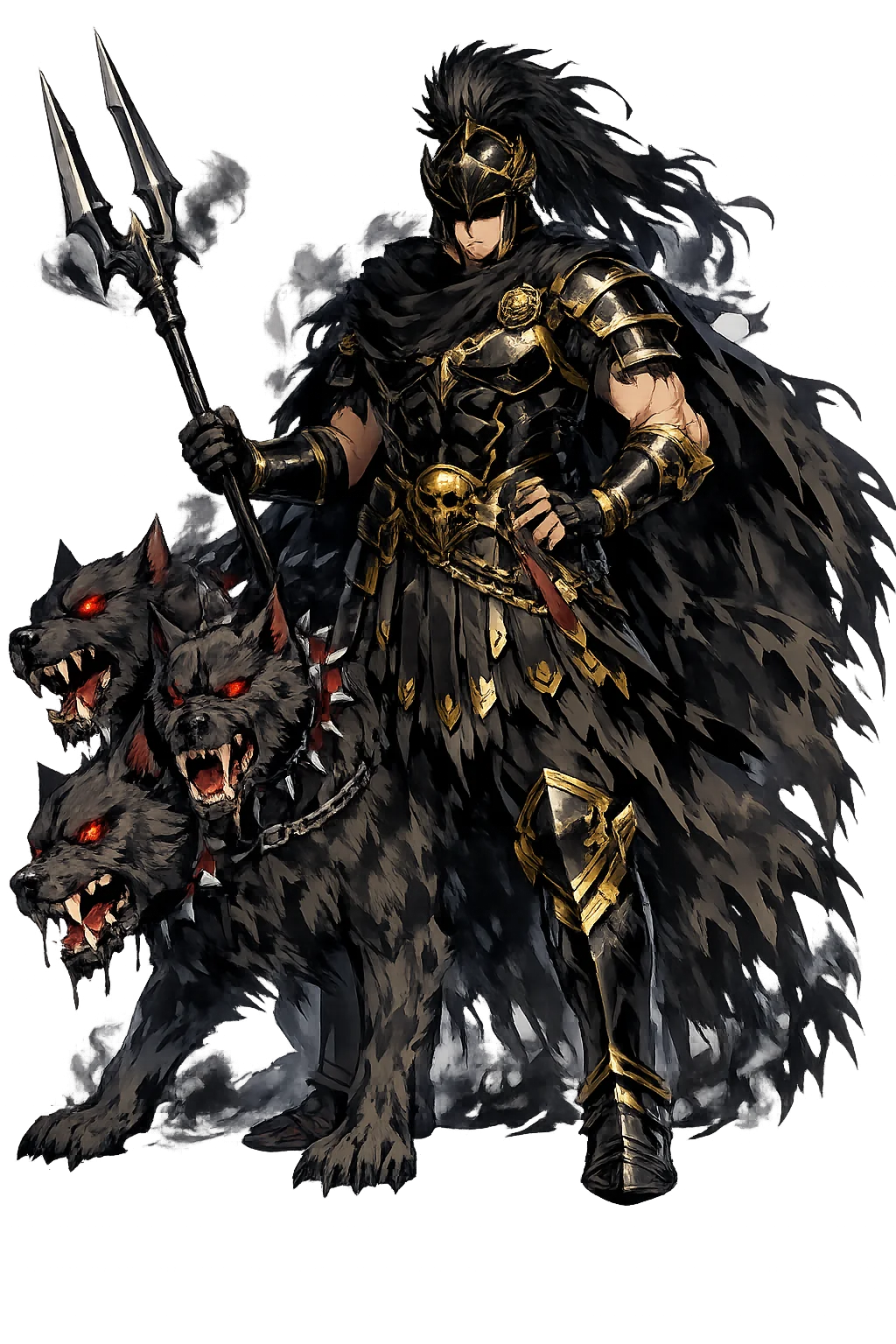
The name Plūtō and the world it opens
A name is a door. Plūtō opens onto an entire world: the domain of underworld, wealth, the dead, a Roman tradition, and centuries of storytelling, worship, and scholarship. This post walks through that world room by room — the name and its roots, the original script, the sound of it, the myths, the symbols, the sites, the afterlife across cultures — and ends at the newest room of all: a Unicode domain that makes the whole structure addressable. pluto gets you to the same building, but only the restored form tells you why it was built.
At a Glance
- Restored name: Plūtō
- ASCII form: pluto
- Meaning: ""The Rich One" — Roman lord of the underworld and of buried wealth"
- Domain of influence: Underworld, Wealth, the Dead
- Pantheon: Roman
- Classification: Tier 1
- Live domain: plūtō.com
Overview
Plūtō (pluto) — Underworld, Wealth, the Dead · "The Rich One" — Roman lord of the underworld and of buried wealth — belongs to the Roman tradition, where it is catalogued under the domain "Underworld, Wealth, the Dead". The name means ""The Rich One" — Roman lord of the underworld and of buried wealth".
Plūtō is Rome's underworld god in his own right — not merely Hádēs renamed, but the Latin "Rich One" who rules the dead and the buried treasure together: the god in whose name the ground gives up both its wealth and its silence.
PuniCodex restores the name as Plūtō and serves its temple at plūtō.com. The original carries both stress and vowel length, and exactly one historically valid Unicode restoration exists, which places the name in Tier 1. The plain ASCII form pluto survives as a modern convenience imposed by the early domain-name system; the restoration, not the fallback, is the form the project defends as philologically complete.
The Name
No indigenous written attestation survives for this name; Plūtō is a scholarly transliteration of the reconstructed spoken form. Etymologically the name means ""The Rich One" — Roman lord of the underworld and of buried wealth".
The ASCII form pluto survives only because the early domain-name system could not carry diacritics; it is a technological compromise, not an ancient spelling. The Unicode restoration Plūtō recovers the full diacritic detail of the scholarly transliteration directly in the address bar. The original carries both stress and vowel length, and exactly one historically valid Unicode restoration exists, which places the name in Tier 1.
The letter-by-letter transformation runs:
- p → P — Same
- l → l — Same
- u → ū — Long ū
- t → t — Same
- o → ō — Long ō
The project holds the domain plūtō.com (xn--plt-sxa2m.com) as the canonical home of this name.
The Original Script
The original script for this roman name has not yet been added to PUNICODEX. The form shown is a scholarly transliteration.
The form Plūtō is therefore a scholarly transliteration rather than an attested ancient spelling; it encodes the reconstructed sound of the name for modern use, and no mark in it is decorative.
Pronunciation
The reconstructed pronunciation of the name is /ˈpluː.toː/ — Classical Latin.
For the modern speaker, the closest approximation is: PLOO-toh — both vowels long.
Kindred and historical forms of the name:
- Latin — Plūtō
- Greek twin — Πλούτων
- Etruscan — Aita
- Owned form — Plūtō
Latin Plūtō carries two long vowels, both marked by the restoration. His name is Rome's calque of the Greek Πλούτων — "the Rich One" — the underworld god whose buried wealth made death and riches share a single name. Both vowels are long in the classical scansion; Lewis & Short print the macrons that the restoration keeps.
Mythology
Plūtō's Roman myths retell the Greek cycle with a merchant's accent: the underworld as a treasury as much as a tribunal.
Proserpina in the Meadow (The Taking)
Ovid tells the Roman version of the oldest underworld story: Plūtō rose through the earth of Henna's meadow as Proserpina gathered flowers, and carried her down through the lake's opening to be his queen. Cerēs searched the world with torches; the famine followed her grief; and the settlement — half the year above, half below — made the seasons. Rome read it as agriculture's charter-myth: seed descends, grain returns.
Plūtus the Giver (The Wealth)
Under the name Plūtus he was the benign twin: the wealth that comes from under the earth — grain, metal, the harvest itself. Aristophanes' comedy made him a blind old man who, healed, gives riches to the just; Rome's poets used him for the moral that wealth, like the grave, is no respecter of persons. The two names stayed one god: the Rich One below is also the Giver below.
The Plutonium of Rome (The Gate)
Rome kept its own door to his kingdom: the Plutonium on the Aventine's slope, where, in 249 BCE during the darkest days of the First Punic War, the Senate staged the devotio — Valerius and his men hurled themselves into the pit to seal it with their lives, and the war turned. The story made his gate Rome's nuclear option: the last, deepest offering a city can make to the Rich One Below.
Symbols & Iconography
The iconography associated with Plūtō concentrates in a small set of recurring attributes, each a compressed statement about the name:
- The bident — His two-pronged staff — the scepter of the depths
- The cornucopia — Wealth rising from the earth — his benign face
- The cypress — The underworld's tree — the dark column of the graveyard
Epithets & Cult Titles
His titles divide, as he does, between dread and gift.
- Plūtō — 'the Rich One'; Rome's own name for the underworld's wealth.
- Plūtus — 'Wealth'; the benign twin, the giver from below.
- Dis (Pater) — 'the Rich Father'; the old Italic name, claimed by Gauls as their ancestor.
- Orcus — the punisher-face; the underworld as the oath's enforcer.
- Tartarus — the poetic address; the deep by its Greek name.
Oracle Sites & Sanctuaries
Rome kept his door: the Plutonium on the Aventine, the underworld gate where the devotio of 249 BCE was staged (Livy's account of the men who sealed the pit with their lives). The Etruscan underworld of Tarquinia's painted tombs shows Aita and Phersipnai — his Italian face before Rome's — in the François Tomb's great demon-scenes. Sicily's Henna (Enna), the meadow of the Proserpina myth, was his cult's southern capital; the lake of the taking is shown to visitors still.
Archaeology & Evidence
The Plutonium site on the Aventine is text-attested (Livy) though not certainly located; the great painted tombs of the Etruscan underworld — Aita and Phersipnai at Tarquinia — show his Italian face two centuries before Rome's. His richest monument is negative space: the absence of any grand Plūtō-temple in Rome itself, the city preferring to worship the giver (Plūtus, with Cerēs) and wall the taker out.
Realm & Domain
Plūtō is Rome's underworld god in his own right — not merely Hádēs renamed, but the Latin "Rich One" who rules the dead and the buried treasure together: the god in whose name the ground gives up both its wealth and its silence.
The Doors
The Plutonia — the underworld gates, of which Rome kept its own at the Aventine.
Plūtus
His twin-name: the wealth-god Plutus — cornucopia from below.
Cerberus
The three-headed hound of the threshold — the deep's own border guard.
Proserpina
The queen he took by force and kept by season — Rome's Persephonē.
Across Cultures
His Greek equation with Hádēs was total and early, but Rome kept the distinction of names: Hádēs the Unseen, Plūtō the Rich — the wealth-emphasis Roman. Etruria's Aita stood behind him on the Piacenza liver; Gaul's Dis Pater, claimed by Caesar as the Gauls' ancestor, absorbed his worship northward; and the alchemists kept "plutonic" for all deep-earth fire, whence the element plutonium takes its name from his planet.
Within the Roman tradition, closely related names in the corpus include [[ceres|Cerēs]], [[diana|Diāna]], [[ianus|Iānus]], [[iuno|Iūnō]], [[iuppiter|Iūppiter]], and [[neptunus|Neptūnus]].
Cultural Legacy
The dwarf planet demoted in 2006 bears his name — and the irony is his: the richest name in the sky, given to the smallest body. "Plutocracy" is his grammar of wealth; "plutonic" his geology. In the Renaissance his image became Fortune's dark twin, and modern finance still speaks of the "underworld" of markets — the Rich One below, invoked daily by people who have forgotten him.
The Scholarly Record
The account of Plūtō given in this edition rests on the witnesses and reference works listed below. Lexica and etymological dictionaries secure the form and meaning of the name; the literary and religious texts supply the narrative evidence.
- Lewis & Short, A Latin Dictionary, Oxford, Clarendon Press; Perseus digitization, 1879. Full text
- Varro, De Lingua Latina / Antiquitates Rerum Divinarum, Loeb Classical Library, 45 BCE.
- Cicero, Marcus Tullius — collected works, Loeb Classical Library, 43 BCE. Full text
- Ovid (Publius Ovidius Naso), Metamorphoses / Fasti / Heroides, Loeb Classical Library, 17. Full text
- Macrobius, Saturnalia, Loeb Classical Library (Kaster), 430.
- Cambridge Ancient History, Multiple volumes, 1970. Full text
A Meditation
Plūtō is the god of what the ground holds: the dead, the ore, the seed, the secret. Rome's insight was to give all four one name and one address — the rich dark below where everything valuable also fears to go. He asks the miner's and the mourner's common question: what will you trust to the deep — and what, in your season, will it give back?
The poets gave him two names because one was not enough: the Rich One for the harvesters, the Unseen for everyone else. Rome's honesty was to worship the first and wall out the second — and to know they were the same door. The deep gives; the deep keeps; the deep does not explain.
The devotio at his gate is Rome's darkest and most instructive rite: when the city could not win, it fed the deep its bravest, and history says the war turned. Plūtō's lesson is the one empires learn last — the deep takes payment in advance, in courage, and returns it as history. Every treasury and every cemetery is his bookkeeping.
The Unicode Restoration
Plūtō is classified as Tier 1: the original carries both stress and length, and only one valid Unicode restoration exists. The ASCII fallback pluto still resolves everywhere, but it is the restored form that carries the name's full information. Across the 5 characters of the name, the restoration adjusts 2: 2 further adjustments (ū, ō). That is the whole thesis of this temple: the marks are the message.
Character by Character
The journey from pluto to Plūtō, one character at a time:
- p → P — Same
- l → l — Same
- u → ū — Long ū
- t → t — Same
- o → ō — Long ō
The Domain Name
The restored name is live as a working domain: plūtō.com, which the DNS carries in punycode form as xn--plt-sxa2m.com — an ASCII-compatible encoding that lets a non-ASCII name travel the global network without breaking older infrastructure. The visitor sees Plūtō; the machines see the encoding. That duality is the engineering compromise on which the entire restoration rests, and it is why a name written the way its own tradition wrote it in Original Script can now be typed into any browser on earth.
The Roman Pantheon
Plūtō is one of 8 entries the PuniCodex lexicon catalogues under the Roman pantheon. The Pantheon page gathers the tradition's major figures in one place, and the Lexicon lets you filter all 924 restorations by tradition, tier, or script — the fastest way to see where this name sits among its kin.
Frequently Asked Questions
What does Plūtō mean? The traditional gloss is ""The Rich One" — Roman lord of the underworld and of buried wealth."
Which tradition does Plūtō belong to? Plūtō is catalogued in the Roman pantheon of the PuniCodex lexicon.
Why is Plūtō classified as Tier 1? Because the original carries both stress and length, and only one valid Unicode restoration exists — and the marks in the restored spelling preserve exactly that evidence.
Is Plūtō a working domain? Yes — plūtō.com resolves today and routes to this temple.
What is the punycode for plūtō.com? The DNS encoding is xn--plt-sxa2m.com; browsers perform the translation automatically, so visitors only ever see the restored name.
Typing Plūtō
You do not need a special keyboard to use this restoration. The PuniCodex Type Tool converts the ASCII form pluto into Plūtō as you type, and the browser extension offers the same conversion inside any text field. Copy the restored form, paste it into the address bar, and the DNS does the rest.
Sister Temples
Other temples in the Roman pantheon include Iānus — each with its own restoration story, its own scholarly record, and its own place in the lexicon.
Why This Restoration Matters
A door only matters if people walk through it. plūtō.com is open, and everything behind it — the myths, the scholarship, the canvas, the patrons — hangs on the restored spelling. The PuniCodex project bets that the web will make room for names as they were actually written, and Plūtō is one of its standing proofs. Visit, share, cite, type it yourself: each use is a small rehearsal for a web where no name has to hide its marks to be found.
Explore Further
This post is one doorway into the temple. The home page carries the full character breakdown and the ambient canvas; the lore page tells the myths in long form; the Scholarly Edition preserves the sources, pronunciation data, and revision history; and the patron wall supports the restoration directly. For the wider map, browse the Lexicon, explore the Pantheon, or return to the PuniCodex blog.
Related Names
Sources
The full scholarly apparatus — every citation, revision, and review — lives in the Scholarly Edition. Key references for this post:
- Lewis & Short, A Latin Dictionary, Oxford, Clarendon Press; Perseus digitization, 1879.
- Cicero, Marcus Tullius — collected works, Loeb Classical Library, 43 BCE.
- Ovid (Publius Ovidius Naso), Metamorphoses / Fasti / Heroides, Loeb Classical Library, 17.
- Cambridge Ancient History, Multiple volumes, 1970.
- Lewis & Short, s.v. Pluto, Dis, Orcus; Varro and Cicero.
- Livy (the devotio); the Tarquinia tomb corpora; Cicero on Enna.
- Varro, De Lingua Latina / Antiquitates Rerum Divinarum, Loeb Classical Library, 45 BCE.
- Macrobius, Saturnalia, Loeb Classical Library (Kaster), 430.
- Lexicon authorities for this entry: Lewis & Short, Varro, Cicero, Ovid, Macrobius, Cambridge.