
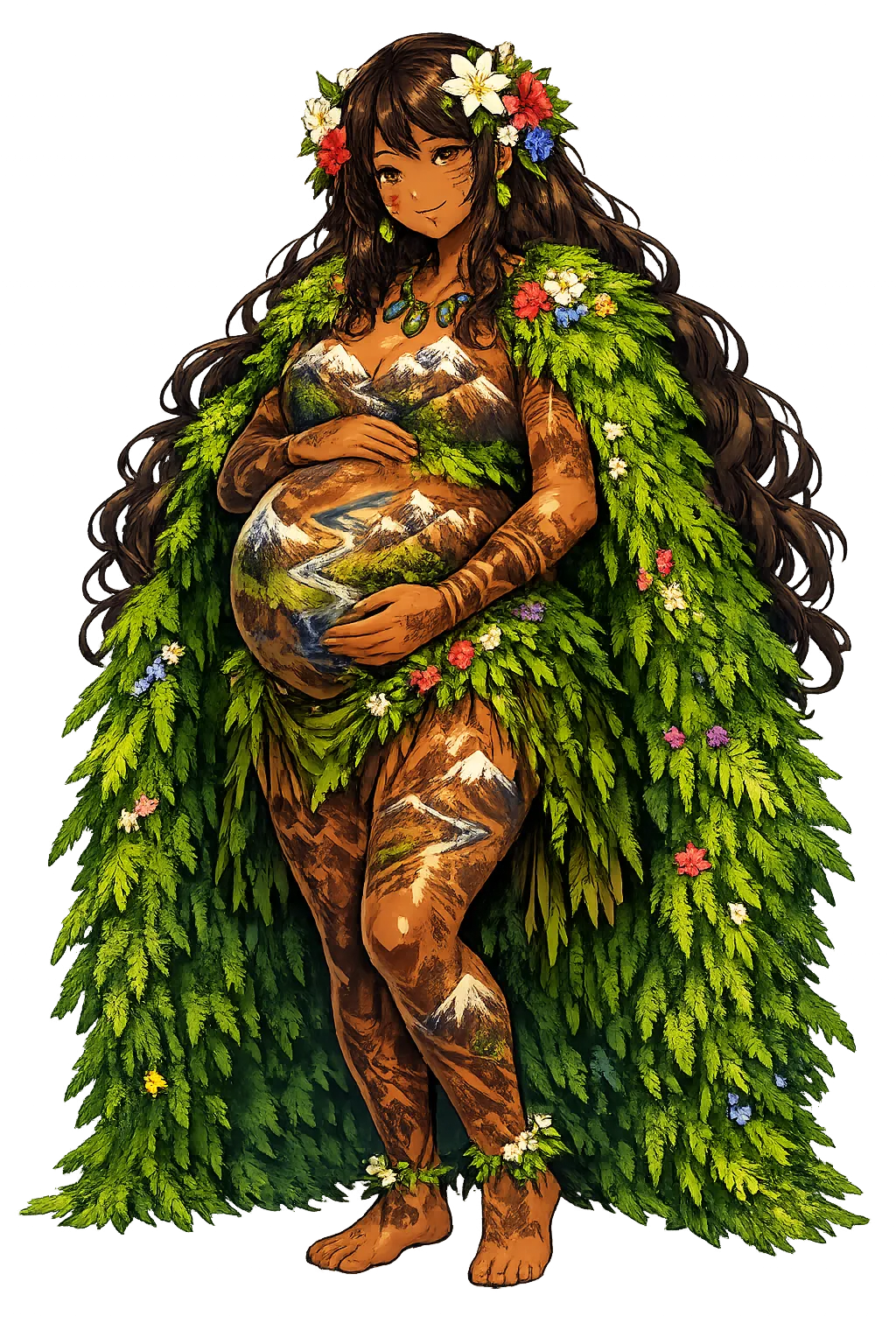
Why Papatūānuku is spelled that way — and what it costs to get it right
There is a version of this name the early internet had to settle for: papatuanuku. This is the file on how Papatūānuku replaced it.
Papatūānuku's central myth is the separation of earth and sky, one of the most widely distributed creation narratives in Polynesia. The Māori version is preserved in nineteenth-century written versions of oral tradition collected by Grey, Best, and Smith.
At a Glance
- Restored name: Papatūānuku
- ASCII form: papatuanuku
- Meaning: "Earth Mother; the land that gives birth to all living things"
- Domain of influence: Earth, Creation, Fertility
- Pantheon: Polynesian
- Classification: Tier 1
- Original script: —
- Series: The Restoration Files, No. 188 of 271
The Name Before the Marks
Strip Papatūānuku to papatuanuku and 2 pieces of evidence vanish:
- u → ū — Macron: long u: the vowel length the ASCII form cannot show.
- a → ā — Macron: long a: the vowel length the ASCII form cannot show.
These are the small, provable things a restoration is made of: not taste, not branding — attestation.
Spoken, the name runs `/ˈpa.pa.tuːˈaː.nu.ku/` — 'PAH-pah-too-AH-noo-koo' — keep the p's gentle and unaspirated, hold the ū and ā long, and give each vowel its own syllable.
The Temple That Stands Now
The restored name is not a plaque; it is an address. The temple of Papatūānuku lives at /sites/papatuanuku/, with its mythology in the lore halls, its peer-reviewed record in the Scholarly Edition, and its place in the pattern atlas on the patterns floor.
The restoration preserves more than the ASCII form can express — stress, length, or a letter the Latin keyboard lost — which places it, mechanically, in Tier-1.
Where the Name Stood First
There are no monumental temple sculptures of Papatūānuku comparable to those of Aztec or Greek deities; Māori sacred expression was primarily oral, architectural, and environmental. Marae and carved meeting houses (wharenui) encode genealogical narratives linking the living community to Papatūānuku and Ranginui. Rock art, greenstone ornaments, and burial practices reflect the cosmology of return to the earth. Nineteenth-century written records by Grey, Best, and Smith preserve the oral mythology in detail. The temple on the web is the newest of these addresses — the first one that fits in a pocket.
The Archetype at Work
The pattern atlas seats this temple in 4 industries, each match argued and weighted: Agriculture, Food & Harvest (the earth mother from whom all food comes.); Environmental & Climate Services (the land that gives birth to all living things; stewardship personified.); Ancestry & Heritage Services (mother of the gods and of humankind; whakapapa recites every lineage in Aotearoa in layers back to her.). The Resonance File reads those seats through the myths themselves.
In the Sacred Texts
The Polynesian tradition is not a vibe; it is a library. The Sacred Texts collection holds Kumulipo and Polynesian Mythology — the primary sources the temple's scholarship is built on. The temple is the argument; the texts are the evidence.
The File Continues
The temple's founding dispatch tells the name's story; its Resonance File reads the myths into the industries; the blog index holds the whole archive.
Continue the series — previous file: Pángǔ (read it here) · next file: Pārvatī (read it here).
The Restoration Files are written from the same canonical record as the temples themselves: the lexicon, the lore catalog, the pattern atlas, and the cited scholarly sources. If a file ever disagrees with its temple, the temple is right — tell us, and the file will be corrected.