
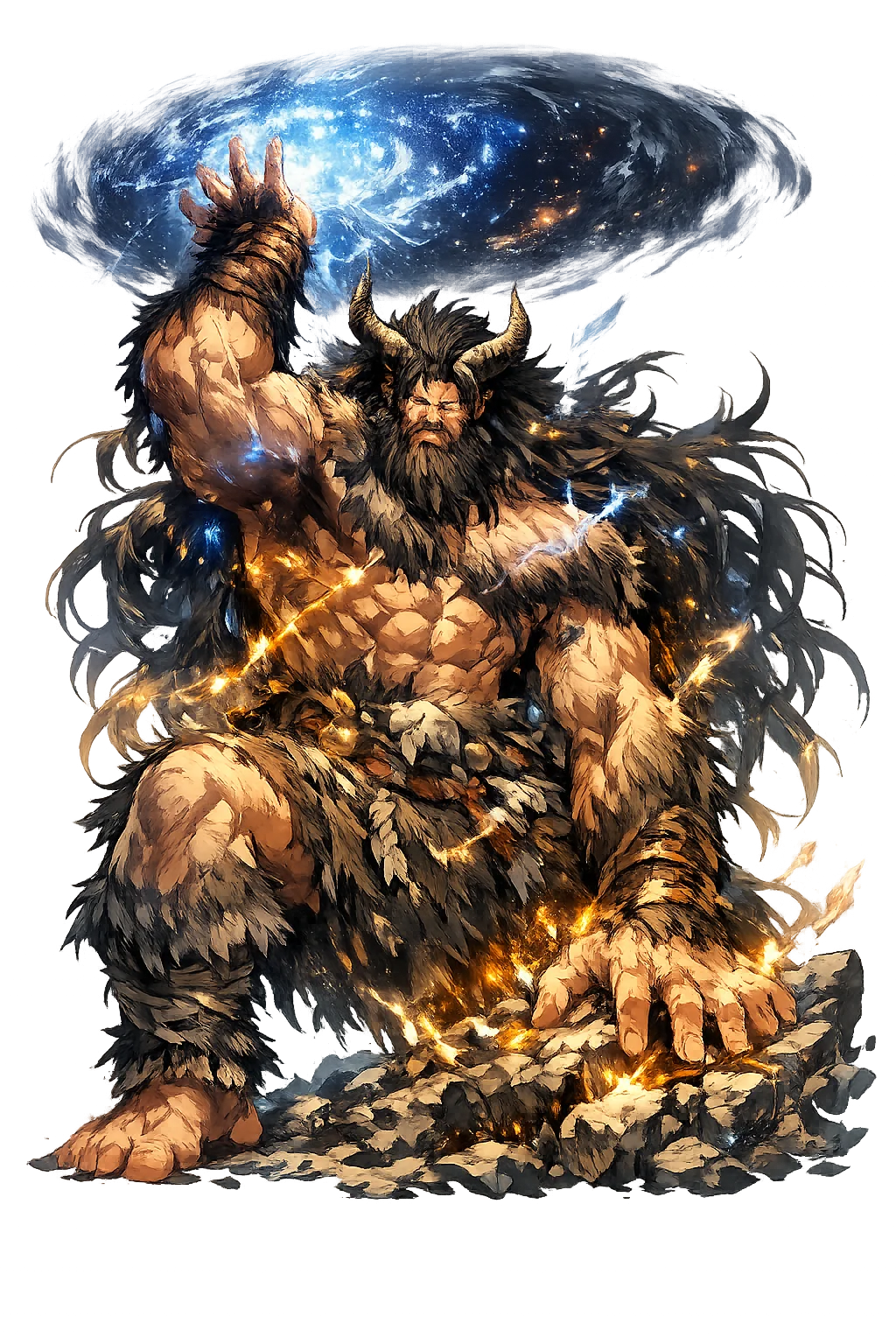
Why Pángǔ is spelled that way — and what it costs to get it right
There is a version of this name the early internet had to settle for: pangu. This is the file on how Pángǔ replaced it.
Pángǔ's myth exists in two sentences of immense consequence, recorded by Xú Zhěng in the 3rd century CE — and expanded by a civilization into its canonical account of how the world began.
At a Glance
- Restored name: Pángǔ
- ASCII form: pangu
- Meaning: "'Coiled antiquity' (盤古), the giant who split heaven from earth"
- Domain of influence: Creation, Separation, Foundation
- Pantheon: Chinese
- Classification: Tier 1
- Original script: —
- Series: The Restoration Files, No. 187 of 271
The Name Before the Marks
Strip Pángǔ to pangu and one piece of evidence vanishes:
- a → á — Stress mark (acute/tone): the stress position the ASCII form cannot show.
None of these marks is decoration. Each one is a fact about how the name was spoken, and each one is checkable against the scholarly record the temple cites.
Spoken, the name runs `/pʰa˧˥ ku˨˩˦/` — pahng-goo, rising tone on Pang, low-dipping on Gu.
The Temple That Stands Now
The restored name is not a plaque; it is an address. The temple of Pángǔ lives at /sites/pangu/, with its mythology in the lore halls, its peer-reviewed record in the Scholarly Edition, and its place in the pattern atlas on the patterns floor.
What survives here cannot be shown in ASCII: a feature of the original that the fallback alphabet flattens. That is the Tier-1 test, and this name passes it without argument.
Where the Name Stood First
No cult-temple of Pángǔ predates the myth's literary arrival, but his material afterlife is real: the Pángǔ temples of Tongbai (Henan) and the southern shrines of Guangdong and Guangxi mark the festival of his "birth" in the tenth lunar month. The textual archaeology is exact — Xú Zhěng's Sānwǔ lìjì and the Wǔyùn lìnián jì (both 3rd century, preserved in encyclopedias) are the two struts of the whole tradition, and the history of their quotation is the history of the myth itself. The temple on the web is the newest of these addresses — the first one that fits in a pocket.
The Archetype at Work
The pattern atlas seats this temple in 3 industries, each match argued and weighted: Startups & Venture Creation (creation from chaos; the first founder pushing heaven and earth apart.); Manufacturing, Craft & Automation (the chisel and axe of the first separation; making itself.); Space, Astronomy & Celestial Science (the cosmic egg and the separating sky; the creation narrative of celestial mechanics.). The Resonance File reads those seats through the myths themselves.
In the Sacred Texts
The Chinese tradition is not a vibe; it is a library. The Sacred Texts collection holds Tao Te Ching — the primary sources the temple's scholarship is built on. The temple is the argument; the texts are the evidence.
The File Continues
The temple's founding dispatch tells the name's story; its Resonance File reads the myths into the industries; the blog index holds the whole archive.
Continue the series — previous file: Ọya (read it here) · next file: Papatūānuku (read it here).
The Restoration Files are written from the same canonical record as the temples themselves: the lexicon, the lore catalog, the pattern atlas, and the cited scholarly sources. If a file ever disagrees with its temple, the temple is right — tell us, and the file will be corrected.