The Authentic Orthography
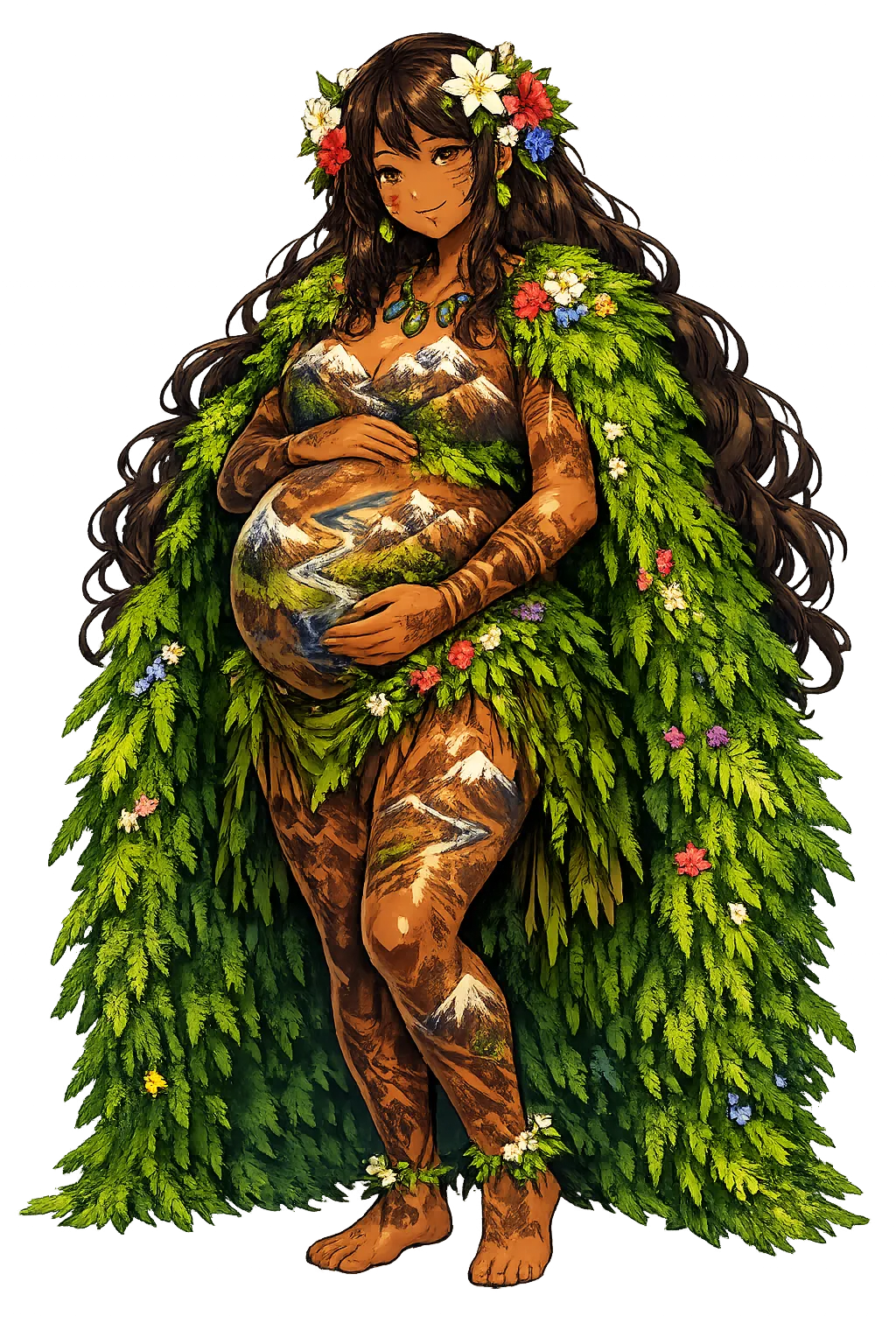
Earth, Creation, Fertility · Earth Mother; the land that gives birth to all living things
Unicode restoration and ASCII comparison
Papatūānuku
The name survives only in scholarly transliteration. Papatūānuku is the standard Polynesian romanisation, documented in academic sources — “Earth Mother; the land that gives birth to all living things”. Its macron-length vowels preserve distinctions lost in plain ASCII.
No indigenous writing system is securely attested for individual polynesian names. The form shown is a modern scholarly transliteration.
papatuanuku
Reduced to plain papatuanuku, the name loses everything that made it specific: macron-length vowels. What remains is an ASCII string that machines can parse but that no longer speaks with its original voice.
Papatūānuku
The Unicode restoration recovers what ASCII flattened. Papatūānuku restores macron-length vowels, returning the name to its original written dignity. The domain encodes to Punycode, but the browser displays the truth.
Papatūānuku.com → xn--papatnuku-9bb97i.com
The non-ASCII characters in Papatūānuku are encoded while the ASCII remains visible. To the DNS, it is Punycode. To humanity, it is Papatūānuku.
How Papatūānuku is preserved in writing
No indigenous writing system is securely attested for individual polynesian names. The form shown is a modern scholarly transliteration.
Contribute scholarly provenance →How Papatūānuku was spoken
Creation, Fertility, and the Land
Papatūānuku is the broad earth lying beneath the sky, the mother from whose body all living things spring. In Māori cosmology she and Ranginui, the Sky Father, were once locked in an embrace so tight that their children lived in darkness between them. Their separation by Tāne brought light and space into the world — and a wound of separation that still marks every creature's relation to earth and sky.
All plants, animals, and humans arise from her body; she is the source of nourishment and growth.
The Sky Father lies upon her; their separation is the primal act of creation.
The land (whenua) is her body; Māori identity is inseparable from the earth that names and sustains the people.
The dead return to her; she receives all things and makes them grow again.
Stories of Papatūānuku
Papatūānuku's central myth is the separation of earth and sky, one of the most widely distributed creation narratives in Polynesia. The Māori version is preserved in nineteenth-century written versions of oral tradition collected by Grey, Best, and Smith.
In the beginning Ranginui, the Sky, and Papatūānuku, the Earth, clung together in a close embrace. Their children — Tāne, Tāwhirimātea, Tangaroa, Tū, Rongo, and Haumia-tiketike — were born into the cramped darkness between their parents' bodies. Tired of confinement, the brothers debated how to escape. Tū wanted to kill the parents, but Tāne proposed separating them instead. He lay on his back and pushed upward with his legs until Ranginui rose into the sky and light streamed into the world. Papatūānuku remained below, mourning her husband, while Ranginui wept tears of rain upon her. (Grey, Polynesian Mythology; Best, Māori Religion and Mythology.)
Each of Papatūānuku's children claimed a domain from her body. Tāne became lord of forests and birds. Tangaroa took the sea. Rongo received the cultivated plants, especially the kūmara. Haumia-tiketike took the wild foods that grow without cultivation. Tū took humankind and war. Tāwhirimātea, the wind, angered by the separation, departed to wage storms upon his brothers. From these divisions the ordered world emerged.
Papatūānuku's moisture is the mist that rises from the ground at dawn, sometimes interpreted as her tears for Ranginui or as the milk that nourishes her children. The dead are returned to her body so that the cycle of giving and receiving continues. This closing of the loop — from her body, into life, back to her body — is the moral shape of the Māori cosmos.
Papatūānuku is the earth not as resource but as ancestor. To stand on her is to stand on the body of a being who loved, who was separated from her partner, and who continues to give birth despite that grief. The Māori creation story does not begin with a single male creator speaking the world into order; it begins with an embrace so close that no one can breathe, and a separation that is also a wound.
Enter Extended Lore