
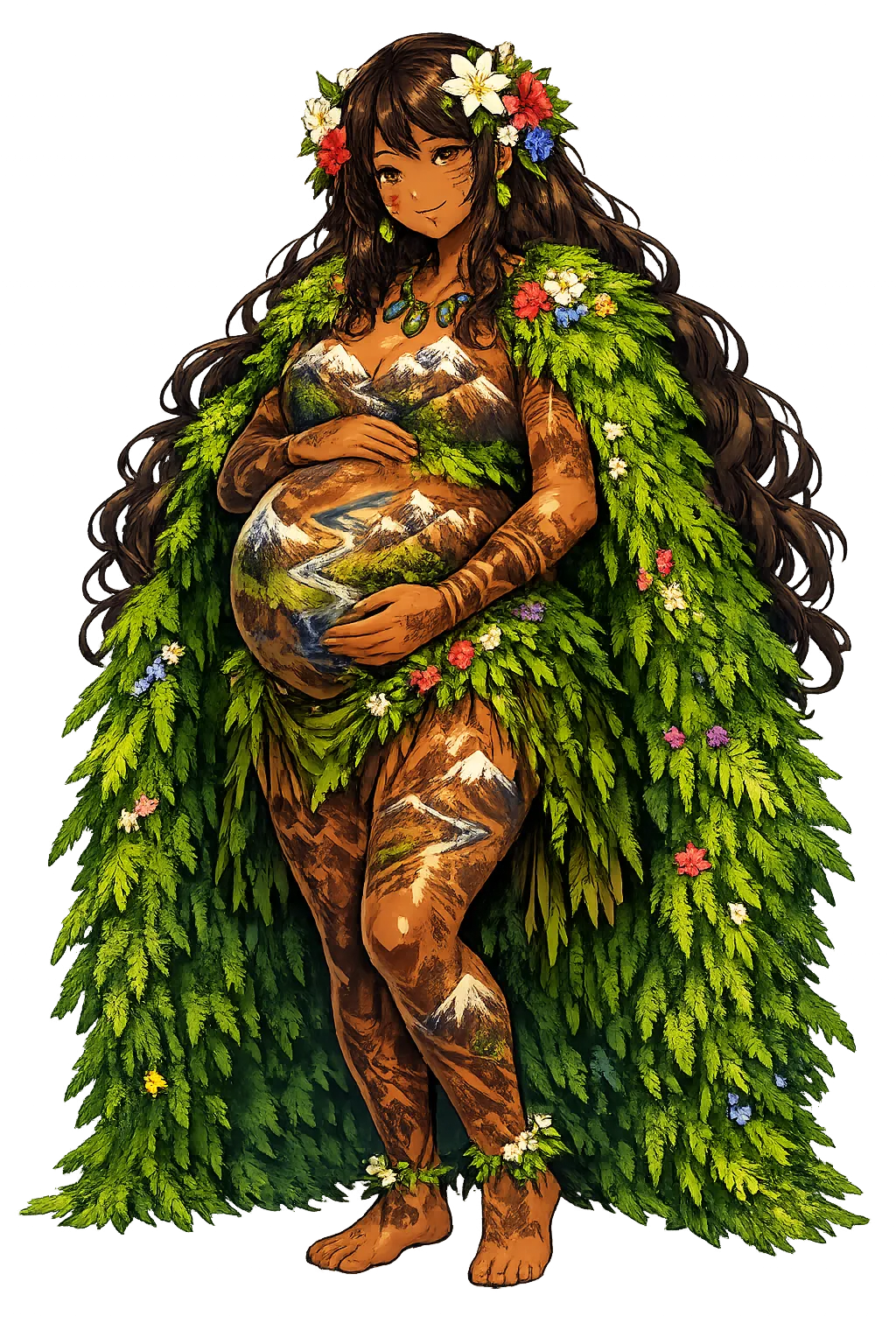
How Papatūānuku got its accent back
The ASCII form papatuanuku is missing something. Papatūānuku restores the marks the source language used to distinguish this name from a thousand others — and those marks change how the name is read, pronounced, and understood. This post explains, with the full scholarly record behind it, what each restored mark preserves: the Polynesian transcription evidence, the reconstructed sound, the myths the name carries, and the classification logic that separates Tier 1 restorations from Tier 2. By the end, the marks in Papatūānuku will look less like ornaments and more like what they are — recovered evidence, pinned back in its proper place.
At a Glance
- Restored name: Papatūānuku
- ASCII form: papatuanuku
- Meaning: "Earth Mother; the land that gives birth to all living things"
- Domain of influence: Earth, Creation, Fertility
- Pantheon: Polynesian
- Classification: Tier 2
- Live domain: papatūānuku.com
Overview
Papatūānuku (papatuanuku) — Earth, Creation, Fertility · Earth Mother; the land that gives birth to all living things — belongs to the Polynesian tradition, where it is catalogued under the domain "Earth, Creation, Fertility". The name means "Earth Mother; the land that gives birth to all living things".
Papatūānuku is the broad earth lying beneath the sky, the mother from whose body all living things spring. In Māori cosmology she and Ranginui, the Sky Father, were once locked in an embrace so tight that their children lived in darkness between them. Their separation by Tāne brought light and space into the world — and a wound of separation that still marks every creature's relation to earth and sky.
PuniCodex restores the name as Papatūānuku and serves its temple at papatūānuku.com. The original preserves one prosodic feature — stress or vowel length — rather than both, which places the name in Tier 2. The plain ASCII form papatuanuku survives as a modern convenience imposed by the early domain-name system; the restoration, not the fallback, is the form the project defends as philologically complete.
The Name
No indigenous written attestation survives for this name; Papatūānuku is a scholarly transliteration of the reconstructed spoken form. Etymologically the name means "Earth Mother; the land that gives birth to all living things".
The reconstructed proto-form is papa (proto-polynesian, "earth, rock, foundation"). Māori Papa (earth) + tū (to stand) + ā (emphatic) + nuku (extended, far-reaching). The name describes the broad earth standing firm.
Cognate forms across related languages:
- Papa (polynesian) — Short form used across Polynesia
- Papa (hawaiian) — Earth mother in Hawaiian tradition
The ASCII form papatuanuku survives only because the early domain-name system could not carry diacritics; it is a technological compromise, not an ancient spelling. The Unicode restoration Papatūānuku recovers the vowel length of the original directly in the address bar. The original preserves one prosodic feature — stress or vowel length — rather than both, which places the name in Tier 2.
The letter-by-letter transformation runs:
- p → P — Same, capitalized
- a → a — Same
- p → p — Same
- a → a — Same
- t → t — Same
- u → ū — Macron: long u
- a → ā — Macron: long a
- n → n — Same
- u → u — Same
- k → k — Same
- u → u — Same
Attested and derived spellings of the name:
- Papa-tū-ā-nuku — scholarly variant: Hyphenated analytical spelling emphasizing the components
The project holds the domain papatūānuku.com (xn--papatnuku-9bb97i.com) as the canonical home of this name.
Etymology & Roots
The recorded derivation reads: Māori Papa (earth) + tū (to stand) + ā (emphatic) + nuku (extended, far-reaching). The name describes the broad earth standing firm.
The reconstructed proto-form is *papa (proto-polynesian), glossed as "earth, rock, foundation".
The reconstruction is classed as attested.
Kindred forms recorded in the lexicon:
- Papa (polynesian) — Short form used across Polynesia
- Papa (hawaiian) — Earth mother in Hawaiian tradition
The Original Script
No indigenous writing system is securely attested for individual Polynesian names; pre-contact Māori was an oral culture whose archives were memory, recitation, carving, and weaving rather than text. The form shown, Papatūānuku, is therefore a modern scholarly transliteration, not an attested ancient spelling — but its written history is fully documentable.
Māori was first committed to print by missionaries: Thomas Kendall's A Korao no New Zealand (Sydney, 1815), the first book in the language, followed by Kendall and Samuel Lee's A Grammar and Vocabulary of the Language of New Zealand (Cambridge, 1820), prepared with the chiefs Hongi Hika and Waikato. That orthography fixed the consonant inventory but marked vowel length only erratically, and nineteenth-century scholars accordingly wrote the name Papa-tu-a-nuku or Papatuanuku; Tregear's comparative dictionary (1891) analyses the compound — papa 'earth, foundation', tū 'to stand', ā (emphatic particle), nuku 'extended, far-reaching' — without consistent length marking.
In the twentieth century two conventions for the long vowels competed: doubled vowels, championed by Bruce Biggs at the University of Auckland, and the macron (tohutō), which Te Taura Whiri i te Reo Māori (the Māori Language Commission, established 1987) adopted as the national standard. The macrons in Papatūānuku therefore belong to a modern standardization, recording the phonemic lengths /pa.pa.tuː.aː.nu.ku/ exactly as the compound analysis requires. No mark in the restoration is decorative.
Pronunciation
The reconstructed pronunciation of the name is /ˈpa.pa.tuːˈaː.nu.ku/ — Māori Reconstruction.
Phoneme by phoneme:
- Pa- — Voiceless bilabial plosive [p] plus open front [a]; Māori p is unaspirated and crisp.
- -pa- — Repeated syllable meaning 'earth, rock, foundation,' a reduplication common to Polynesian earth names.
- -tū- — Voiceless alveolar plosive [t] plus long close back rounded [uː]; tū means 'to stand.'
- -ā- — Long open central [aː], an emphatic particle in the compound.
- -nuku — Alveolar nasal [n] plus close back rounded [u], then voiceless velar stop [k] plus close back rounded [u]; nuku means 'extended, far-reaching.'
For the modern speaker, the closest approximation is: 'PAH-pah-too-AH-noo-koo' — keep the p's gentle and unaspirated, hold the ū and ā long, and give each vowel its own syllable.
Kindred and historical forms of the name:
- Māori — Papatūānuku — Papa 'earth' + tū 'stand' + ā + nuku 'extended'
- Tongan — Papatuʻanuku, a cognate form of the earth mother
- Proto-Polynesian — *papa 'earth, rock, foundation'
- Partner — Ranginui, the Sky Father who lies upon her
The name is a transparent Māori compound. Papa means 'earth, rock, foundation' and is found across Polynesia; tū means 'to stand'; ā is an emphatic particle; nuku means 'extended, far-reaching.' The macrons on ū and ā mark long vowels, the distinctive prosodic feature that makes this form Tier 2. Some dialects and orthographies write the short form Papa.
Mythology
Papatūānuku's central myth is the separation of earth and sky, one of the most widely distributed creation narratives in Polynesia. The Māori version is preserved in nineteenth-century written versions of oral tradition collected by Grey, Best, and Smith.
The Separation of Rangi and Papa (Creation myth)
In the beginning Ranginui, the Sky, and Papatūānuku, the Earth, clung together in a close embrace. Their children — Tāne, Tāwhirimātea, Tangaroa, Tū, Rongo, and Haumia-tiketike — were born into the cramped darkness between their parents' bodies. Tired of confinement, the brothers debated how to escape. Tū wanted to kill the parents, but Tāne proposed separating them instead. He lay on his back and pushed upward with his legs until Ranginui rose into the sky and light streamed into the world. Papatūānuku remained below, mourning her husband, while Ranginui wept tears of rain upon her. (Grey, Polynesian Mythology; Best, Māori Religion and Mythology.)
The Children of Papatūānuku (Genealogical myth)
Each of Papatūānuku's children claimed a domain from her body. Tāne became lord of forests and birds. Tangaroa took the sea. Rongo received the cultivated plants, especially the kūmara. Haumia-tiketike took the wild foods that grow without cultivation. Tū took humankind and war. Tāwhirimātea, the wind, angered by the separation, departed to wage storms upon his brothers. From these divisions the ordered world emerged.
The Earth's Tears (Mourning and return)
Papatūānuku's moisture is the mist that rises from the ground at dawn, sometimes interpreted as her tears for Ranginui or as the milk that nourishes her children. The dead are returned to her body so that the cycle of giving and receiving continues. This closing of the loop — from her body, into life, back to her body — is the moral shape of the Māori cosmos.
Symbols & Iconography
The iconography associated with Papatūānuku concentrates in a small set of recurring attributes, each a compressed statement about the name:
- Flat, dark earth — Her body is the soil itself, often figured as lying prone beneath the sky
- Mountains and valleys — The folds and ridges of her body, the places where her children still touch her
- Caves — Openings into her body, places of birth, burial, and communication with the dead
- The kūmara and food plants — Crops grown from her body, especially the sweet potato brought from Hawaiki
- The whenua — In Māori the word whenua means both 'land' and 'placenta'; the afterbirth is returned to ancestral soil at birth, so that every delivery literally reopens her body and rebinds the child to the land.
The set is deliberately non-figural: Papatūānuku is not represented as a carved idol but as the land itself, so her 'image' is the terrain a community inhabits.
Archaeology & Evidence
No monumental cult sculpture of Papatūānuku is attested, and none should be expected: Māori sacred expression was primarily oral, architectural, and environmental rather than statuary. The material record instead encodes her cosmology at three scales.
At the architectural scale, the carved meeting house (wharenui) is itself a body: its ridgepole (tāhuhu) is read as the spine, its rafters (heke) as the ribs, and the whole structure is named for an ancestor, so that a community gathers inside the very lineage that descends from Rangi and Papa. At the landscape scale, the marae ātea (ceremonial courtyard), urupā (burial grounds), and South Island rock-art sites such as the limestone shelters of Te Ana treat the terrain itself as sacred text; the dead return to her soil in the urupā as the myth prescribes. At the small-object scale, pounamu (greenstone) ornaments — the most valued Māori material — are heirlooms cut from the land's body, passed down with their own names and histories.
Nineteenth-century written records by Grey, Best, and Smith remain the principal witnesses to the oral mythology that this material world presupposes.
Realm & Domain
Papatūānuku is the broad earth lying beneath the sky, the mother from whose body all living things spring. In Māori cosmology she and Ranginui, the Sky Father, were once locked in an embrace so tight that their children lived in darkness between them. Their separation by Tāne brought light and space into the world — and a wound of separation that still marks every creature's relation to earth and sky.
Mother of Life
All plants, animals, and humans arise from her body; she is the source of nourishment and growth.
Partner of Ranginui
The Sky Father lies upon her; their separation is the primal act of creation.
Whenua and Identity
The land (whenua) is her body; Māori identity is inseparable from the earth that names and sustains the people.
Return and Renewal
The dead return to her; she receives all things and makes them grow again.
Across Cultures
Papatūānuku is cognate with the Hawaiian earth mother Papa and with earth-deity figures across eastern Polynesia. In Māoridom today she is often paired with Ranginui in prayers, environmental discourse, and artistic representations of the creation story. Some Christian Māori theologians have drawn parallels between Papatūānuku and the created earth praised in biblical psalms, while contemporary environmental movements invoke her as the personification of ecological responsibility and land rights.
Within the Polynesian tradition, closely related names in the corpus include [[kanaloa|Kānāloa]], [[tane|Tāne]], [[babaluaye|Ọbalúayé]], [[cihuacoatl|Cihuacōātl]], [[coatlicue|Cōātlīcue]], and [[gaia|Gaîa]].
Cultural Legacy
Papatūānuku has become a central figure in modern Māori cultural identity and in Aotearoa New Zealand's environmental and educational vocabulary. Schools, health services, and land-restoration projects invoke her name, and the phrase 'kaitiaki of Papatūānuku' expresses an ethic of guardianship (kaitiakitanga) over the land.
Two recent developments carry her name into new registers. In the revived Māori New Year observance of Matariki, the star Tupuānuku — the whetū (star) connected with all food grown in the soil, cultivated and uncultivated — is glossed 'to grow (tupu) in the earth (Papatūānuku)', embedding the earth mother in the national calendar, which has marked Matariki with a public holiday since 2022. And in law, the statutory grants of legal personhood to Te Urewera (2014) and to the Whanganui River (Te Awa Tupua, 2017) translate into legislation the older conviction that land and water are living ancestors rather than property — a worldview of which Papatūānuku is the theological ground.
Internationally she is one of the most widely recognized Polynesian deities, a symbol of indigenous earth-relationship in an era of climate crisis.
The Scholarly Record
The account of Papatūānuku given in this edition rests on the witnesses and reference works listed below. The record is doubly mediated: the primary narratives passed from Māori experts to nineteenth-century collectors, and the lexica and syntheses then codified those collections. The dictionary of Tregear secures the form and analysis of the name; the narrative texts supply the mythology.
- Grey, Sir George, Polynesian Mythology (1855) — first English-language printing of the Rangi–Papa separation cycle, from Māori narratives gathered in the 1840s–50s.
- Tregear, Edward, The Maori-Polynesian Comparative Dictionary (1891) — the lexical authority for the compound Papa + tū + ā + nuku and its cognates.
- Best, Elsdon, Maori Religion and Mythology (1924) — the fullest ethnographic account of Māori religion, from fieldwork among the Tūhoe.
- Smith, S. Percy, The Lore of the Whare-wānanga (1913–15) — priestly recitations of the whare wānanga (houses of learning), published by the Polynesian Society.
- Buck, Peter (Te Rangi Hiroa), The Coming of the Maori (1949) — the standard synthesis of Māori material culture and social life.
- Orbell, Margaret, The Illustrated Encyclopedia of Māori Myth and Legend (1995) — the modern literary-critical reference work.
- Marsden, Māori, The Woven Universe: Selected Writings of Rev. Māori Marsden, ed. Te Ahukaramū Charles Royal (2003) — a Māori Anglican priest and scholar's own account of the Māori cosmos.
A Meditation
Papatūānuku is the earth not as resource but as ancestor. To stand on her is to stand on the body of a being who loved, who was separated from her partner, and who continues to give birth despite that grief. The Māori creation story does not begin with a single male creator speaking the world into order; it begins with an embrace so close that no one can breathe, and a separation that is also a wound.
In an age of ecological extraction, Papatūānuku offers a different grammar: the land is not something we have but someone we belong to. The name Papatūānuku, with its long vowels held like a breath, says that the earth is extended, standing, and reaching. We are her reach, her standing, her return.
The Unicode Restoration
Papatūānuku is classified as Tier 2: the original preserves at least one philological feature that ASCII cannot encode. The ASCII fallback papatuanuku still resolves everywhere, but it is the restored form that carries the name's full information. Across the 11 characters of the name, the restoration adjusts 2: 2 marks of length (ū, ā). That is the whole thesis of this temple: the marks are the message.
The Domain Name
The restored name is live as a working domain: papatūānuku.com, which the DNS carries in punycode form as xn--papatnuku-9bb97i.com — an ASCII-compatible encoding that lets a non-ASCII name travel the global network without breaking older infrastructure. The visitor sees Papatūānuku; the machines see the encoding. That duality is the engineering compromise on which the entire restoration rests, and it is why a name written the way its own tradition wrote it in Polynesian transcription can now be typed into any browser on earth.
Why This Restoration Matters
The marks in Papatūānuku were never lost; they were only waiting for a carrier that could hold them. Now that the carrier exists, the burden flips: every use of papatuanuku is a choice to leave evidence on the table. The PuniCodex temple keeps the restored form in circulation — as a domain, a dataset entry, and a scholarly argument — so that the choice to use it stays easy. Accent by accent, macron by macron, that is how the original names come back: not with a single grand gesture, but with a spelling that finally works everywhere.
Explore Further
This post is one doorway into the temple. The home page carries the full character breakdown and the ambient canvas; the lore page tells the myths in long form; the Scholarly Edition preserves the sources, pronunciation data, and revision history; and the patron wall supports the restoration directly. For the wider map, browse the Lexicon, explore the Pantheon, or return to the PuniCodex blog.
Related Names
Sources
The full scholarly apparatus — every citation, revision, and review — lives in the Scholarly Edition. Key references for this post:
- Grey, Polynesian Mythology.
- Tregear, The Maori-Polynesian Comparative Dictionary.
- Best, Maori Religion and Mythology.
- Grey, George, Polynesian Mythology (1855).
- Lexicon authorities for this entry: Tregear, Grey, Best.