
How Pān got its accent back
The ASCII form pan is missing something. Pān restores the marks the source language used to distinguish this name from a thousand others — and those marks change how the name is read, pronounced, and understood. This post explains, with the full scholarly record behind it, what each restored mark preserves: the Greek evidence, the reconstructed sound, the myths the name carries, and the classification logic that separates Tier 1 restorations from Tier 2. By the end, the marks in Pān will look less like ornaments and more like what they are — recovered evidence, pinned back in its proper place.
At a Glance
- Restored name: Pān
- ASCII form: pan
- Meaning: "God of shepherds, flocks, mountain wilds, and the panic that strikes lonely places; his name was popularly derived from Greek πᾶν ("all") but likely originated in Arcadian Πάων ("shepherd")"
- Domain of influence: Wilderness, Shepherds, Flocks
- Pantheon: Greek
- Classification: Tier 2
- Original script: Πάν (Greek)
- Live domain: pān.com
Overview
Pān (pan) — Wilderness, Shepherds, Flocks · God of shepherds, flocks, mountain wilds, and the panic that strikes lonely places; his name was popularly derived from Greek πᾶν ("all") but likely originated in Arcadian Πάων ("shepherd") — belongs to the Greek tradition, where it is catalogued under the domain "Wilderness, Shepherds, Flocks". The name means "God of shepherds, flocks, mountain wilds, and the panic that strikes lonely places; his name was popularly derived from Greek πᾶν ("all") but likely originated in Arcadian Πάων ("shepherd")".
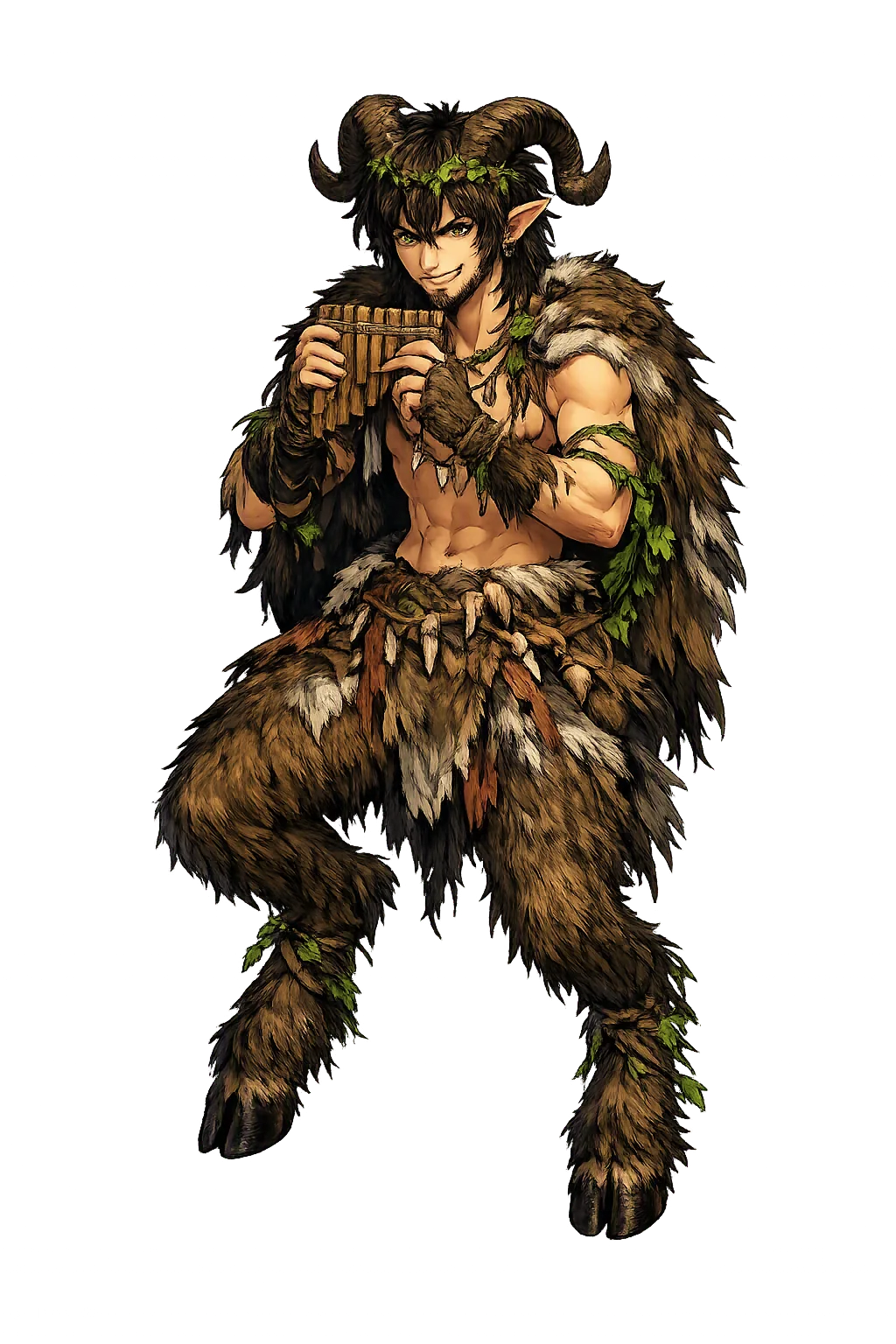
Pān is the goatherd-god of Arcadia: master of shepherds and flocks, lord of the mountain wilds, and author of the sudden, groundless terror the Greeks named for him. He belongs to the empty places and the empty hours — above all to noon, when the hills fall silent and the wise shepherd lays down his pipe. His temples were caves, his congregation the nymphs, and his music the sound a reed makes when it is no longer a girl.
PuniCodex restores the name as Pān and serves its temple at pān.com. The original preserves one prosodic feature — stress or vowel length — rather than both, which places the name in Tier 2. The plain ASCII form pan survives as a modern convenience imposed by the early domain-name system; the restoration, not the fallback, is the form the project defends as philologically complete.
The Name
The name is attested in Greek as Πάν. Etymologically it means "God of shepherds, flocks, mountain wilds, and the panic that strikes lonely places; his name was popularly derived from Greek πᾶν ("all") but likely originated in Arcadian Πάων ("shepherd")".
The reconstructed proto-form is peh₂- (proto-indo-european, "to guard, to shepherd"). The gods name was popularly explained as πᾶν ("all"), but its true root is probably Arcadian Πάων ("shepherd"), from a PIE root meaning "to guard" or "protect"
Cognate forms across related languages:
- ποιμήν (poimēn) (Greek)
- pāscō (Latin)
The ASCII form pan survives only because the early domain-name system could not carry diacritics; it is a technological compromise, not an ancient spelling. The Unicode restoration Pān recovers the vowel length of the original directly in the address bar. The original preserves one prosodic feature — stress or vowel length — rather than both, which places the name in Tier 2.
The letter-by-letter transformation runs:
- p → P — Same, capitalized
- a → ā — Macron marks the long alpha
- n → n — Same
Attested and derived spellings of the name:
- Pán — ideal form: Stress-preserved ideal form; currently registered/unavailable
The project holds the domain pān.com (xn--pn-dla.com) as the canonical home of this name.
Etymology & Roots
The recorded derivation reads: The gods name was popularly explained as πᾶν ("all"), but its true root is probably Arcadian Πάων ("shepherd"), from a PIE root meaning "to guard" or "protect"
The reconstructed proto-form is *peh₂- (proto-indo-european), glossed as "to guard, to shepherd".
The reconstruction is classed as disputed.
Kindred forms recorded in the lexicon:
- ποιμήν (poimēn) (Greek) — derivative
- pāscō (Latin) — cognate
The Original Script
The name is written in Greek as Πάν. This original script is the form against which the ASCII fallback pan and the PuniCodex restoration Pān are measured: the restoration preserves its vowel quantity of the written form, so that a reader typing the modern address still speaks the ancient name.
Pronunciation
The reconstructed pronunciation of the name is /pán/ — Attic Greek Reconstruction.
Phoneme by phoneme:
- Π- — unaspirated voiceless bilabial stop [p], like the p of English 'spin' — Attic π carried no burst of breath
- -ά- — short open [a] bearing the acute accent — a rising pitch, not an English stress-beat; the Arcadian by-form Πάων lengthens this vowel to ā
- -ν — dental nasal [n], tongue on the teeth, closing the single syllable
For the modern speaker, the closest approximation is: 'PAHN' — one clean syllable; let the pitch lift on the á rather than hammering it, and keep the vowel open and pure.
Kindred and historical forms of the name:
- Greek — πᾶν (pan), 'all, everything' — the popular ancient derivation, already jested with by Plato (Cratylus 408b–d)
- Arcadian — Πάων (Pāōn), 'shepherd' — the likelier true form behind the Attic Πάν
- PIE — often traced to *peh₂-, 'to guard, to pasture' (Latin pāscere, pastor); the old comparison with Vedic Pūṣáṇ, god of herds, is doubtful — Beekes urges caution
Tier 2 — a single preserved feature. The Attic name Πάν carries only an acute accent on a short alpha (stress without length); the long ā belongs to the Arcadian by-form Πάων, 'shepherd', which the restoration Pān honors instead. Either way the name keeps one distinctive mark, never both, which is exactly what Tier 2 certifies.
Mythology
Pān is late to Olympus and always half outside it: a god of the threshold between pasture and wilderness, music and dread, whose stories are told by shepherds, runners, and sailors — never by kings.
Syrinx (The Pipes)
In Metamorphoses 1 (689–712), Ovid tells how Pān pursued the Arcadian nymph Syrinx to the river Ladon, where her sisters' prayers changed her into marsh reeds just as his arms closed around her. His sigh stirred the reeds into music, and, vowing that he and she would speak together so, he bound reeds of unequal length with wax and made the pipe that keeps her name. The syrinx is therefore not an instrument Pān owns but a beloved he could not hold — and its breathy voice is the sound of desire outlasting transformation.
The Runner on Mount Parthenion (Marathon)
Herodotus (6.105) records that when the Athenian messenger Pheidippides was sent to Sparta before Marathon, Pān met him on Mount Parthenion above Tegea, called him by name, and asked why Athens paid no honors to a god well-disposed toward the city, who had often helped it and would again. After the victory the Athenians believed him: they founded his shrine in the cave on the north slope of the Acropolis and honored him with annual sacrifices and a torch-race (6.106). Few gods enter the historical record so precisely — a named mountain, a named witness, and a cult whose founding can be dated to 490 BCE.
Born on the Hills, Carried to Olympus (Birth)
The Homeric Hymn to Pan (19.35–47) makes him the son of Hermes and an Arcadian nymph, born goat-legged, horned, and laughing; his nurse took one look and fled. Hermes, delighted, wrapped him in hare-skins and carried him to Olympus, where all the immortals were gladdened by him — and so, the hymn puns, they named him Pan because he charmed them all (πάντες). The joke is ancient and serious at once: even his birth hymn derives his name from πᾶν, the very folk-etymology Plato would tease in the Cratylus.
Great Pan is Dead (The Last Cry)
Plutarch, in On the Obsolescence of Oracles 17 (Moralia 419c–d), tells that in the reign of Tiberius a ship drifting off the Echinades heard a voice from shore calling the Egyptian pilot Thamus by name, bidding him proclaim off Palodes: 'The great Pān is dead' (Πὰν ὁ μέγας τέθνηκε). When he obeyed, a great groaning rose from the land. Early Christian writers seized on the tale as the death-knell of the old gods; modern scholars are less certain what Thamus heard — some detect a garbled ritual lament for a dying eastern god — and Plutarch himself offers it only as a puzzle. It remains the strangest afterlife of the most earthly of gods.
Symbols & Iconography
The iconography associated with Pān concentrates in a small set of recurring attributes, each a compressed statement about the name:
- Syrinx (panpipes) — The instrument that is also his beloved: the nymph Syrinx, transformed into reeds at the river Ladon, bound with wax into the shepherd's pipe that keeps her name (Ovid, Metamorphoses 1).
- Goat legs and horns — His irreconcilable half-wildness made flesh; the Homeric Hymn to Pan (19.2–3) describes him at birth as goat-footed and two-horned, and Arcadian art never let him outgrow it.
- Lagobolon — The shepherd's throwing-stick for hares, carried in his hand on Arcadian coinage and statuary — the hunting companion of the crook.
- Pine wreath — Pān wears the pine in cult and art; later poets told that the nymph Pitys, fleeing him, was changed into the pine, and that his crown keeps her.
- The hare — His quarry and his swaddling: Hermes carried the infant Pān to Olympus wrapped in hare-skins (Homeric Hymn to Pan 19.41–42), and the god still holds the hare in Arcadian images.
- The cave — His architecture: grotto-shrines rather than temples — the Acropolis cave founded after Marathon, the Corycian Cave shared with the nymphs above Delphi.
Archaeology & Evidence
The Athenian cult begins exactly where Herodotus leaves it: a cave-shrine cut into the north slope of the Acropolis, founded after Marathon and honored with a torch-race (Hdt. 6.106). Above Delphi the great Corycian Cave was sacred to Pān and the nymphs together, and Pausanias (10.32.7) saw their statues standing inside it. In Arcadia itself his cult was everywhere — Pausanias's eighth book records grotto-shrines, altars, and temples of Pān in every corner of the mountain country he called home.
Realm & Domain
Pān is the goatherd-god of Arcadia: master of shepherds and flocks, lord of the mountain wilds, and author of the sudden, groundless terror the Greeks named for him. He belongs to the empty places and the empty hours — above all to noon, when the hills fall silent and the wise shepherd lays down his pipe. His temples were caves, his congregation the nymphs, and his music the sound a reed makes when it is no longer a girl.
Flocks & Shepherds
The Mountain Wilds
Sudden Fear
Across Cultures
Rome identified Pān with Faunus, the prophetic field-and-flock spirit, and with Silvanus of the woodland fringe; Virgil had already naturalized him into Latin pastoral as the god who 'cares for the sheep and their masters' (Eclogues 2.33). A second transformation ran the other way: because Plato (Cratylus 408b–d) had read his name as πᾶν, 'the All', late-antique piety enlarged the goatherd into a cosmic god — the Orphic Hymn to Pan (11) hymns him as ether, sea, earth, and fire, the very body of the world. The Arcadian cave-dweller ends as a name for Nature entire.
Kindred figures in the PuniCodex cross-tradition index include ꜥAnat, Ártemis, and Ọṣọọsì, each linked through hunt / wild.
Cultural Legacy
His most durable gift to English is the word panic: Greek τὸ πανικὸν δεῖμα, 'the fear that comes from Pān', passed through Latin panicus and French panique into the modern languages almost unchanged. Pastoral poetry kept his pipes playing from Virgil to the Romantics — Keats's 'Hymn to Pan' crowns the opening of Endymion (1818) — and Elizabeth Barrett Browning's 'A Musical Instrument' fixed him for the Victorian age: 'What was he doing, the great god Pan, / Down in the reeds by the river?' Arthur Machen's novella The Great God Pan (1894) proved the old dread still had teeth.
The Scholarly Record
The account of Pān given in this edition rests on the witnesses and reference works listed below. Lexica and etymological dictionaries secure the form and meaning of the name; the literary and religious texts supply the narrative evidence.
- Liddell-Scott-Jones Greek-English Lexicon, 9th ed. with 1996 supplement, 1940. Full text
- Etymological Dictionary of Greek, 2 vols., Brill, 2010. Full text
- Chantraine.
- Homeric Hymn to Pan (Homeric Hymn 19), Homeric Hymns, Loeb Classical Library No. 496, 600 BCE. Full text
- Histories, Loeb Classical Library, 440 BCE. Full text
- Plato, Dialogues, Loeb Classical Library / Oxford Classical Texts, 348 BCE. Full text
- Pausanias, Description of Greece, Loeb Classical Library, 180. Full text
- Ovid (Publius Ovidius Naso), Metamorphoses / Fasti / Heroides, Loeb Classical Library, 17. Full text
- Virgil (Publius Vergilius Maro), Aeneid / Eclogues / Georgics, Loeb Classical Library / Oxford Classical Texts, 19 BCE. Full text
- Orphic Hymns.
A Meditation
Pān is the god of the hour when the world goes quiet. Theocritus (Idyll 1.15–17) preserves the shepherds' rule: do not pipe at noon, for Pān is resting from the hunt, and bitter anger sits upon his nostrils. Yet the same rustics who feared him also chastised him — in Idyll 7 (106–108) the Arcadians scourge his statue with squills when the larder is empty — a familiarity no Olympian would tolerate. That intimacy is the point: Pān is the divine at its least transcendent, the god of the day's empty middle and the hill's far side, whom one may fear, feed, whip, and laugh with. The Greeks did not believe in him the less for treating him so; they believed in him the more, as one believes in weather.
The Unicode Restoration
Pān is classified as Tier 2: the original carries only one of the two prosodic features — stress or vowel length — not both. The ASCII fallback pan still resolves everywhere, but it is the restored form that carries the name's full information. Across the 3 characters of the name, the restoration adjusts 1: 1 mark of length (ā). That is the whole thesis of this temple: the marks are the message.
Name Variations
The lexicon records 1 additional form of the name:
- Pán (ideal) — Stress-preserved ideal form; currently registered/unavailable
The temple uses Pān as the primary form: it is the spelling that best balances philological accuracy with the practical limits of DNS.
Character by Character
The journey from pan to Pān, one character at a time:
- p → P — Same, capitalized
- a → ā — Macron marks the long alpha
- n → n — Same
The Domain Name
The restored name is live as a working domain: pān.com, which the DNS carries in punycode form as xn--pn-dla.com — an ASCII-compatible encoding that lets a non-ASCII name travel the global network without breaking older infrastructure. The visitor sees Pān; the machines see the encoding. That duality is the engineering compromise on which the entire restoration rests, and it is why a name written the way its own tradition wrote it in Greek can now be typed into any browser on earth.
The Greek Pantheon
Pān is one of 266 entries the PuniCodex lexicon catalogues under the Greek pantheon. The Pantheon page gathers the tradition's major figures in one place, and the Lexicon lets you filter all 925 restorations by tradition, tier, or script — the fastest way to see where this name sits among its kin.
Why This Restoration Matters
The marks in Pān were never lost; they were only waiting for a carrier that could hold them. Now that the carrier exists, the burden flips: every use of pan is a choice to leave evidence on the table. The PuniCodex temple keeps the restored form in circulation — as a domain, a dataset entry, and a scholarly argument — so that the choice to use it stays easy. Accent by accent, macron by macron, that is how the original names come back: not with a single grand gesture, but with a spelling that finally works everywhere.
Explore Further
This post is one doorway into the temple. The home page carries the full character breakdown and the ambient canvas; the lore page tells the myths in long form; the Scholarly Edition preserves the sources, pronunciation data, and revision history; and the patron wall supports the restoration directly. For the wider map, browse the Lexicon, explore the Pantheon, or return to the PuniCodex blog.
Related Names
Sources
The full scholarly apparatus — every citation, revision, and review — lives in the Scholarly Edition. Key references for this post:
- Liddell-Scott-Jones Greek-English Lexicon, 9th ed. with 1996 supplement, 1940.
- Etymological Dictionary of Greek, 2 vols., Brill, 2010.
- Pausanias, Description of Greece, Loeb Classical Library, 180.
- Homeric Hymn to Pan (Homeric Hymn 19), Homeric Hymns, Loeb Classical Library No. 496, 600 BCE.
- Histories, Loeb Classical Library, 440 BCE.
- Plato, Dialogues, Loeb Classical Library / Oxford Classical Texts, 348 BCE.
- Chantraine.
- Orphic Hymns.
- Lexicon authorities for this entry: LSJ, Pape-Benseler, Beekes, Homeric Hymn to Pan.