
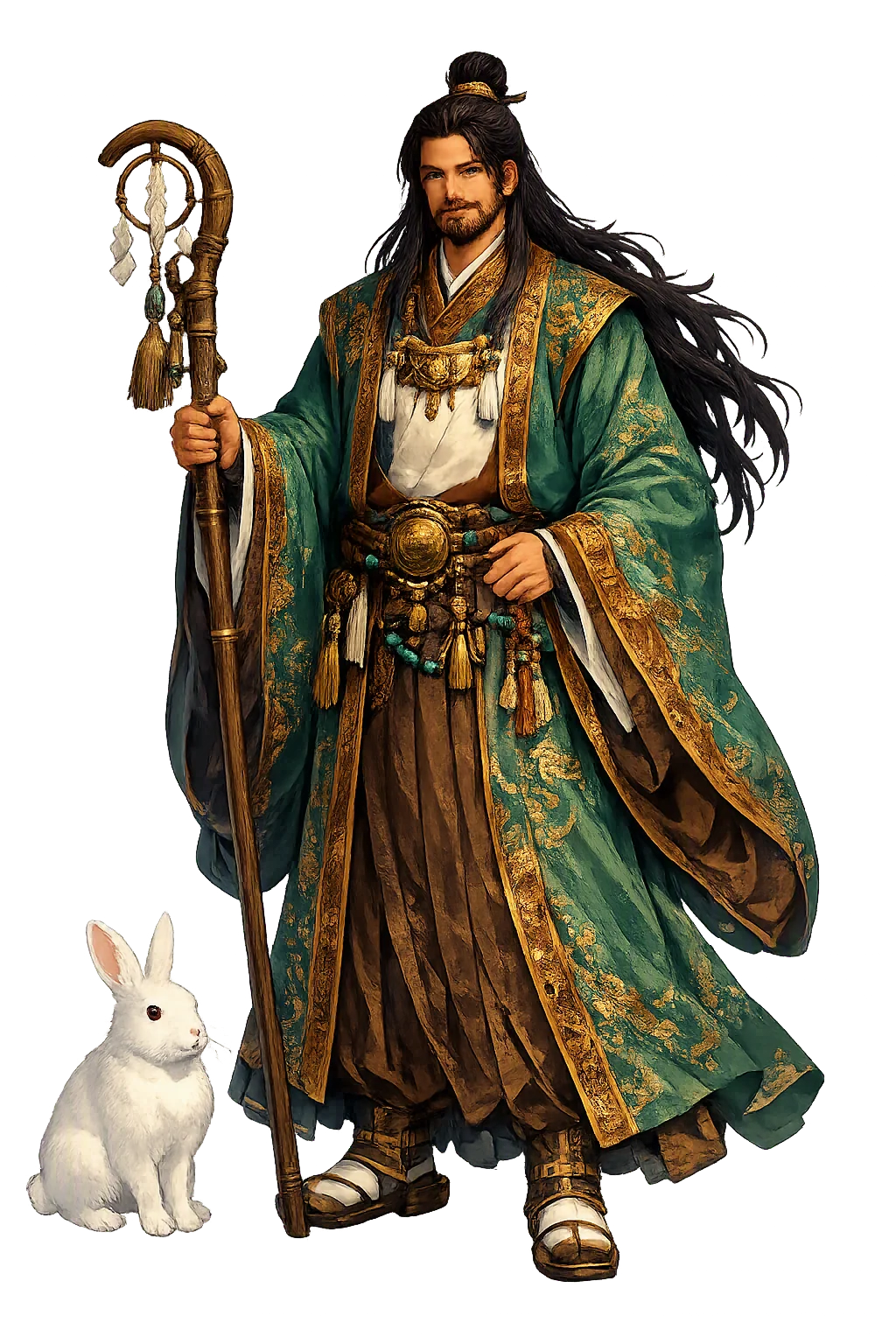
Ōkuninushi and the industries that were always telling its story
The myths did not retire. They moved offices. This is the file on where Ōkuninushi works now.
Ōkuninushi's cycle, preserved in the Kojiki (712) and the Nihon Shoki (720), is the longest and most novelistic narrative in Japanese myth — a story of escape, ordeal, sovereignty and renunciation at the meeting-point of earth and heaven.
The pattern atlas — which maps every flagship temple to the industries its archetype demonstrably resonates with, each match argued and open to challenge — seats this temple in 4 industries. This file reads those seats the way they were earned: through the myths.
At a Glance
- Temple: Ōkuninushi
- Pantheon: Japanese
- Domain of influence: Nation-building, Marriage
- Pattern seats: 4
- Sectors touched: Home & Lifestyle · Technology & Innovation · Commerce & Governance
- Strongest seat: Architecture & Spatial Design
- Series: The Resonance Files, No. 182 of 282
The Myth at Work
The White Hare of Inaba. In the Kojiki (Book I), a hare from the isle of Oki tricks the wani sea-beasts into forming a bridge, is flayed for the deception, and meets the eighty cruel brothers of Ōnamuji, who mockingly prescribe a bath in salt sea-water — agony for its wounds. The youngest brother, Ōnamuji (later Ōkuninushi), advises instead a rinse in fresh river water and a roll in the pollen of katami, the cattail rush; the hare is healed. — hold that image; the industries below are where it goes to work.
The Trials of Ne-no-Kuni. Fleeing his brothers' repeated attempts to kill him, Ōnamuji descends to Ne-no-Kuni, the root-land of Susanoo, as the Kojiki (Book I) relates. There he loves Susanoo's daughter Suseribime, and the storm-god tests him: a night in a hall of snakes, a night in a hall of centipedes and wasps — each survived through Suseribime's protective scarves — and a burning meadow where a mouse leads him to safety underground and retrieves the arrow Susanoo had fired. — that is not just a story. It is a business model, four thousand years early.
The Seats
Each of these is argued in the atlas with a weight and a why-line. What the atlas cannot fit in one line is the whole myth — so here is each seat with its story restored.
Architecture & Spatial Design
Architecture, interior design, and spatial harmony. (Sector: Home & Lifestyle)
The why-line says it in one breath: The nation-builder of Izumo — he raised the land itself with Sukunabikona; the architect of a whole country. That is not a resemblance; it is the same act, performed in a newer building.
Construction & Engineering
Building, civil engineering, and the trades that raise the world. (Sector: Technology & Innovation)
The Great Land-Master who built the reed-plain into a nation; civil engineering as a sacred office. — the atlas stops there, out of discipline. The myth keeps going: the function Ōkuninushi performs in the stories is precisely the function this industry sells.
Disaster Resilience & Recovery
Emergency management, recovery, and business continuity. (Sector: Commerce & Governance)
He survived the underworld's trials and returned to rule; resilience is his biography. — the atlas stops there, out of discipline. The myth keeps going: the function Ōkuninushi performs in the stories is precisely the function this industry sells.
Wedding, Family & Maternity
Weddings, childcare, and family services. (Sector: Home & Lifestyle)
The matchmaker of Izumo — marriage is among his gifts; the shrine that blesses unions bears his name. — the atlas stops there, out of discipline. The myth keeps going: the function Ōkuninushi performs in the stories is precisely the function this industry sells.
The Long Employment
Ōkuninushi still anchors the Izumo region of Shimane, where Izumo-taisha draws millions of pilgrims and couples across Japan pray to him as the nation's matchmaker. The white hare of Inaba endures as the emblem of Tottori prefecture, and his son Kotoshironushi presides over the great pilgrimage shrine of Kotohira in Shikoku. The age changed. The work did not.
The Method, Stated Plainly
None of this is numerology. A seat exists only where the match can be argued from the deity’s documented domains and deeds — weighted, published, and falsifiable. The derivation, the weights, and the challenge process are public on the methodology page. If a seat in this file reads wrong, the atlas itself tells you how to prove it — and the correction becomes part of the record.
For the Ones Who Work There
If you work in architecture & spatial design, construction & engineering, or any trade this temple holds a seat in, this is the honest version of what a placement means: your industry beside the story it has been re-telling all along — on the temple floor itself, before an audience that came specifically to read it. The patron tier and the advertising terms describe the mechanics; the resonance above describes the fit.
The File Continues
One of 282 Resonance Files — the series where the pantheon goes to work. Read the founding dispatch for the name, the Restoration File for the spelling, or the whole archive end to end.
Continue the series — previous: Ōkeanós (read it) · next: Olódùmarè (read it).
The Resonance Files are argued from the same canonical record as the pattern atlas itself: the lexicon, the lore catalog, and the cited sources. Every seat can be challenged at the methodology page — and the challenge is the point.