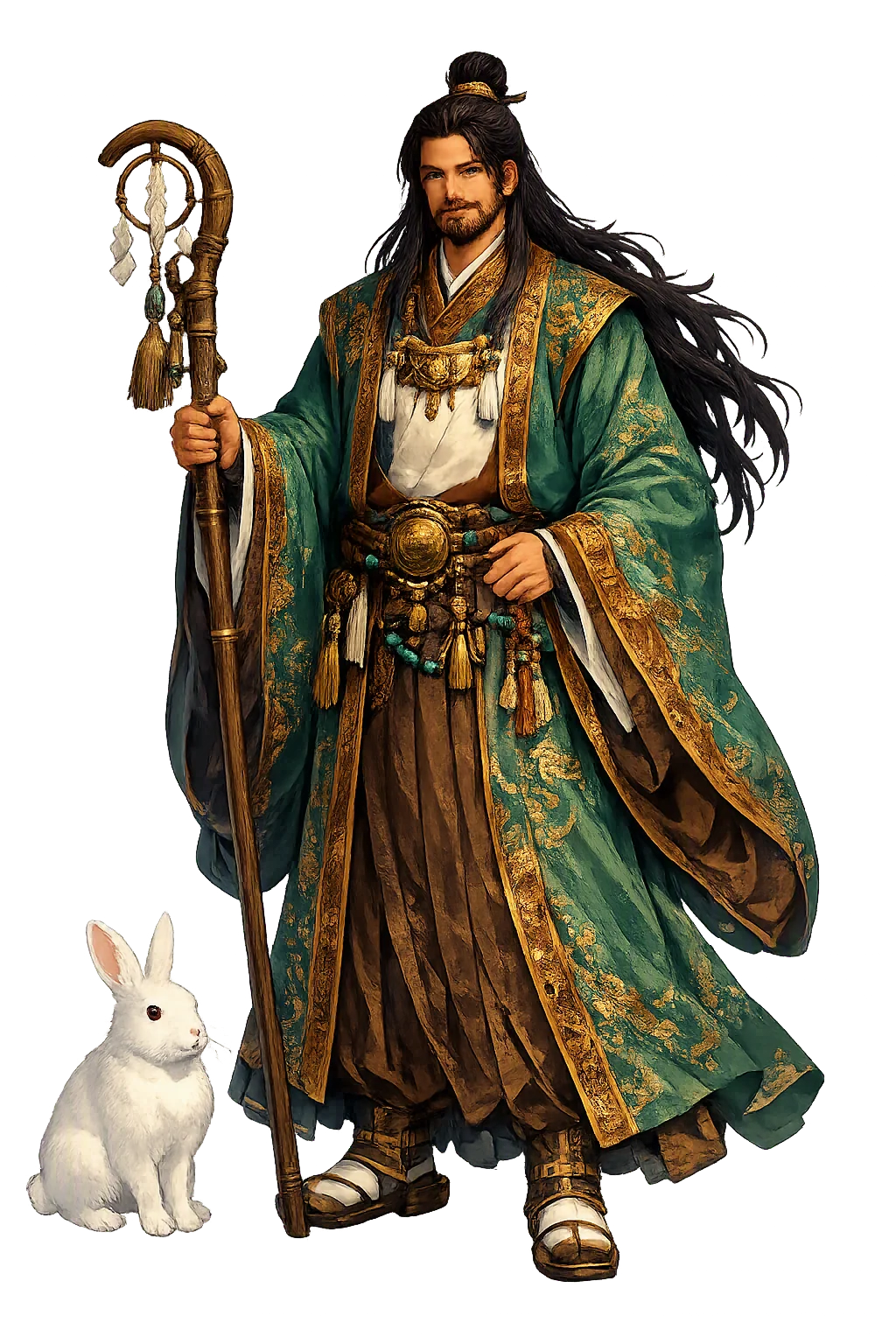
Ōkuninushi through the eyes of sculptors, painters, and craftsmen across the ages

Ōnamuchi no Mikoto — Aoki Shigeru's great Meiji canvas (Ishibashi Museum of Art, Kurume). Slain by his eighty brothers, the lord of Izumo lies in the grass while the two shell-goddesses sent by Kamimusubi anoint him with clam milk — the Kojiki's resurrection of the land-builder, painted at the height of Japan's Western-style art.

Prince Okuni and a Hare — Yashima Gakutei, surimono, probably 1819 (Metropolitan Museum of Art). The white-haired god of Izumo stands in chrysanthemum-patterned robes on a rocky shore, the White Hare of Inaba crouched at his feet — the little prophet whose blessing made Ōkuninushi master of the Central Land of Reed-Plains.

Ōnamuchi from the Shinbutsu-zue — Edo-period woodblock compendium of the kami and buddhas. Haloed and staff in hand, the god sits beneath a litany of his seven names — Ōkuninushi, Ōnamuchi, Ōmononushi — the standard early-modern icon of the deity who built and then yielded Japan's heartland.

Bronze of Ōkuninushi and the White Rabbit — Jishu Shrine, Kyoto's famed shrine of love-matches. Mallet raised, the god of nation-building stands beside the hare he healed at Cape Keta — the act of kindness that won him a kingdom, cast in bronze where couples still pray for en-musubi, the tying of fates.

Ōkuninushi and the Field Mouse — Meiji-era book illustration, 1911. Amid the burning meadow of Susano-o's cruelest trial, a field mouse leads the god to a burrow and returns his arrow — the Kojiki's proof that the smallest ally can undo a storm-god's trap.

Ōkuninushi asks the toad — illustration from Izumo Shinwa, 1938. The god points across the water at a tiny approaching craft while the toad names its rider — Sukunabikona, the dwarf god come in a kagami-bune to help Ōkuninushi finish building the land.

The Kōjindani bronze cache — Shimane Museum of Ancient Izumo. Three hundred fifty-eight bronze swords, spears and bells buried in ritual order in Yayoi-period Izumo — the unearthed arsenal of the ancient land Ōkuninushi ruled, and by his own word surrendered to the heavenly sun-line.
