
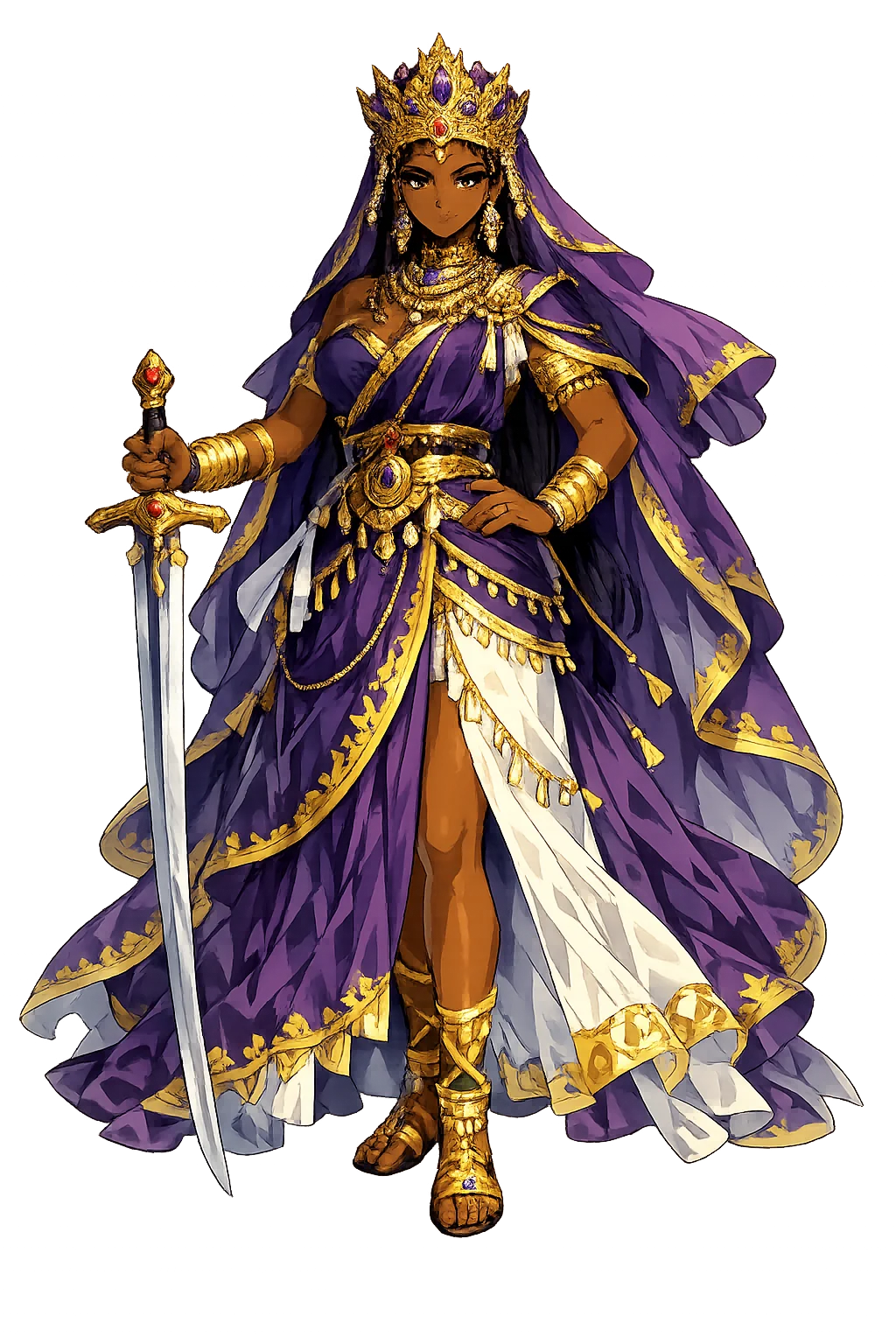
The many faces of Ọba
No important name has only one face. Ọba appears as a figure of myth, a scholarly reconstruction, a piece of material culture, a memory carried across languages, and — most recently — a Unicode domain. This post looks at each face in turn: the name and its roots, the Yoruba transcription original, the reconstructed pronunciation, the mythological record, the symbols and sanctuaries, the cross-cultural afterlife, and the engineering that lets the restored spelling resolve in a browser. Taken together, those faces explain why oba was never going to be enough — and why the restored form is worth a domain of its own.
At a Glance
- Restored name: Ọba
- ASCII form: oba
- Meaning: "The river orisha Ọba — co-wife of the thunder god, lady of the sacred waters"
- Domain of influence: River, Devotion, Sanctuary
- Pantheon: Yoruba
- Classification: Tier 1
- Live domain: ọba.com
Overview
Ọba (oba) — River, Devotion, Sanctuary · The river orisha Ọba — co-wife of the thunder god, lady of the sacred waters — belongs to the Yoruba tradition, where it is catalogued under the domain "River, Devotion, Sanctuary". The name means "The river orisha Ọba — co-wife of the thunder god, lady of the sacred waters".
Ọba is the river orisha who loved and lost: the third and most senior wife of Ṣàngó, whose jealousy cost her an ear and whose grief became a lake. She is the Yoruba study of endurance — the quiet river that outlasts the storm-god's louder wives.
PuniCodex restores the name as Ọba and serves its temple at ọba.com. The original carries both stress and vowel length, and exactly one historically valid Unicode restoration exists, which places the name in Tier 1. The plain ASCII form oba survives as a modern convenience imposed by the early domain-name system; the restoration, not the fallback, is the form the project defends as philologically complete.
The Name
No indigenous written attestation survives for this name; Ọba is a scholarly transliteration of the reconstructed spoken form. Etymologically the name means "The river orisha Ọba — co-wife of the thunder god, lady of the sacred waters".
The ASCII form oba survives only because the early domain-name system could not carry diacritics; it is a technological compromise, not an ancient spelling. The Unicode restoration Ọba recovers the full diacritic detail of the scholarly transliteration directly in the address bar. The original carries both stress and vowel length, and exactly one historically valid Unicode restoration exists, which places the name in Tier 1.
The letter-by-letter transformation runs:
- o → Ọ — Open-mid o with underdot
- b → b — Same
- a → a — Same
The project holds the domain ọba.com (xn--ba-58s.com) as the canonical home of this name.
The Original Script
No indigenous writing system is securely attested for individual yoruba names. The form shown is a modern scholarly transliteration.
The form Ọba is therefore a scholarly transliteration rather than an attested ancient spelling; it encodes the reconstructed sound of the name for modern use, and no mark in it is decorative.
Pronunciation
The reconstructed pronunciation of the name is /ɔ̀.bá/ — Standard Yoruba.
For the modern speaker, the closest approximation is: aw-BAH — open o, low-high melody.
Kindred and historical forms of the name:
- Yoruba — Ọ̀bá
- Cuba (Santería) — Obá
- Owned form — Ọba
Ọba names the river orisha of the Ọba River; the precomposed dot-below Ọ is the domain-maximal form (tone marks cannot be registered), and the fuller tone-marked Ọ̀bá is preserved in the temple's display text. The dot-below marks the open-mid vowel; the fuller tonal form Ọ̀bá is preserved in the temple's display text.
Mythology
Ọba's myths are domestic tragedy told as hydrology: the co-wife's war that became a river and a lake.
Three Wives, One Storm (The Rivalry)
Ṣàngó, the thunder-king, took three river-wives: Ọba the senior, Ọṣun the beloved, and Ọya the storm-sharer. The oríkì tell how Ọba, seeing her husband's love flow to Ọṣun, schemed — and how Ọṣun, learning of it, tricked her in return: she told Ọba the king loved the ear of a woman in his soup, and Ọba, desperate to be loved, cut her own ear and cooked it for him.
The Ear in the Soup (The Rage)
When the trick was revealed, Ṣàngó's disgust and rage drove her from the palace; the co-wives laughed, and Ọba fled north, weeping. She hid her maimed head under her crown and her hair — which is why her images cover the ears — and the thunder-king, in the later tellings, never stopped regretting the day. Her myth is the Yoruba warning about jealousy: not the villain's punishment, but the victim's endurance.
The Water of Her Grief (The Lake)
Her tears became her realm: the Ọba River and the lake of her worship, where her priests keep her cult to this day. The co-wives' war never ended — Ọba and Ọya still cannot be honored in the same shrine — but her people say the senior wife outlasted them: storms pass, the river stays. The crown that hides her ear is her whole theology: dignity is what you keep when you have lost what you loved.
Symbols & Iconography
The iconography associated with Ọba concentrates in a small set of recurring attributes, each a compressed statement about the name:
- The covered ear — Wounds hidden and endured — dignity after injury
- The brass bracelet — Her marriage-token from the thunder-king
- The red parrot feather — Her sign beside the other wives' red
Archaeology & Evidence
Her river rises in the hills of the Ọyọ country, and her cult-centers at Ọṣogbo and the Ọba lake preserve her shrines and her priests; the brass and terracotta figures of the covered-ear goddess are documented in the museum collections from Ifẹ̀ to Havana. The oríkì of the three wives, recorded by Bascom and others, is among the finest domestic myth-cycles in the Yoruba corpus.
Realm & Domain
Ọba is the river orisha who loved and lost: the third and most senior wife of Ṣàngó, whose jealousy cost her an ear and whose grief became a lake. She is the Yoruba study of endurance — the quiet river that outlasts the storm-god's louder wives.
The Ọba River
Her water in Yorubaland — the stream that bears her name and her temperament.
The Hidden Ear
The ear she lost to Ṣàngó's rage — hidden under her crown and her hair.
The Senior Wife
First among the three — and last to be believed.
The Lake
Her grief made geography: the lake where the faithful mourn with her.
Across Cultures
In Cuba's Santería she is Obá, syncretized with Santa Catalina de Alejandría (Saint Catherine, whose wheel she shares) — her cult strong in Matanzas; in Brazil's Candomblé, Obá keeps her river and her covered ear, the devotee-dancers' hair arranged to hide what the king did. The three-wife cycle (Ọba-Ọṣun-Ọya) is the diaspora's standard parable of the polygamous household, told wherever the orisha went.
Within the Yoruba tradition, closely related names in the corpus include [[aganju|Aganjú]], [[babaluaye|Ọbalúayé]], [[eshu|Ẹṣu]], [[obatala|Ọbatálá]], [[ogun|Ògún]], and [[olodumare|Olódùmarè]].
Cultural Legacy
Her image — the crowned figure hiding her ears — is one of Yoruba art's most intimate: the wound as regalia. The co-wives' cycle structures the orisha households of two continents; her river in Yorubaland keeps her shrines active; and the "Obá" of Cuban Santería is beloved as the most patient of the female orisha — the one who teaches that endurance is also a form of power.
The Scholarly Record
The account of Ọba given in this edition rests on the witnesses and reference works listed below. Lexica and etymological dictionaries secure the form and meaning of the name; the literary and religious texts supply the narrative evidence.
- William Bascom, Ifa Divination: Communication Between Gods and Men in West Africa, Indiana University Press, 1969.
- E. Bolaji Idowu, Olódùmarè: God in Yoruba Belief, Longmans, Green & Co., 1962.
- Abraham (biblical patriarch / Genesis narrative), Book of Genesis, 1000 BCE.
- Folklore (traditional oral narrative), Oral traditions, various.
- Cambridge Ancient History, Multiple volumes, 1970. Full text
- Oxford Classical Dictionary, 4th ed., Oxford University Press, 2012. Full text
A Meditation
Ọba is the goddess of what remains when the shouting is over. The storm-wives got the thunder; she got the river — and rivers outlive storms by definition. Her crown covers her ear, not her shame: the difference is everything. She asks the question the senior wife knows best: after the injustice, what do you cover, what do you keep, and what do you let become a lake?
The priests say her crown was made to her own design, after the flight — the first piece of jewelry in the corpus that exists to hide a wound and to honor it at once. Everyone who has dressed carefully on a difficult morning knows her liturgy. The river does not hide; it covers, and continues.
The co-wives' war never officially ends in the tellings — Ọba and Ọya still cannot share a shrine — and that honesty is the corpus' gift: reconciliation is not mandatory, but endurance is possible. Her lake holds its annual mourners quietly, without demanding anyone forgive. The river just keeps being a river, which is the last word of every telling.
The priests arrange the devotee's hair the same way she arranged hers — forward, covering — and the gesture has crossed four hundred years and an ocean intact. In Matanzas they say her patience is the kind the world does not notice until it is the only thing left standing. The thunder made his point; the river is still making hers.
Her lake keeps what the palace could not: a congregation that has never once asked her to be anyone else. The covered ear, the crown, the river, the patience — the whole of her is a single sentence, and it reads the same in Ọṣogbo and Matanzas: endurance is not surrender; it is sovereignty, kept quietly, until the storm runs out of thunder.
The storm-wives write the loud chapters; she writes the long one. And long chapters are the ones the grandchildren keep.
The river does not argue its case. It simply arrives, season after season, until the whole valley agrees: the quiet one was the permanent one all along.
The Unicode Restoration
Ọba is classified as Tier 1: the original carries both stress and length, and only one valid Unicode restoration exists. The ASCII fallback oba still resolves everywhere, but it is the restored form that carries the name's full information. Across the 3 characters of the name, the restoration adjusts 1: 1 further adjustment (Ọ). That is the whole thesis of this temple: the marks are the message.
Character by Character
The journey from oba to Ọba, one character at a time:
- o → Ọ — Open-mid o with underdot
- b → b — Same
- a → a — Same
The Domain Name
The restored name is live as a working domain: ọba.com, which the DNS carries in punycode form as xn--ba-58s.com — an ASCII-compatible encoding that lets a non-ASCII name travel the global network without breaking older infrastructure. The visitor sees Ọba; the machines see the encoding. That duality is the engineering compromise on which the entire restoration rests, and it is why a name written the way its own tradition wrote it in Yoruba transcription can now be typed into any browser on earth.
The Yoruba Pantheon
Ọba is one of 32 entries the PuniCodex lexicon catalogues under the Yoruba pantheon. The Pantheon page gathers the tradition's major figures in one place, and the Lexicon lets you filter all 924 restorations by tradition, tier, or script — the fastest way to see where this name sits among its kin.
Frequently Asked Questions
What does Ọba mean? The traditional gloss is "The river orisha Ọba — co-wife of the thunder god, lady of the sacred waters."
Which tradition does Ọba belong to? Ọba is catalogued in the Yoruba pantheon of the PuniCodex lexicon.
Why is Ọba classified as Tier 1? Because the original carries both stress and length, and only one valid Unicode restoration exists — and the marks in the restored spelling preserve exactly that evidence.
Is Ọba a working domain? Yes — ọba.com resolves today and routes to this temple.
What is the punycode for ọba.com? The DNS encoding is xn--ba-58s.com; browsers perform the translation automatically, so visitors only ever see the restored name.
Typing Ọba
You do not need a special keyboard to use this restoration. The PuniCodex Type Tool converts the ASCII form oba into Ọba as you type, and the browser extension offers the same conversion inside any text field. Copy the restored form, paste it into the address bar, and the DNS does the rest.
Sister Temples
Other temples in the Yoruba pantheon include Olókun, Ọrúnmìlà, and Ọṣumàrè — each with its own restoration story, its own scholarly record, and its own place in the lexicon.
Why This Restoration Matters
Myth, script, sound, cult, legacy, domain: the faces of Ọba add up to a single argument — that a name is a record, and records deserve fidelity. The PuniCodex restoration keeps that record in working order: the temple presents it, the Scholarly Edition footnotes it, the lexicon catalogs it, and the domain makes it addressable. oba will always exist as a fallback. But fallback is not identity. Ọba is the name; everything else is a convenience.
Explore Further
This post is one doorway into the temple. The home page carries the full character breakdown and the ambient canvas; the lore page tells the myths in long form; the Scholarly Edition preserves the sources, pronunciation data, and revision history; and the patron wall supports the restoration directly. For the wider map, browse the Lexicon, explore the Pantheon, or return to the PuniCodex blog.
Related Names
Sources
The full scholarly apparatus — every citation, revision, and review — lives in the Scholarly Edition. Key references for this post:
- Cambridge Ancient History, Multiple volumes, 1970.
- Oxford Classical Dictionary, 4th ed., Oxford University Press, 2012.
- Bascom, Ifa Divination (the co-wives odù).
- Idowu, Olodumare (Ogun and river oríkì); the Ọba shrine traditions.
- Bascom, Shango in the New World (Obá cults); the Matanzas records.
- William Bascom, Ifa Divination: Communication Between Gods and Men in West Africa, Indiana University Press, 1969.
- Lexicon authorities for this entry: Idowu, Bascom, Abraham, Folklore, Cambridge, Oxford.