
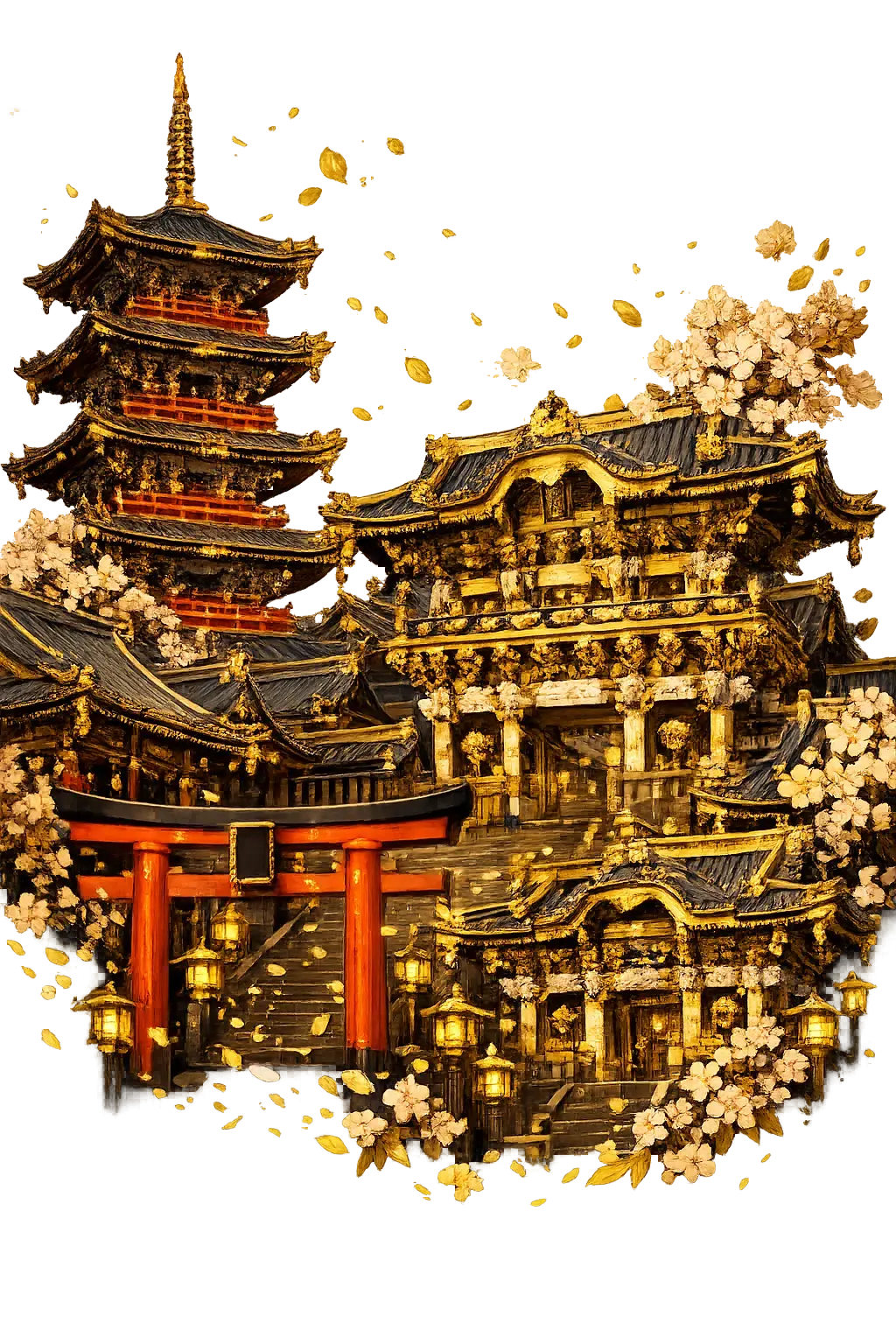
Stress-testing Nikkō: do the industry seats hold?
Audit: Nikkō, seat by seat. The atlas makes claims; the myths decide which ones stand. This is the record of what held.
At a Glance
- Temple: Nikkō
- Pantheon: Japanese
- Domain of influence: Sacred Site, Tochigi
- Pattern seats: 5
- Sectors touched: Culture & Entertainment · Home & Lifestyle · Energy & Natural World · Society & Spirit
- Strongest seat: Travel, Tourism & Place Branding
- Series: The Resonance Files, No. 164 of 271
The Test
Seat 1: Travel, Tourism & Place Branding
Claim: UNESCO shrines under sunlight; Japan’s sacred getaway. Exhibit: Shōdō Shōnin and the Sacred Bridge — According to tradition, the Buddhist monk Shōdō Shōnin founded the first temple at Nikkō in the 8th century.
Verdict: stands. Strip both to their function and the functions match.
Seat 2: Architecture & Spatial Design
Claim: Tōshōgū is the baroque apex of Japanese shrine architecture; Yōmeimon its showpiece. Exhibit: The Deification of Tokugawa Ieyasu — After his death in 1616, Tokugawa Ieyasu was enshrined at Nikkō as Tōshō Daigongen, a manifestation of the Buddhist divinity Yakushi Nyorai and the Shinto sun goddess Amaterasu.
Verdict: stands. Strip both to their function and the functions match.
Seat 3: Forestry, Conservation & Outdoor Industries
Claim: Thousands of giant cryptomeria line her avenues; the approach itself is a sacred forest. Exhibit: Separation of Shinto and Buddhism — The Meiji government's policy of shinbutsu bunri forcibly separated Shinto and Buddhism.
Verdict: holds under load. The correspondence is functional, not decorative.
Seat 4: Funerary & Memorial Services
Claim: The shrine-tomb of the deified Ieyasu; Japan's most opulent mausoleum. Exhibit: Shōdō Shōnin and the Sacred Bridge — According to tradition, the Buddhist monk Shōdō Shōnin founded the first temple at Nikkō in the 8th century.
Verdict: holds under load. The correspondence is functional, not decorative.
Seat 5: Solar & Renewable Energy
Claim: The name means sunlight; the sacred site brands itself on radiance. Exhibit: The Deification of Tokugawa Ieyasu — After his death in 1616, Tokugawa Ieyasu was enshrined at Nikkō as Tōshō Daigongen, a manifestation of the Buddhist divinity Yakushi Nyorai and the Shinto sun goddess Amaterasu.
Verdict: survives scrutiny. The myth and the trade do the same work.
The Control Group
Against the seats that survived, one control: the temple's own summary of its figure — Nikkō's mythology is both ancient and recent. The seats do not drift far from it. That is the audit's cleanest result.
The Method, Stated Plainly
Skeptical? Good — the system is built for you. Every seat in this file carries its why-line and its weight, the full derivation is public at the methodology page, and the challenge process is part of the design. Falsifiable is not a posture here; it is the mechanism.
For the Ones Who Work There
For a sponsor in travel, tourism & place branding, the fit here is not adjacency — it is inheritance. Your trade already tells this story every working day; the temple simply holds the original. The patron tier and the advertising terms carry the mechanics; the myths above carry the reason.
The File Continues
This is one of 271 Resonance Files — the third dispatch from every flagship temple, where the myths meet the markets. The temple's founding dispatch tells the name's story; its Restoration File tells the spelling's; the blog index holds the whole archive.
Continue the series — previous: Níkē (read it) · next: Nirmātā (read it).
The Resonance Files are argued from the same canonical record as the pattern atlas itself: the lexicon, the lore catalog, and the cited sources. Every seat can be challenged at the methodology page — and the challenge is the point.