Unicode restoration and ASCII comparison
日光
The name in its original Japanese form. Nikkō (日光) is attested in the source tradition — “Sunlight”. Its macron-length vowels carry the full phonetic and orthographic weight of the source tradition.
nikko
Reduced to plain nikko, the name loses everything that made it specific: macron-length vowels. What remains is an ASCII string that machines can parse but that no longer speaks with its original voice.
Nikkō
The Unicode restoration recovers what ASCII flattened. Nikkō restores macron-length vowels, returning the name to its original written dignity. The domain encodes to Punycode, but the browser displays the truth.
Nikkō.com → xn--nikk-o3a.com
The non-ASCII characters in Nikkō are encoded while the ASCII remains visible. To the DNS, it is Punycode. To humanity, it is Nikkō.
How Nikkō travels from ancient script to the modern URL
From Middle Chinese *nyit-kwang 'sunlight' (日 *nyit + 光 *kwang); borrowed into Japanese as Sino-Japanese nikkō.
Sunlight; by extension the sacred site and UNESCO World Heritage complex at Nikkō.
Nikkō with macron is Tier 1 because the long vowel is the only distinctive feature; the ASCII form Nikko loses length. The kanji form is not used as a .com domain because Japanese scripts are not in the .com IDN table.
How Nikkō was spoken
Mountain Shrine, Tokugawa Memorial, and Living Heritage
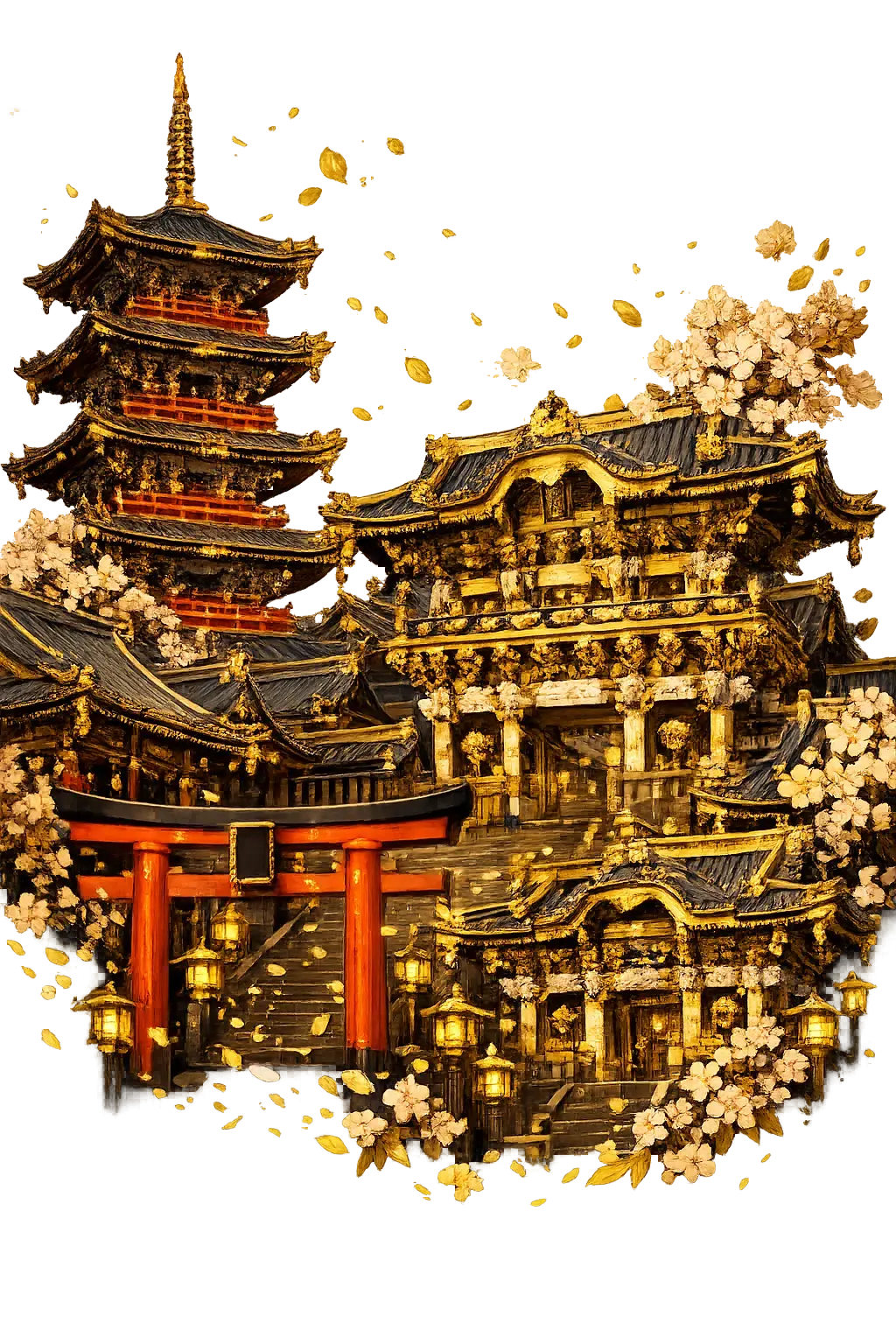
Nikkō is the town, the mountain, and the luminous name that binds them. In Japanese, the word means simply 'sunlight,' but by the 17th century it had become synonymous with one of Japan's most spectacular religious sites: the Tōshōgū shrine complex, where Tokugawa Ieyasu, the founder of the Tokugawa shogunate, was enshrined as the deified Tōshō Daigongen, 'Great Illuminating Deity of the East.'
Nikkō is where nature and politics meet in gold. Cedar avenues, waterfalls, and mountain mists frame shrines and mausoleums built with the wealth and craftsmanship of a newly unified Japan. It is a place of sunlight filtered through forest, of ancestral power made beautiful, and of Shinto-Buddhist synthesis at its most ornate.
The lavish shrine-tomb of Tokugawa Ieyasu, a UNESCO World Heritage site and masterpiece of early Edo art.
The famous 'see no evil, hear no evil, speak no evil' carving on the sacred stable.
Thousands of giant cryptomeria trees line the approach, turning the path itself into a sacred corridor.
The Shinkyō, a vermillion lacquered bridge over the Daiya River, marks the boundary between worlds.
Stories of Nikkō
Nikkō's mythology is both ancient and recent. The mountain had long been a site of Buddhist-Shinto practice, but its modern identity was forged by the apotheosis of Tokugawa Ieyasu and the extraordinary building campaign that followed his death.
According to tradition, the Buddhist monk Shōdō Shōnin founded the first temple at Nikkō in the 8th century. When he could not cross the turbulent Daiya River, the mountain deity appeared in a dream and offered two serpents to form a bridge. The Shinkyō, the vermillion lacquered bridge at the entrance to the shrine complex, commemorates this divine assistance and marks the boundary between the secular world and the sacred mountain.
After his death in 1616, Tokugawa Ieyasu was enshrined at Nikkō as Tōshō Daigongen, a manifestation of the Buddhist divinity Yakushi Nyorai and the Shinto sun goddess Amaterasu. His grandson Iemitsu rebuilt the complex between 1634 and 1636 with staggering opulence, employing thousands of craftsmen. The result was both a mausoleum and a political statement: the shogun's power now rested in a sacred mountain bathed in sunlight.
The Meiji government's policy of shinbutsu bunri forcibly separated Shinto and Buddhism. At Nikkō, Buddhist elements were stripped from the Tōshōgū, and the complex was reclassified as a Shinto shrine. Despite this rupture, the art and architecture of Nikkō preserve the hybrid religious world of early modern Japan, where kami and Buddhas were understood as local manifestations of one another.
Nikkō asks what it means to make power visible. The Tokugawa shogunate did not bury its founder in quiet simplicity; it wrapped him in gold, cedar, and carved beasts, turning a mountainside into a sermon on authority. Yet the forest is older than the shogunate, and the sunlight falls on the gates without preference.
Enter Extended Lore