
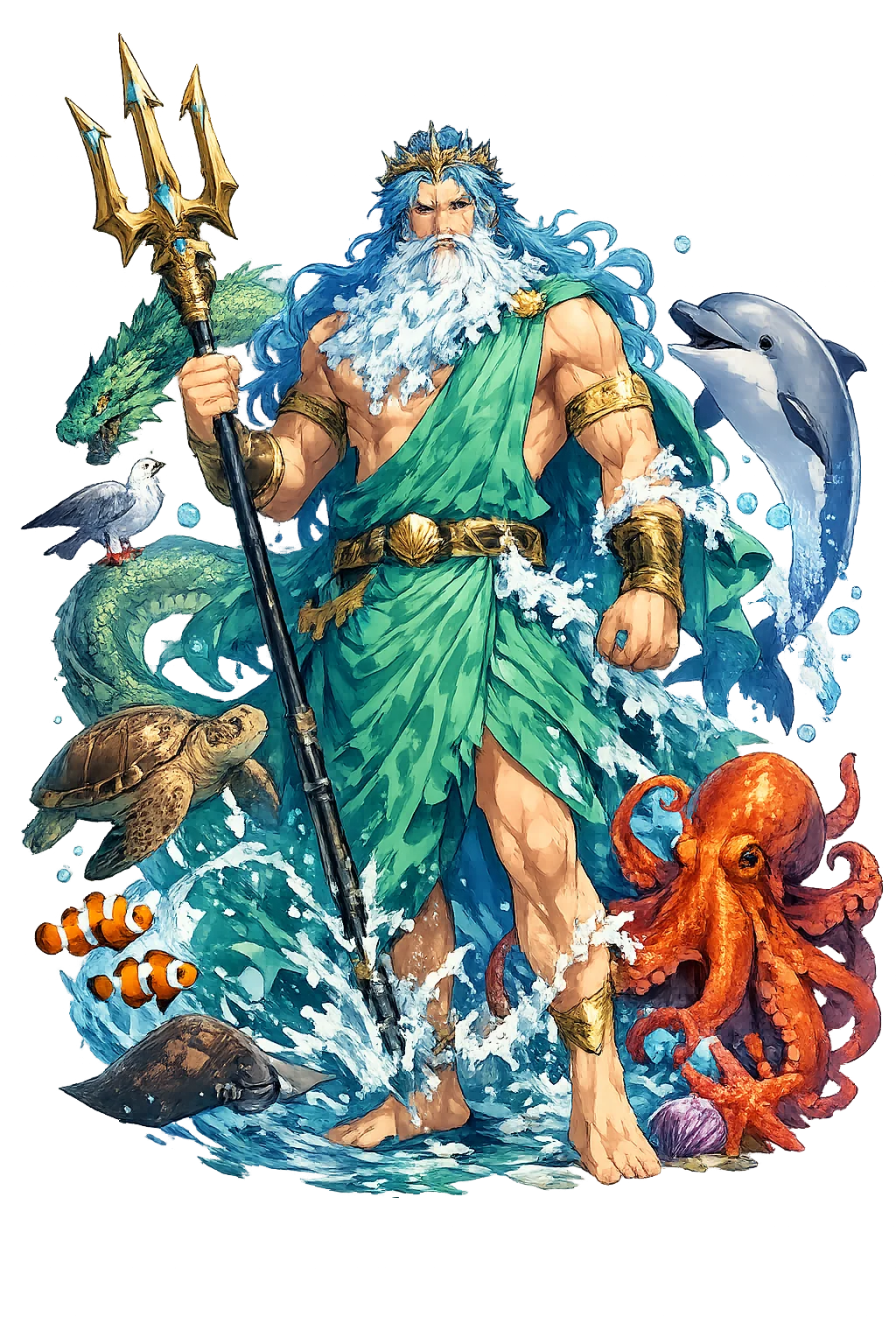
The provenance file on Neptūnus
Provenance record 161 · Neptūnus · one temple, fully accounted for.
Provenance
1. The attestation. —, from the tradition's own record. On record: Lewis & Short, Varro, Horace, Cicero.
2. The preserved evidence. u → ū (Macron marks the long vowel) — absent from the ASCII form neptunus, present in the restoration, verifiable against the sources above.
3. The narrative record. The Huts of Branches — The Neptunalia of July 23 is Rome's oldest water rite: families built umbrae — huts woven of leafy branches — and poured water offerings at the height of summer's drought. The god's first realm was the spring and the stream, the waters that keep a farm alive; the Mediterranean, with its trade and war, was the empire's later gift to him. Lord of the Race — As Neptunus Equester he shared the underground altar of Consus, god of stored grain, at whose games — the Consualia — horses and mules were garlanded and rested from labour. It was at one such festival that Romulus staged the seizure of the Sabine women: Rome's foundation story begins at Neptūnus' racetrack, with the horses watching.
4. The physical record. The Piacenza liver (3rd–2nd century BCE) inscribes Nethuns on the liver's sea-zone — the Etruscan original caught in bronze. His Roman temple stood by the Circus Flaminius; the great marine-thiasos mosaics of North Africa and Ostia show the imperial image: the god in his hippocamp chariot. In Britain, the genuine Neptune dedications stand on the empire's wet edge: altars to Neptune and Oceanus set up on the Tyne at Newcastle and South Shields (RIB 1319–20) and the Neptune-and-Minerva altar from Chichester (RIB 91).
5. The current holding. The temple at /sites/neptunus/, classified Tier 1. The restoration preserves more than the ASCII form can express — stress, length, or a letter the Latin keyboard lost — which places it, mechanically, in Tier-1.
6. The documented resonances. Maritime, Shipping & Ocean Industries, Freshwater & Hydrology, Disaster Resilience & Recovery — seats argued and weighted in the pattern atlas, read through the myths in this temple's Resonance File.
7. The primary sources. Metamorphoses — the library this file answers to, open at the Sacred Texts collection.
8. The continuing record. The planet Neptune — discovered by mathematics before telescopes (Adams and Le Verrier, 1846) — carries his name and trident symbol into every classroom. "Neptune's realm" is still navy slang for the open sea; the Order of Neptune initiates sailors crossing the equator; and the trident survives from Ukrainian heraldry to Maserati's badge.
At a Glance
- Restored name: Neptūnus
- ASCII form: neptunus
- Meaning: "Possibly related to nepos (descendant) or a pre-Roman water root"
- Domain of influence: Sea, Horses, Earthquake
- Pantheon: Roman
- Classification: Tier 1
- Original script: —
- Series: The Restoration Files, No. 161 of 271
The File Continues
Read the founding dispatch for the name's full story, the Resonance File for the archetype at work — or the whole archive in one sitting.
Continue the series — previous file: Muspellheimr (read it here) · next file: Nḫt (read it here).
The Restoration Files are written from the same canonical record as the temples themselves: the lexicon, the lore catalog, the pattern atlas, and the cited scholarly sources. If a file ever disagrees with its temple, the temple is right — tell us, and the file will be corrected.