
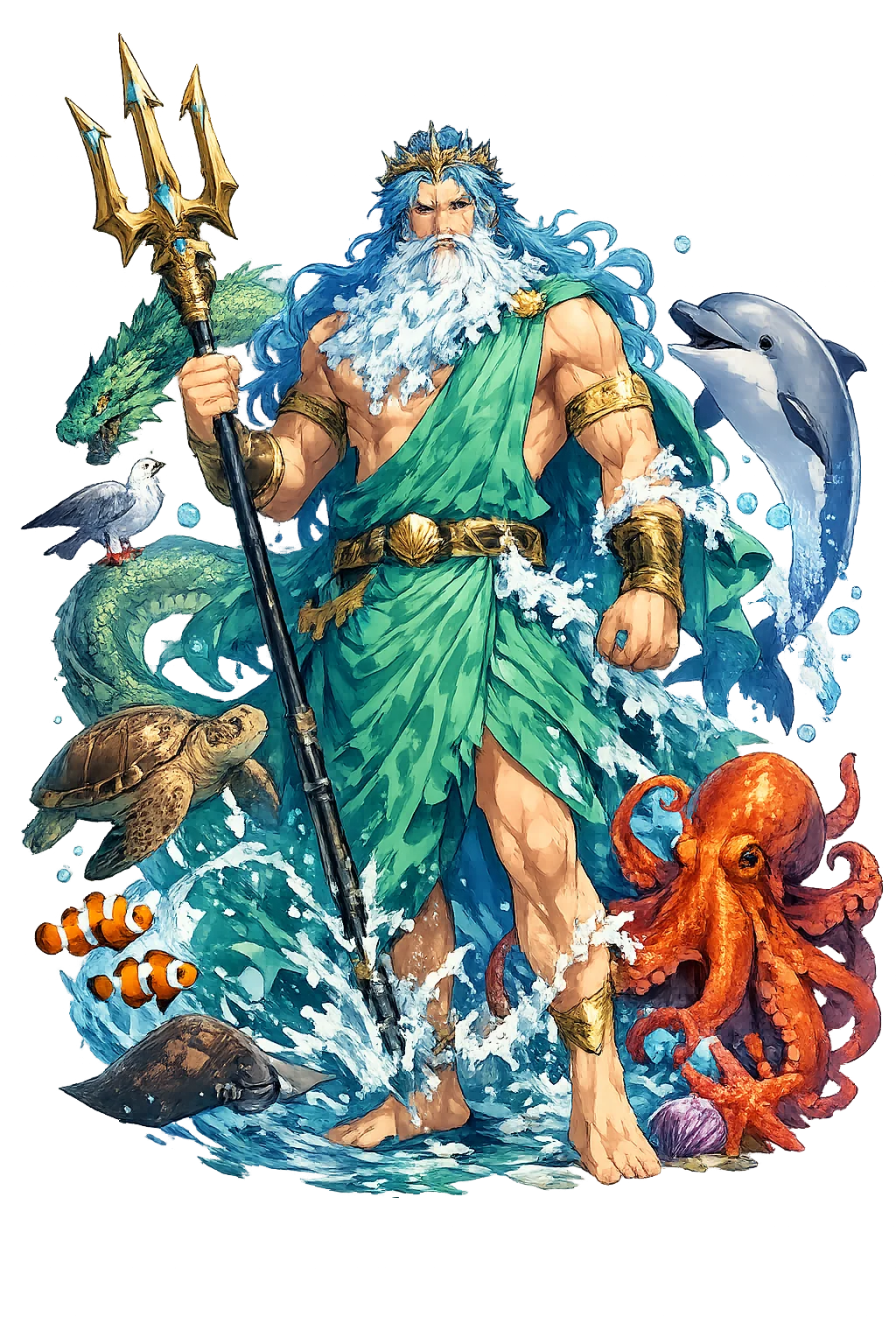
Neptūnus in 2026: why scholars still care
In 2026, names are treated as data points. Neptūnus is a reminder that they are also cultural artifacts — and that the difference matters for search engines, AI training corpora, and anyone who types the name of a Roman figure into a browser. Scholars never stopped caring about the difference between neptunus and Neptūnus; the web simply made that care actionable. What follows is the full scholarly picture — name, script, sound, myth, cult, and legacy — followed by the engineering compromise that lets a restored spelling live at a real address. The question is not whether the name is old. It is whether the digital world is old enough to hold it.
At a Glance
- Restored name: Neptūnus
- ASCII form: neptunus
- Meaning: "Possibly related to nepos (descendant) or a pre-Roman water root"
- Domain of influence: Sea, Horses, Earthquake
- Pantheon: Roman
- Classification: Tier 2
- Live domain: neptūnus.com
Overview
Neptūnus (neptunus) — The Lord of Waters — belongs to the Roman tradition, where it is catalogued under the domain "Sea, Horses, Earthquake". The name means "Possibly related to nepos (descendant) or a pre-Roman water root".
Neptūnus was god of fresh water before he was god of the sea: his oldest festival, the Neptunalia, falls in the parching days of late July, when Romans built huts of branches and prayed the waters not to fail. The Greek sea came later, and with it Poseidṓn's whole mythology.
PuniCodex restores the name as Neptūnus and serves its temple at neptūnus.com. The original preserves one prosodic feature — stress or vowel length — rather than both, which places the name in Tier 2. The plain ASCII form neptunus survives as a modern convenience imposed by the early domain-name system; the restoration, not the fallback, is the form the project defends as philologically complete.
The Name
No indigenous written attestation survives for this name; Neptūnus is a scholarly transliteration of the reconstructed spoken form. Etymologically the name means "Possibly related to nepos (descendant) or a pre-Roman water root".
The ASCII form neptunus survives only because the early domain-name system could not carry diacritics; it is a technological compromise, not an ancient spelling. The Unicode restoration Neptūnus recovers the vowel length of the original directly in the address bar. The original preserves one prosodic feature — stress or vowel length — rather than both, which places the name in Tier 2.
The letter-by-letter transformation runs:
- n → N — Same letter
- e → e — Same letter
- p → p — Same letter
- t → t — Same letter
- u → ū — Macron marks the long vowel
- n → n — Same letter
- u → u — Same letter
- s → s — Same letter
The project holds the domain neptūnus.com (xn--neptnus-3sb.com) as the canonical home of this name.
The Original Script
The original script for this roman name has not yet been added to PUNICODEX. The form shown is a scholarly transliteration.
The form Neptūnus is therefore a scholarly transliteration rather than an attested ancient spelling; it encodes the reconstructed sound of the name for modern use, and no mark in it is decorative.
Pronunciation
The reconstructed pronunciation of the name is /nepˈtuː.nus/ — Classical Latin.
For the modern speaker, the closest approximation is: nep-TOO-nus, long ū on the stressed second syllable.
Kindred and historical forms of the name:
- Latin — Neptūnus
- Greek twin — Ποσειδῶν
- Etruscan — Nethuns
- Owned form — Neptūnus
The etymology of Neptūnus is genuinely uncertain: the Etruscan sea god Nethuns stands behind him, and linguists have proposed a pre-Indo-European Mediterranean origin, with Pokorny suggesting a root for "damp, wet." The long ū of the second syllable is the secure classical quantity — the macron marks it in the restoration.
Mythology
Rome gave Neptūnus few native myths — his biography is Poseidṓn's translated — but the festival and the horse-cult are Italy's own, older than the sea-borrowing.
The Huts of Branches (The Drought)
The Neptunalia of July 23 is Rome's oldest water rite: families built umbrae — huts woven of leafy branches — and poured water offerings at the height of summer's drought. The god's first realm was the spring and the stream, the waters that keep a farm alive; the Mediterranean, with its trade and war, was the empire's later gift to him.
Lord of the Race (The Horse)
As Neptunus Equester he shared the underground altar of Consus, god of stored grain, at whose games — the Consualia — horses and mules were garlanded and rested from labour. It was at one such festival that Romulus staged the seizure of the Sabine women: Rome's foundation story begins at Neptūnus' racetrack, with the horses watching.
Minerva and the City (The Contest)
Roman retellings kept the Greek contest for Athens: Neptūnus struck the Acropolis with his trident and brought forth the salt spring — or the first horse — but Minerva's olive won the city's name. The myth explained, for Roman readers, why wisdom outranks force: a civic lesson the conquerors of the Mediterranean repeated against themselves.
Agrippa at Naulochus (The Plea)
When Agrippa destroyed Sextus Pompeius' fleet at Naulochus in 36 BCE, the victory was dedicated to Neptune — and the poet Horace marked the sea-god's favour to the Julian cause. Roman sea-power, relatively late in coming, made the borrowed god genuinely Roman: by the empire, Neptūnus had sailors' cults from Ostia to the British coast.
Symbols & Iconography
The iconography associated with Neptūnus concentrates in a small set of recurring attributes, each a compressed statement about the name:
- The trident — The fisher's tool exalted to kingship of three water-realms
- The horse — His second domain — waves and stallions share one crest
- The dolphin — His messenger and the sailor's friend
Epithets & Cult Titles
His Roman titles keep the memory of the land-water god under the sea-god.
- Equester — 'of the Horses'; his cult title at the Circus altar, shared with Consus.
- Pelagius — 'of the Open Sea'; the sea-faring title of the empire's sailors.
- Ennosigaios — 'Earth-Shaker'; Poseidṓn's Homeric title, translated and kept.
- Pater — 'the Father'; the old Italic water-father of the springs.
- Dominus maris — 'lord of the sea'; the imperial poets' full style.
Oracle Sites & Sanctuaries
His Roman temple stood by the Circus Flaminius, restored under the empire and tied to the horse-cult of the Consualia; the Neptunalia arbours of July 23 filled the fields around it. At Ostia, the harbour city's sailors kept his cult in the corporations' clubhouses, and the great marine mosaics of the baths show his thiasos exactly as the sailors imagined him. In the provinces his altars line the sea-roads: the Boulogne altar of the Classis Britannica and the curse-tablets of Britain's waters record the empire's vows to the god of crossings.
Archaeology & Evidence
The Piacenza liver (3rd–2nd century BCE) inscribes Nethuns on the liver's sea-zone — the Etruscan original caught in bronze. His Roman temple stood by the Circus Flaminius; the great marine-thiasos mosaics of North Africa and Ostia show the imperial image: the god in his hippocamp chariot. In Britain, the curse tablets of Bath and the altar of the Classis Britannica at Boulogne record sailors' vows to Neptune across the empire's wet edge.
Realm & Domain
Neptūnus was god of fresh water before he was god of the sea: his oldest festival, the Neptunalia, falls in the parching days of late July, when Romans built huts of branches and prayed the waters not to fail. The Greek sea came later, and with it Poseidṓn's whole mythology.
The Trident
The three-pronged fisher's spear that became the sceptre of the sea — and of a planet.
Neptunus Equester
His Roman title as horse-lord: the consus-cult of underground granaries and racing.
The Earth-Shaker
Ennosigaios in Greek, but Rome knew him too — the power that moves the ground the city stands on.
Neptunalia
July 23: arbours of woven branches, water rites at the height of the drought.
Across Cultures
His equation with Poseidṓn is one of the oldest certain interpretatio Romana; his Etruscan substrate Nethuns appears on the Piacenza liver, the bronze model used to read omens. In the provinces he fused with local water powers — the Celtic river gods of Gaul and the Germanic North Sea powers — and his name became the standard gloss for "whatever god rules deep water here."
Within the Roman tradition, closely related names in the corpus include [[diana|Diāna]], [[ianus|Iānus]], [[iuno|Iūnō]], [[iuppiter|Iūppiter]], [[vulcanus|Vulcānus]], and [[aseratu|Ašeratu]].
Cultural Legacy
The planet Neptune — discovered by mathematics before telescopes (Adams and Le Verrier, 1846) — carries his name and trident symbol into every classroom. "Neptune's realm" is still navy slang for the open sea; the Order of Neptune initiates sailors crossing the equator; and the trident survives from Ukrainian heraldry to Maserati's badge. Every western image of the sea as a person is his portrait.
The Scholarly Record
The account of Neptūnus given in this edition rests on the witnesses and reference works listed below. Lexica and etymological dictionaries secure the form and meaning of the name; the literary and religious texts supply the narrative evidence.
- Lewis & Short, A Latin Dictionary, Oxford, Clarendon Press; Perseus digitization, 1879. Full text
- Varro, De Lingua Latina / Antiquitates Rerum Divinarum, Loeb Classical Library, 45 BCE.
- Horace, Carmina / Opera, Oxford Classical Texts; Loeb, 23 BCE.
- Cicero, Marcus Tullius — collected works, Loeb Classical Library, 43 BCE. Full text
- Indogermanisches etymologisches Wörterbuch, 2 vols., Francke, 1959. Full text
- Cambridge Ancient History, Multiple volumes, 1970. Full text
A Meditation
Neptūnus began as the water that must be prayed for and became the water that must be crossed. He holds both truths: the sea that feeds and the sea that swallows, the spring in the drought and the earthquake under the harbour. To sail, to drill a well, to trust the ground — each is a small treaty with him.
The drought-festival and the sea-empire belong together, and the old god keeps both books still: the water we pray for and the water we fear, the well and the wave. Every age that pumps an aquifer or insures a coastline is doing his liturgy in engineering — asking the question his festival asked in the July heat: will the water come, will it be enough, and what will it cost when it does?
The Unicode Restoration
Neptūnus is classified as Tier 2: the original preserves at least one philological feature that ASCII cannot encode. The ASCII fallback neptunus still resolves everywhere, but it is the restored form that carries the name's full information. Across the 8 characters of the name, the restoration adjusts 1: 1 mark of length (ū). That is the whole thesis of this temple: the marks are the message.
Character by Character
The journey from neptunus to Neptūnus, one character at a time:
- n → N — Same letter
- e → e — Same letter
- p → p — Same letter
- t → t — Same letter
- u → ū — Macron marks the long vowel
- n → n — Same letter
- u → u — Same letter
- s → s — Same letter
The Domain Name
The restored name is live as a working domain: neptūnus.com, which the DNS carries in punycode form as xn--neptnus-3sb.com — an ASCII-compatible encoding that lets a non-ASCII name travel the global network without breaking older infrastructure. The visitor sees Neptūnus; the machines see the encoding. That duality is the engineering compromise on which the entire restoration rests, and it is why a name written the way its own tradition wrote it in Original Script can now be typed into any browser on earth.
The Roman Pantheon
Neptūnus is one of 6 entries the PuniCodex lexicon catalogues under the Roman pantheon. The Pantheon page gathers the tradition's major figures in one place, and the Lexicon lets you filter all 915 restorations by tradition, tier, or script — the fastest way to see where this name sits among its kin.
Frequently Asked Questions
What does Neptūnus mean? The traditional gloss is "Possibly related to nepos (descendant) or a pre-Roman water root."
Which tradition does Neptūnus belong to? Neptūnus is catalogued in the Roman pantheon of the PuniCodex lexicon.
Why is Neptūnus classified as Tier 2? Because the original preserves at least one philological feature that ASCII cannot encode — and the marks in the restored spelling preserve exactly that evidence.
Is Neptūnus a working domain? Yes — neptūnus.com resolves today and routes to this temple.
What is the punycode for neptūnus.com? The DNS encoding is xn--neptnus-3sb.com; browsers perform the translation automatically, so visitors only ever see the restored name.
Typing Neptūnus
You do not need a special keyboard to use this restoration. The PuniCodex Type Tool converts the ASCII form neptunus into Neptūnus as you type, and the browser extension offers the same conversion inside any text field. Copy the restored form, paste it into the address bar, and the DNS does the rest.
Sister Temples
Other temples in the Roman pantheon include Diāna — each with its own restoration story, its own scholarly record, and its own place in the lexicon.
Why This Restoration Matters
In 2026 the stakes are practical. Search indexes, language models, and localization pipelines all inherit whatever spelling the web normalizes — which means every Unicode domain is also a training signal. Neptūnus teaches the machinery that the restored form exists, that it is used, and that it points to a real place. That is why a project built on philology ends up caring about DNS: the infrastructure decides which names the future sees. This restoration makes sure the future sees the whole name.
Explore Further
This post is one doorway into the temple. The home page carries the full character breakdown and the ambient canvas; the lore page tells the myths in long form; the Scholarly Edition preserves the sources, pronunciation data, and revision history; and the patron wall supports the restoration directly. For the wider map, browse the Lexicon, explore the Pantheon, or return to the PuniCodex blog.
Related Names
Sources
The full scholarly apparatus — every citation, revision, and review — lives in the Scholarly Edition. Key references for this post:
- Virgil (Publius Vergilius Maro), Aeneid / Eclogues / Georgics, Loeb Classical Library / Oxford Classical Texts, 19 BCE.
- Lewis & Short, A Latin Dictionary, Oxford, Clarendon Press; Perseus digitization, 1879.
- Cicero, Marcus Tullius — collected works, Loeb Classical Library, 43 BCE.
- Indogermanisches etymologisches Wörterbuch, 2 vols., Francke, 1959.
- Cambridge Ancient History, Multiple volumes, 1970.
- Varro, De Lingua Latina / Antiquitates Rerum Divinarum, Loeb Classical Library, 45 BCE.
- Horace, Carmina / Opera, Oxford Classical Texts; Loeb, 23 BCE.
- Varro and Festus on Neptunus Equester; Horace, Odes 1.5.
- The Ostia mosaic corpora; CIL XIII (Boulogne altar).
- Lexicon authorities for this entry: Lewis & Short, Varro, Virgil.