
Why Muspellheimr is spelled that way — and what it costs to get it right
There is a version of this name the early internet had to settle for: muspellheimr. This is the file on how Muspellheimr replaced it.
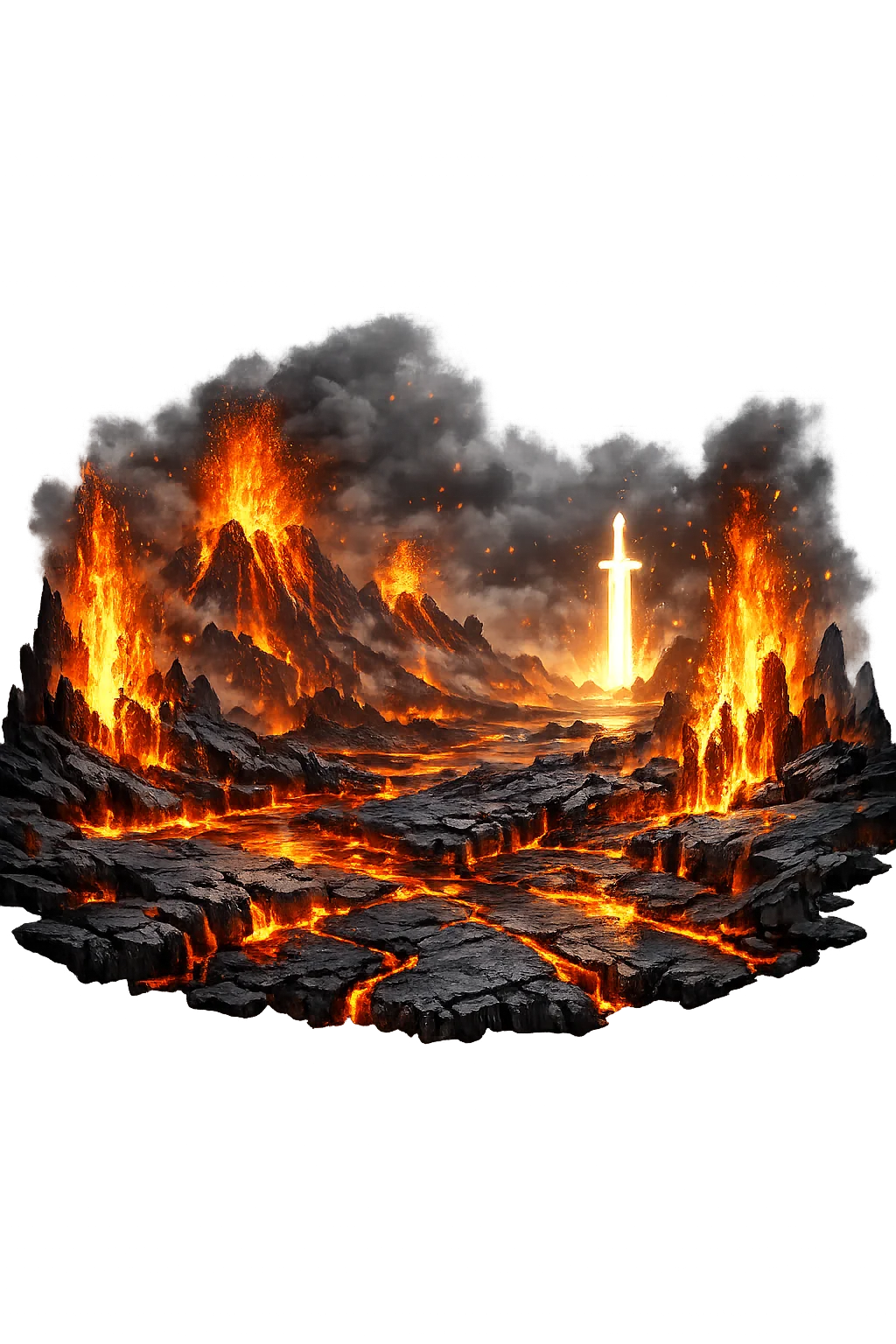
Muspellheimr is the world of fire, the southern realm of flame that existed even before the ordered cosmos was shaped. It is the home of Surtr, the fire giant who will lead its sons across Bifröst at Ragnarǫk, burning the world and slaying Freyr. Unlike Niflheimr's ice, Muspellheimr represents unconstrained destruction and the heat that first melted the primordial rime, allowing Ymir to emerge from Ginnungagap. No gods dwell there permanently; its inhabitants are fire giants and burning beings for whom order itself is fuel. Medieval Icelanders, living in the shadow of Hekla and Eldgjá, knew this fire firsthand; their lava fields gave empirical weight to the idea of a southern world of flame. Its fire is both creative and terminal, the furnace and the final conflagration. Muspell's fire is older than creation and will survive its end. Snorri's account makes it the southern origin of the world-destroying force that surges under Surtr's leadership at Ragnarǫk. The realm thus embodies the apocalyptic insight that the same heat that first quickens life will finally consume the ordered cosmos.
At a Glance
- Restored name: Muspellheimr
- ASCII form: muspellheimr
- Meaning: "Muspel-home (world-ender)"
- Domain of influence: World of Fire
- Pantheon: Norse
- Classification: Tier 2
- Original script: ᛘᚢᛋᛒᛁᛚᛚᚼᛁᛘᚱ
- Series: The Restoration Files, No. 160 of 271
The Name Before the Marks
Spoken, the name runs `/ˈmus.pelˌhɛi̯mr/` — 'MOOS-pel-haymr' — stress the first syllable, keep the vowels short, and glide through the final 'haymer'.
The Temple That Stands Now
The restored name is not a plaque; it is an address. The temple of Muspellheimr lives at /sites/muspellheimr/, with its mythology in the lore halls, its peer-reviewed record in the Scholarly Edition, and its place in the pattern atlas on the patterns floor.
The restoration keeps one feature the ASCII form drops. One is enough to matter, and the label says so plainly: Tier-2.
Where the Name Stood First
The fiery south is anchored in the volcanic geology witnessed by medieval Icelanders. The Eldgjá fissure eruption of c. 939 CE and repeated Hekla eruptions supplied an empirical model for a world of flame. The name Muspell itself echoes continental Germanic eschatological fire poems such as the Old High German Muspilli, preserved in the manuscript at the Bavarian State Library. The temple on the web is the newest of these addresses — the first one that fits in a pocket.
The Archetype at Work
The pattern atlas seats this temple in 5 industries, each match argued and weighted: Thermal, Geothermal & Fire Energy (the world of fire at creation’s edge, home of Surtr’s ember-host — primordial heat as a realm.); Disaster Resilience & Recovery (the world-fire under Surtr — the conflagration the industry exists to model and survive.); Environmental & Climate Services (creation and destruction fueled by the same primordial heat; the myth the climate debate keeps rediscovering.). The Resonance File reads those seats through the myths themselves.
In the Sacred Texts
The Norse tradition is not a vibe; it is a library. The Sacred Texts collection holds Poetic Edda and Prose Edda — the primary sources the temple's scholarship is built on. The temple is the argument; the texts are the evidence.
The File Continues
The temple's founding dispatch tells the name's story; its Resonance File reads the myths into the industries; the blog index holds the whole archive.
Continue the series — previous file: Mūt (read it here) · next file: Neptūnus (read it here).
The Restoration Files are written from the same canonical record as the temples themselves: the lexicon, the lore catalog, the pattern atlas, and the cited scholarly sources. If a file ever disagrees with its temple, the temple is right — tell us, and the file will be corrected.