
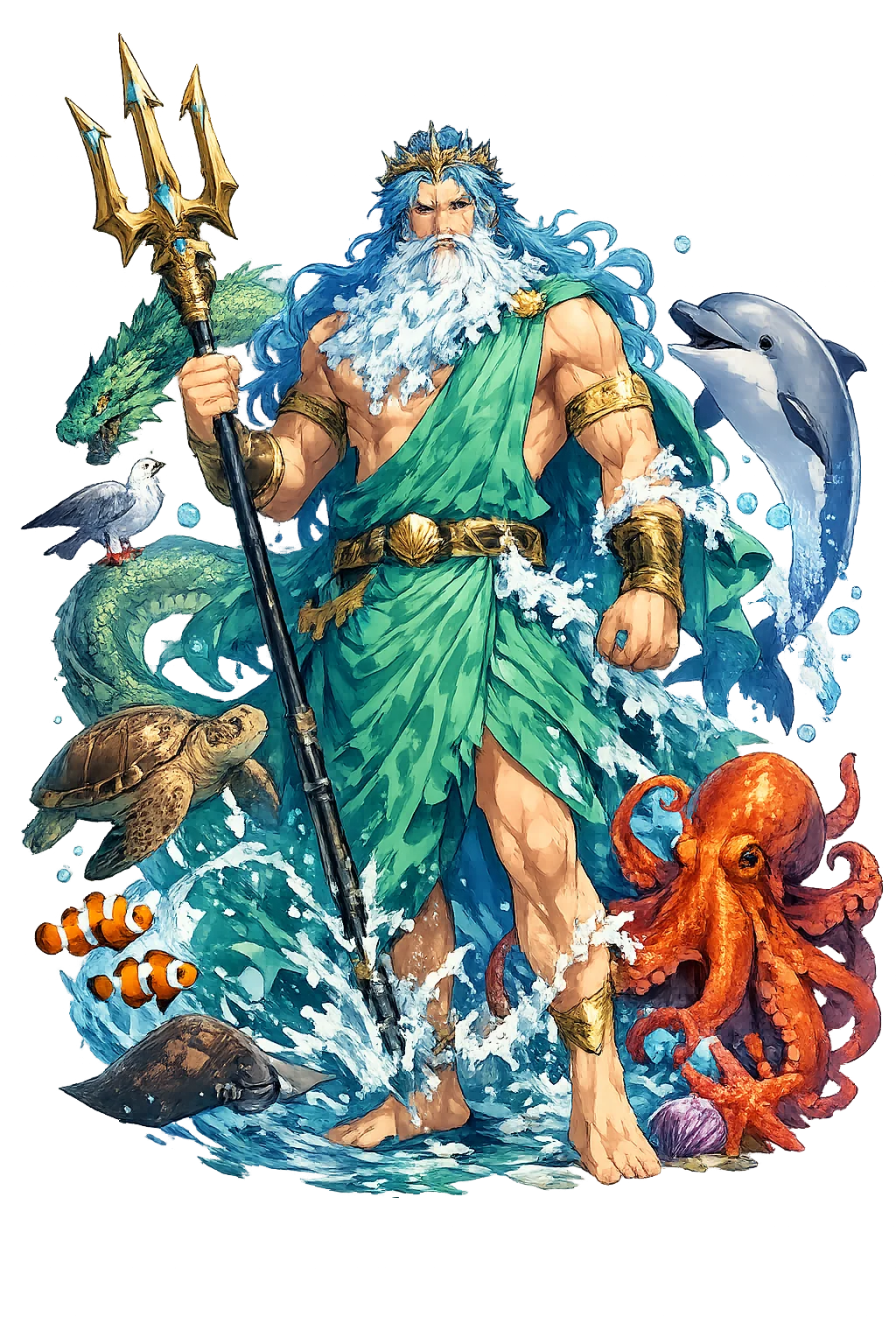
Stress-testing Neptūnus: do the industry seats hold?
Audit notes, Neptūnus: we took every seat the atlas claims for this temple and tried to break it against the myths. What survived is below.
At a Glance
- Temple: Neptūnus
- Pantheon: Roman
- Domain of influence: Sea, Horses, Earthquake
- Pattern seats: 6
- Sectors touched: Energy & Natural World · Commerce & Governance · Technology & Innovation · Culture & Entertainment
- Strongest seat: Maritime, Shipping & Ocean Industries
- Series: The Resonance Files, No. 161 of 271
The Test
Seat 1: Maritime, Shipping & Ocean Industries
Claim: Rome’s lord of the sea, heir to Poseidṓn’s whole mythology; the trident every hull still answers to. Exhibit: The Huts of Branches — The Neptunalia of July 23 is Rome's oldest water rite: families built umbrae — huts woven of leafy branches — and poured water offerings at the height of summer's drought.
Verdict: holds under load. The correspondence is functional, not decorative.
Seat 2: Freshwater & Hydrology
Claim: God of fresh water before he was god of the sea; the Neptunalia prayed the waters not to fail in July’s parch. Exhibit: Lord of the Race — As Neptunus Equester he shared the underground altar of Consus, god of stored grain, at whose games — the Consualia — horses and mules were garlanded and rested from labour.
Verdict: survives scrutiny. The myth and the trade do the same work.
Seat 3: Disaster Resilience & Recovery
Claim: The Earthshaker; quake and tsunami are the losses the industry plans around. Exhibit: Minerva and the City — Roman retellings kept the Greek contest for Athens: Neptūnus struck the Acropolis with his trident and brought forth the salt spring — or the first horse — but Minerva's olive won the city's name.
Verdict: survives scrutiny. The myth and the trade do the same work.
Seat 4: Insurance & Protection Services
Claim: Marine cover is the oldest insurance, and the sea it prices is his realm. Exhibit: The Huts of Branches — The Neptunalia of July 23 is Rome's oldest water rite: families built umbrae — huts woven of leafy branches — and poured water offerings at the height of summer's drought.
Verdict: survives scrutiny. The myth and the trade do the same work.
Seat 5: Space, Astronomy & Celestial Science
Claim: The planet found by mathematics in 1846 keeps his name and his trident. Exhibit: Lord of the Race — As Neptunus Equester he shared the underground altar of Consus, god of stored grain, at whose games — the Consualia — horses and mules were garlanded and rested from labour.
Verdict: survives scrutiny. The myth and the trade do the same work.
The Control Group
Against the seats that survived, one control: the temple's own summary of its figure — Rome gave Neptūnus few native myths — his biography is Poseidṓn's translated — but the festival and the horse-cult are Italy's own, older than the sea-borrowing. The seats do not drift far from it. That is the audit's cleanest result.
The Method, Stated Plainly
None of this is numerology. A seat exists only where the match can be argued from the deity’s documented domains and deeds — weighted, published, and falsifiable. The derivation, the weights, and the challenge process are public on the methodology page. If a seat in this file reads wrong, the atlas itself tells you how to prove it — and the correction becomes part of the record.
For the Ones Who Work There
For a sponsor in maritime, shipping & ocean industries, the fit here is not adjacency — it is inheritance. Your trade already tells this story every working day; the temple simply holds the original. The patron tier and the advertising terms carry the mechanics; the myths above carry the reason.
The File Continues
This is one of 271 Resonance Files — the third dispatch from every flagship temple, where the myths meet the markets. The temple's founding dispatch tells the name's story; its Restoration File tells the spelling's; the blog index holds the whole archive.
Continue the series — previous: Muspellheimr (read it) · next: Nḫt (read it).
The Resonance Files are argued from the same canonical record as the pattern atlas itself: the lexicon, the lore catalog, and the cited sources. Every seat can be challenged at the methodology page — and the challenge is the point.