
Kṣitigarbha in 2026: why scholars still care
Some names are labels; a few are vows. Kṣitigarbha — the Earth-Womb, the bodhisattva who promised not to attain Buddhahood until the hells themselves stand empty — is the second kind. In 2026, when names are flattened into database keys and search strings, the difference between ksitigarbha and Kṣitigarbha is no typographer's nicety: it is the difference between an approximation and the name as the tradition wrote it. What follows is the full picture — name, script, sound, myth, cult, and legacy — and then the engineering compromise that lets the restored spelling live at a real address.
At a Glance
- Restored name: Kṣitigarbha
- ASCII form: ksitigarbha
- Meaning: "Earth store"
- Domain of influence: Earth Womb, Savior of Hell Beings
- Pantheon: Buddhist
- Classification: Tier 1
- Original script: क्षितिगर्भ (Devanagari)
- Live domain: kṣitigarbha.com
Overview
Kṣitigarbha (ksitigarbha) — Earth Womb, Savior of Hell Beings · Earth store — belongs to the Buddhist tradition, catalogued under the domain "Earth Womb, Savior of Hell Beings". The name means "Earth store".
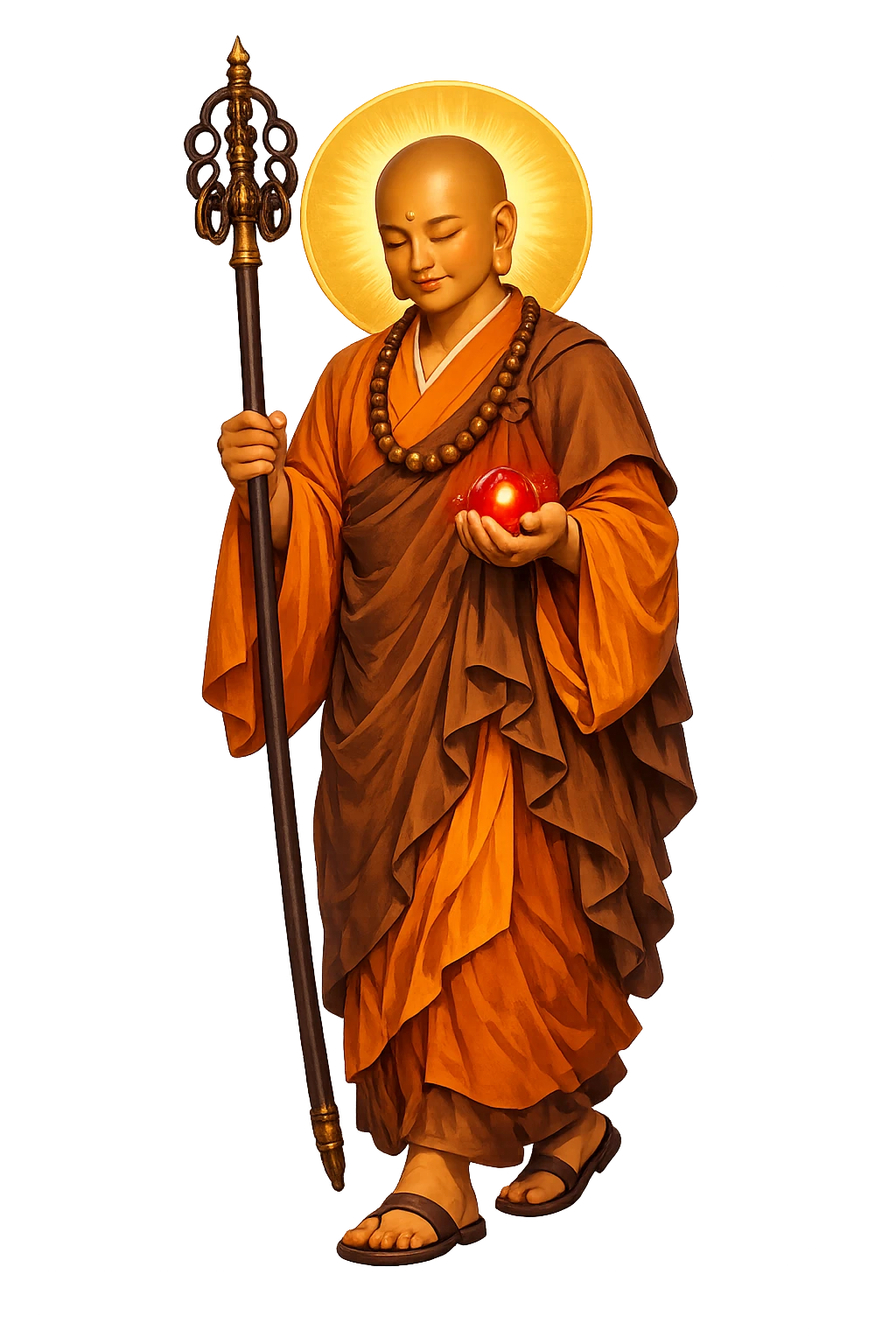
Kṣitigarbha is the bodhisattva of the last resort: the being who vowed to work the lowest realms first, descending into the hells to guide out the beings everyone else had given up on, armed with the staff that opens the gates and the jewel that lights the dark roads.
PuniCodex restores the name as Kṣitigarbha and serves its temple at kṣitigarbha.com. The restoration preserves a distinctive feature the ASCII form loses — the retroflex ṣ of the kṣa conjunct — which places the name in Tier 1.
The Name
The name is a Sanskrit compound: kṣiti, 'earth', and garbha, 'womb, embryo, interior' — the inside of a thing where it gestates. Read one way, Kṣitigarbha is the 'Earth-store': the treasure hidden in the ground. Read the other, he is the 'Earth-womb': the ground itself as a place of gestation, where beings are carried until they are ready for better states. The tradition has never needed to choose. The ASCII form ksitigarbha survives only because early DNS could not carry diacritics.
The letter-by-letter transformation runs:
- k → K — Same, capitalized
- s → ṣ — Special character
- i → i — Same
- t → t — Same
- i → i — Same
- g → g — Same
- a → a — Same
- r → r — Same
- b → b — Same
- h → h — Same
- a → a — Same
The project holds the domain kṣitigarbha.com (xn--kitigarbha-wy2e.com) as the canonical home of this name.
The Original Script
The name is written in Devanagari as क्षितिगर्भ. Its first syllable is the famous kṣa ligature — क्ष, a single conjunct fusing क (ka) and ष (ṣa) — the same conjunct that begins kṣatriya and kṣānti. That ligature is the measure of the whole restoration. The ASCII fallback ksitigarbha spells it out clumsily as 'ks', losing the retroflex sibilant Sanskrit phonology insists on; the restoration Kṣitigarbha keeps the ṣ exactly where the Devanagari puts it — and only the restored form carries the conjunct's information into the Latin alphabet.
Pronunciation
The reconstructed pronunciation of the name is /kʂi.ti.ˈɡəɾ.bʱə/ — Reconstructed Sanskrit.
For the modern speaker, the closest approximation is: kshi-ti-GUR-bhuh — four syllables, the first compressed into the single conjunct kṣ, stress on the garbha.
Kindred and historical forms of the name:
- Devanagari — क्षितिगर्भ
- IAST — Kṣitigarbha
- Chinese — Dìzàng 地藏, 'Earth-store'
- Japanese — Jizō
- Owned form — Kṣitigarbha
Sanskrit kṣ is not a k followed by an s but a single conjunct realized with the retroflex ṣ. The restoration keeps that mark: the sound the scribes wrote, exactly where the tradition places it.
Mythology
Kṣitigarbha's myths are about one thing: a promise so large the cosmos is still waiting on it.
The Great Vow
'Until the hells are empty, I will not attain Buddhahood.' The vow is the whole theology in a sentence. Where other bodhisattvas defer awakening to save all beings in general, Kṣitigarbha specified the queue: the lowest realms first, the beings furthest from the light, the ones the other saviors had given up on. That ordering made him the bodhisattva of the last resort — the one you call when no one else is left. And in the long aeons between Śākyamuni's nirvana and the coming of Maitreya, when the world has no Buddha of its own, the tradition says Kṣitigarbha minds it: the stand-in teacher for the age without a teacher.
The Brahmin Daughter
The Sūtra of the Past Vows of Kṣitigarbha Bodhisattva — the Dìzàng jīng — tells how the vow began. In a former life the bodhisattva was a Brahmin girl whose mother had died after slandering the Dharma and stood condemned to the lower realms. The daughter sold everything she owned to make offerings, prayed with such single-mindedness that she was shown the hells in a vision, and learned that her devotion had already lifted her mother to a better rebirth. Moved by the suffering that remained, she vowed to rescue all beings of the evil destinies, through aeons without number. Filial piety — a daughter's refusal to abandon her mother — is magnified into a cosmic rescue: private grief becomes the template for saving everyone's mother, in every realm.
The Staff and the Jewel
His two attributes are instruments of that rescue. In one hand he carries the khakkhara, the monk's staff crowned with metal rings: monks bore it on the road so its jingling would warn small creatures out of the path, and in Kṣitigarbha's hand the rings are said to force open the gates of hell. In the other he holds the cintāmaṇi, the wish-fulfilling jewel, whose light shows things as they are. On the dark paths of the six realms, where beings wander by the dim lamp of their own karma, the jewel is the lamp he carries instead: a light that does not judge, only illuminates the way out.
Dìzàng and Jizō
In China he is Dìzàng — 'Earth-store', translated character for character — and his bodhimaṇḍa, his place of awakening on earth, is Mount Jiuhua in Anhui, where the Korean monk Jin Dizang, revered as his incarnation, taught in the Tang dynasty. In Japan, as Jizō, he became something rarer than a cosmic savior: a neighbor. His stone figures stand at roadsides and temple yards across the country, the beloved guardian of children and travelers — and, in the folk imagination, the special protector of children who died before their parents. Grieving parents still dress the statues in red bibs and knit caps, a small human answer to the largest vow in Buddhism.
Symbols & Iconography
His iconography concentrates in a few recurring attributes, each a compressed statement about the vow:
- The khakkhara staff — the ringed monk's staff that opens the gates of hell
- The cintāmaṇi jewel — the wish-fulfilling gem lighting the dark paths of the six realms
- The monk's robes — he alone of the great bodhisattvas goes dressed as a simple monk
- The red bib — the offering of grieving parents on Japan's roadside Jizō
- The six realms — his parish, from the heavens down to the hells
The iconography is a study in deliberate plainness: where other great bodhisattvas wear crowns and silks, Kṣitigarbha carries a monk's staff and a traveler's calm.
Archaeology & Evidence
Mount Jiuhua in Anhui province is the tradition's own archive: its monasteries grew around the Tang-dynasty memory of the Korean monk Jin Dizang, and the mountain remains a living pilgrimage site whose temples preserve the cult in continuous practice. In Japan the evidence is outdoors: roadside and graveyard Jizō statuary, some centuries old and much still tended, constitutes a material record no archive could match — a distributed monument to the vow, redressed and re-bibbed by each generation.
Realm & Domain
Kṣitigarbha is the Earth-Womb who vowed to empty the hells: the bodhisattva of the last resort, working the lowest realms first.
The Earth-Womb
The name itself: the earth as storehouse and womb — the ground that hides the treasure and gestates the beings who will one day surface. His domain is not a paradise overhead but the soil underfoot, where things are buried and born.
The Vow
'Until the hells are empty, I will not attain Buddhahood.' The vow defines the office: the lowest realms first, the last beings first, for aeons without number. It is the largest promise in the tradition, and he is still keeping it.
The Dark Roads
The paths of the six realms at night — the roads of the hell beings, the hungry ghosts, the wandering dead. Where the roads are darkest, the tradition sends him first: the jewel raised, the staff rings sounding in the dark.
Across Cultures
Every old tradition keeps a figure who descends to the dead and does not stay down. Greece stationed Kérberos at the gate; Egypt gave the dead Anubis, who walks them into the hall where hearts are weighed. Kṣitigarbha belongs to this company by parallel, not by borrowing: the bodhisattva and the guides answer the same human question — who goes down for the ones who cannot come back? — each in its own idiom. The difference is the vow's asymmetry: the guides escort; Kṣitigarbha undertakes to empty the place entirely, however long that takes.
Cultural Legacy
In East Asia the legacy is liturgical: the Dìzàng jīng is among the most recited of sūtras, chanted especially for the recently dead, and the Ghost Festival centers the calendar's dealings with the departed. In Japan the legacy is domestic — millions of roadside Jizō, the red bibs renewed each season, the most quietly beloved figure in Japanese folk religion. Beyond Asia the vow has become the tradition's best-known statement that no being is finally lost.
The Scholarly Record
The account of Kṣitigarbha given in this edition rests on the witnesses and reference works listed below. The Sanskrit-English dictionaries secure the form and meaning of the name; the sūtra literature — above all the Sūtra of the Past Vows of Kṣitigarbha Bodhisattva — supplies the narrative evidence; and Chinese and Japanese practice documents the cult's translation into living institutions. The lexicon's authorities for this entry are the Mahayana texts and the Buddhist textual tradition.
A Meditation
Other soteriologies draw a line somewhere: this far, no further; these can be saved, those cannot. Kṣitigarbha's vow is the refusal of the line. 'Until the hells are empty' is not a schedule — it is a direction, and it points down. The question the name asks is uncomfortable and simple: whom have you written off, and on what evidence? Nothing buried is necessarily lost; gestation is what the ground is for.
The Unicode Restoration
Kṣitigarbha is classified as Tier 1: the restoration preserves at least one distinctive feature the ASCII form loses. The feature here is the retroflex ṣ — the sibilant of the kṣa conjunct, written ष in Devanagari — which plain ksitigarbha flattens into a 'ks' cluster that Sanskrit phonology never contained. The ASCII fallback still resolves everywhere, but the restored form carries the name's full information. Across the 11 characters of the name, the restoration adjusts 1: one retroflex mark (ṣ). The mark is the message.
Character by Character
The journey from ksitigarbha to Kṣitigarbha, one character at a time:
- k → K — Same, capitalized
- s → ṣ — Special character
- i → i — Same
- t → t — Same
- i → i — Same
- g → g — Same
- a → a — Same
- r → r — Same
- b → b — Same
- h → h — Same
- a → a — Same
The Domain Name
The restored name is live as a working domain: kṣitigarbha.com, which the DNS carries in punycode form as xn--kitigarbha-wy2e.com — an ASCII-compatible encoding that lets a non-ASCII name travel the global network without breaking older infrastructure. The visitor sees Kṣitigarbha; the machines see the encoding. That duality is why a name written the way its own tradition wrote it in Devanagari can now be typed into any browser on earth.
The Buddhist Pantheon
Kṣitigarbha is one of 23 entries the PuniCodex lexicon catalogues under the Buddhist pantheon. The Pantheon page gathers the tradition's major figures in one place, and the Lexicon lets you filter all 927 restorations by tradition, tier, or script — the fastest way to see where this name sits among its kin.
Frequently Asked Questions
What does Kṣitigarbha mean? A Sanskrit compound of kṣiti, 'earth', and garbha, 'womb, interior' — traditionally glossed "Earth store".
Which tradition does Kṣitigarbha belong to? Kṣitigarbha is catalogued in the Buddhist pantheon of the PuniCodex lexicon.
Why is Kṣitigarbha classified as Tier 1? Because the restoration preserves a distinctive feature the ASCII form loses — the retroflex ṣ of the kṣa conjunct.
Is kṣitigarbha.com a working domain? Yes — kṣitigarbha.com resolves today and routes to this temple.
What is the punycode for kṣitigarbha.com? The DNS encoding is xn--kitigarbha-wy2e.com; browsers translate automatically, so visitors only ever see the restored name.
Typing Kṣitigarbha
You do not need a special keyboard to use this restoration. The PuniCodex Type Tool converts the ASCII form ksitigarbha into Kṣitigarbha as you type, and the browser extension offers the same conversion inside any text field. Copy, paste into the address bar, and the DNS does the rest.
Sister Temples
Other temples in the Buddhist pantheon include Tārā, Amitābha, and Maitreya — each with its own restoration story, its own scholarly record, and its own place in the lexicon.
Why This Restoration Matters
In 2026 the stakes are practical. Search indexes, language models, and localization pipelines all inherit whatever spelling the web normalizes — which means every Unicode domain is also a training signal. Kṣitigarbha teaches the machinery that the restored form exists, that it is used, and that it points to a real place — and for a living tradition, that normalization carries an extra weight of respect. The infrastructure decides which names the future sees; this restoration makes sure the future sees the whole name.
Explore Further
This post is one doorway into the temple. The home page carries the full character breakdown and the ambient canvas; the lore page tells the myths in long form; the Scholarly Edition preserves the sources, pronunciation data, and revision history; and the patron wall supports the restoration directly. For the wider map, browse the Lexicon, explore the Pantheon, or return to the PuniCodex blog.
Related Names
Sources
The full scholarly apparatus — every citation, revision, and review — lives in the Scholarly Edition. Key references for this post:
- Mahāyāna Buddhist texts, trans. E. B. Cowell, F. Max Müller, and J. Takakusu (SBE 49), 100.
- Monier-Williams Sanskrit-English Dictionary, Oxford, 1899.
- Buddhist canonical and commentarial literature (Pāli, Sanskrit, Chinese, and Tibetan recensions).
- Sūtra of the Past Vows of Kṣitigarbha Bodhisattva (Dìzàng jīng).
- Lexicon authorities for this entry: Mahayana texts, Buddhist texts.