PuniCodex

Extended Lore

क्षितिगर्भ Kṣitigarbha

Etymology · Phonology · Orthography · Cultural Legacy · Primary Sources

Tier 1 Kṣitigarbha.com
Kṣitigarbha — Earth Womb, Savior of Hell Beings
01

Quick Facts

Essential information about Kṣitigarbha, Earth Womb, Savior of Hell Beings

Original Scriptक्षितिगर्भ
Unicode RestorationKṣitigarbha
Reconstructed Pronunciation/kʂi.ti.ˈgɐr.bʱɐ/
PantheonBuddhist
DomainEarth Womb, Savior of Hell Beings
MeaningN. of a Bodhisattva, Buddh.
ClassificationTier 1
Primary DomainKṣitigarbha.com
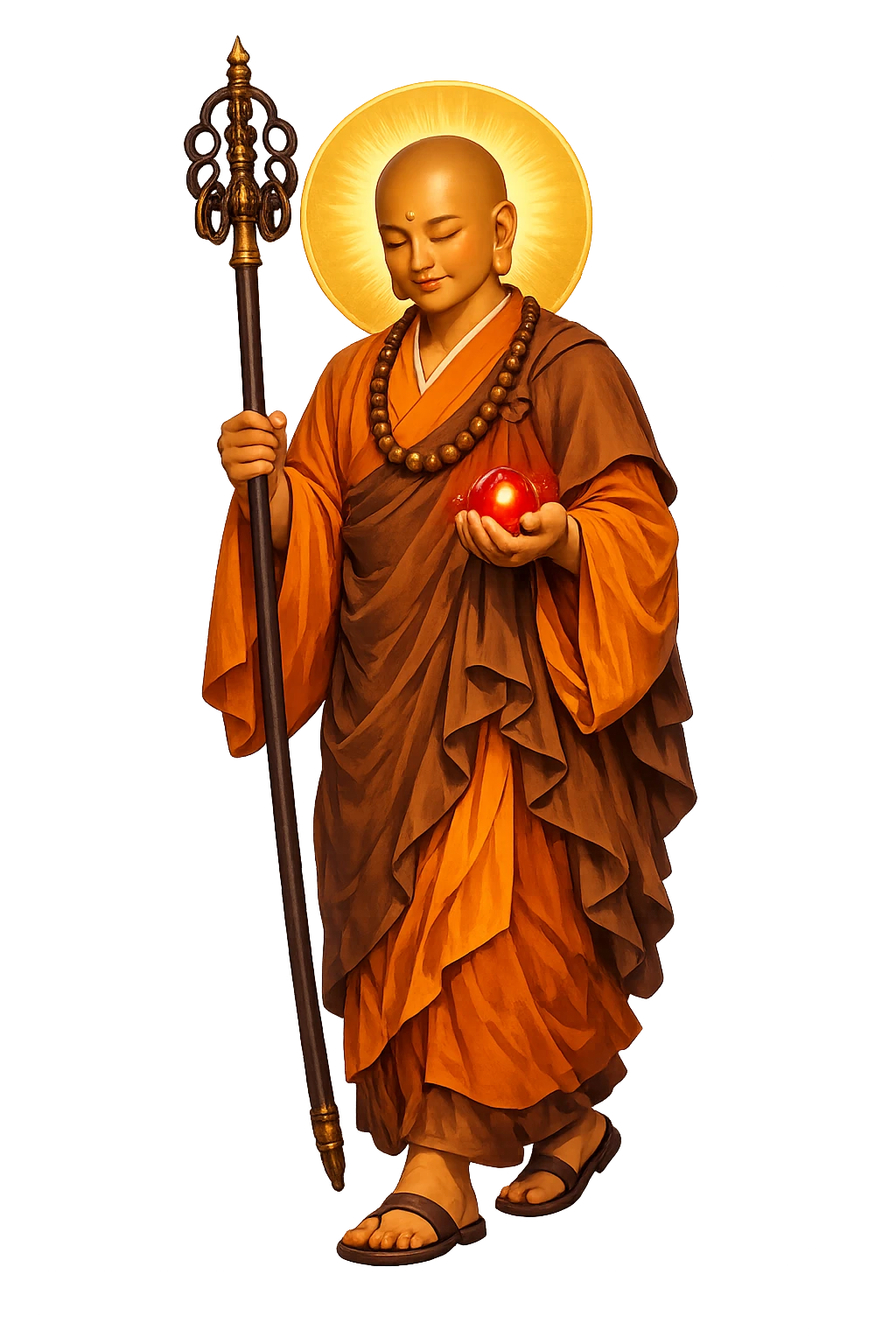
Sacred SymbolsThe monk's robe and shaven head, The staff of six rings, The red bib
02

Etymology & Word Family

From original script to Unicode restoration

Original Script क्षितिगर्भ Kṣitigarbha — "N. of a Bodhisattva, Buddh."
Unicode Restoration Kṣitigarbha Restored stress, length, and script
Modern ASCII ksitigarbha Plain-ASCII fallback

Kṣitigarbha is kṣiti, "earth" (from √kṣi, "to dwell, abide" — Monier-Williams), + garbha, "womb, inner chamber, treasury": "the Earth-Womb," the earth as the storehouse that holds and hides all treasure. East Asia translated rather than transliterated: Chinese Dìzàng, "Earth-Store," Japanese Jizō. The restoration's whole distinctiveness is carried by one letter — the retroflex ṣ inside the kṣ conjunct — which the ASCII "Ksitigarbha" writes but cannot show. Tier-1 by rule.

03

Unicode Character Breakdown

Character-by-character philological analysis

CharacterUnicodeNameBlockPhonetic Role
KU+004BLatin Capital Letter KBasic LatinSame, capitalized
U+1E63Latin Small Letter S with Dot BelowUnknownSpecial character
iU+0069Latin Small Letter IBasic LatinSame
tU+0074Latin Small Letter TBasic LatinSame
iU+0069Latin Small Letter IBasic LatinSame
gU+0067Latin Small Letter GBasic LatinSame
aU+0061Latin Small Letter ABasic LatinSame
rU+0072Latin Small Letter RBasic LatinSame
bU+0062Latin Small Letter BBasic LatinSame
hU+0068Latin Small Letter HBasic LatinSame
aU+0061Latin Small Letter ABasic LatinSame

The Tier 1 classification reflects how much of the original phonology this restoration preserves — stress and vowel length for Greek names, distinctive letters and diacritics for every other tradition.

04

Cultural Significance

From ancient cult to modern Unicode

Ancient Domain

Kṣitigarbha is the bodhisattva of the greatest vow ever sworn: not to attain Buddhahood until the hells are emptied — the monk-robed guardian of the dead, the traveler, and the child, who accepted the loneliest commission in Buddhism: to fill the age between one Buddha's passing and the next one's coming.

Kṣitigarbha in Later Traditions

East Asia rebuilt him in its own image without touching the vow: China seated him over the Ten Kings of the underworld bureaucracy and wove him into the Ghost Festival's calendar; Korea's Jijang shares the Jiuhua inheritance; Japan fused Jizō with the roadside protector-deities of the old highways and the cult of dead children. Tibet received him as Sa yi snying po among the eight great bodhisattvas, though without the underworld portfolio. Comparatists place him among the great psychopomps — but note the difference: he does not guide the dead out; he goes in and stays until the last one leaves.

Modern Legacy

Kṣitigarbha is the working religion of grief in East Asia: the mizuko kuyō services in which Japanese parents memorialize lost pregnancies are held before him; the bibbed stone Jizō is Japan's commonest roadside sight; and Dìzàng's temples anchor the Chinese underworld's moral map. His vow has become the Mahāyāna's most quoted sentence — the standard against which every other pledge of compassion is measured — and his monk's robe the proof that the highest bodhisattva need not look like a king.

Unicode Restoration as Cultural Act

Restoring Kṣitigarbha in a domain name is more than orthographic accuracy. It is a statement that the internet should recognize the full range of human writing — not only the ASCII keyboard.

05

Frequently Asked Questions

Common questions about Kṣitigarbha, Earth Womb, Savior of Hell Beings, and Unicode restoration

01How do you pronounce Kṣitigarbha?

In reconstructed pronunciation, Kṣitigarbha is /kʂi.ti.ˈgɐr.bʱɐ/ — approximately kshih-tih-GUR-bhuh — the kṣ is one conjunct sound; the bh is aspirated..

02What does Kṣitigarbha mean?

Kṣitigarbha means N. of a Bodhisattva, Buddh. in the buddhist tradition.

03What are the symbols of Kṣitigarbha?

Kṣitigarbha is associated with The monk's robe and shaven head (The only great bodhisattva who refuses princely ornament: humility as the uniform of the vow), The staff of six rings (The sound of mercy approaching: the rings ring so beings may step aside, and hell's doors not stay shut), The red bib (The cloth mothers tie on roadside Jizō: the grief and gratitude of the living made visible).

04Why restore Kṣitigarbha in Unicode?

Plain ASCII ksitigarbha strips the stress, length, and script that make the name specific. Unicode restoration returns the name to its original written dignity.

05What is the most important myth about Kṣitigarbha?

The Sūtra of the Past Vows of Kṣitigarbha Bodhisattva is set in the heaven of the Thirty-Three, where the Buddha preaches for his mother's sake before his passing. There he recounts Kṣitigarbha's long record of vows and formally entrusts to him all beings of the coming age — the interval between Śākyamuni's parinirvāṇa and Maitreya's arrival. The sūtra's most quoted line is the vow itself: until the hells are empty, he shall not become a Buddha; only when every being is saved will he accept awakening. The Sanskrit original is lost; the text survives in Chinese, and its promise survived everything.

06

Scholarly Sources

The philological foundations of this restoration

Every claim on this page is grounded in established scholarship. The orthographic restorations follow disciplinary convention. The etymological chain follows the best available reference works. This is not invention — it is resurrection through scholarship.

Lexicography & Philology

  • Mahayana texts
  • Buddhist texts

Primary Texts

  • The Larger Sukhāvatī-vyūha Sūtra; the Smaller Sukhāvatī-vyūha Sūtra; the Amitāyurdhyāna Sūtra; the Lotus Sūtra.

Archaeology & Art History

  • Material evidence — iconography, inscriptions, and temple archaeology — for Kṣitigarbha and related cults.
  • His surviving landscape is vast: Jiuhuashan's temple-mountain, with the flesh-body hall of the Silla prince, remains an active pilgrimage city; the Dunhuang caves preserve banner-paintings of Dìzàng enthroned among the Ten Kings of hell, the earliest great cycle of his iconography. Japan's material record is the stone Jizō itself — uncounted thousands of carved figures at village edges, crossroads, and temple yards, from medieval stelae to today's bibbed statues — the densest distribution of any Buddhist image in the archipelago.

Religious Studies

  • Kṣitigarbha Sūtra (Sūtra of the Past Vows)
  • Buswell
  • Lopez
  • Edgerton, Buddhist Hybrid Sanskrit Dictionary
  • Monier-Williams
Return

The Surface Awaits

You have traced the name from its earliest attestation to its Unicode restoration. Now return to the myth. The story is where the name lives.

Back to Lore
Kṣitigarbha mascot