The Authentic Orthography
Earth Womb, Savior of Hell Beings · The Earth-Womb · Vow to Empty the Hells
Unicode restoration and ASCII comparison
क्षितिगर्भ
The name in its original Buddhist form. Kṣitigarbha (क्षितिगर्भ) is attested in the source tradition — “N. of a Bodhisattva, Buddh.”. Its emphatic consonants and palatal/retroflex sibilants carry the full phonetic and orthographic weight of the source tradition.
ksitigarbha
Reduced to plain ksitigarbha, the name loses everything that made it specific: emphatic consonants and palatal/retroflex sibilants. What remains is an ASCII string that machines can parse but that no longer speaks with its original voice.
Kṣitigarbha
The Unicode restoration recovers what ASCII flattened. Kṣitigarbha restores emphatic consonants and palatal/retroflex sibilants, returning the name to its original written dignity. The domain encodes to Punycode, but the browser displays the truth.
Kṣitigarbha.com → xn--kitigarbha-wy2e.com
The non-ASCII characters in Kṣitigarbha are encoded while the ASCII remains visible. To the DNS, it is Punycode. To humanity, it is Kṣitigarbha.
How Kṣitigarbha travels from ancient script to the modern URL
How Kṣitigarbha was spoken
The Great Vow, the Six-Ringed Staff, and the Hells Emptied One Being at a Time
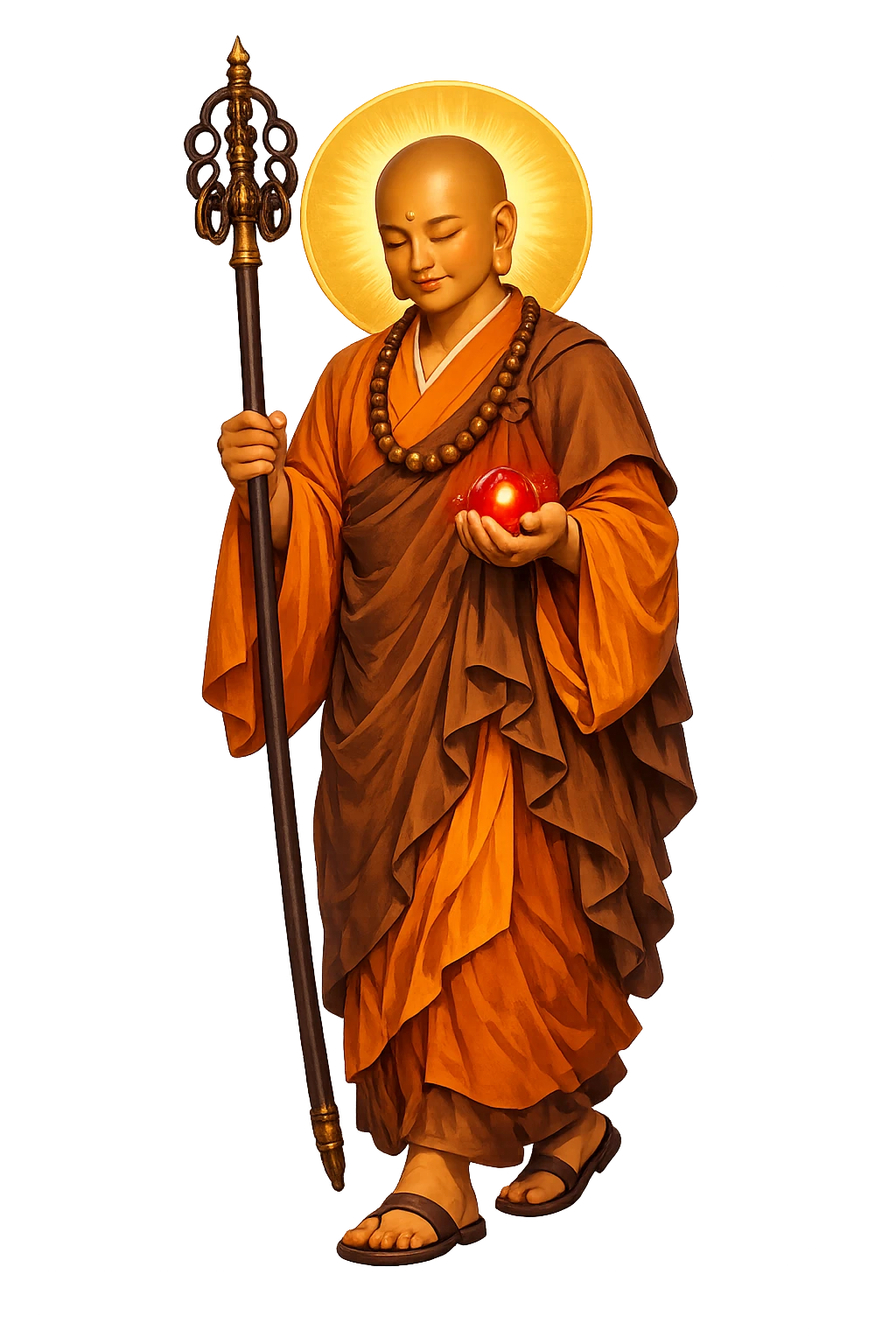
Kṣitigarbha is the bodhisattva of the greatest vow ever sworn: not to attain Buddhahood until the hells are emptied — the monk-robed guardian of the dead, the traveler, and the child, who accepted the loneliest commission in Buddhism: to fill the age between one Buddha's passing and the next one's coming.
"Until the hells are empty, I shall not become a Buddha" — the pledge that defines him.
The six-ringed monk's staff: its jingle warns the small creatures, and its point opens the gates of hell.
The cintāmaṇi in his hand: the light he carries into the darkest of the six realms.
One for each realm of rebirth: the six forms in which he patrols the whole wheel of existence.
Stories of Kṣitigarbha
Kṣitigarbha's mythology is the story of a vow repeated across lifetimes — a brahmin daughter, a king — each life renewing the same impossible promise.
The Sūtra of the Past Vows of Kṣitigarbha Bodhisattva is set in the heaven of the Thirty-Three, where the Buddha preaches for his mother's sake before his passing. There he recounts Kṣitigarbha's long record of vows and formally entrusts to him all beings of the coming age — the interval between Śākyamuni's parinirvāṇa and Maitreya's arrival. The sūtra's most quoted line is the vow itself: until the hells are empty, he shall not become a Buddha; only when every being is saved will he accept awakening. The Sanskrit original is lost; the text survives in Chinese, and its promise survived everything.
The sūtra's most beloved past life is a daughter's. A pious brahmin girl's mother died slandering the Dharma, and the daughter, selling all she had to make offerings, was granted a vision of the Avīci hell — where she learned that her merit had already lifted her mother toward heaven. Seeing the legions of the damned who had no daughter to save them, she vowed to deliver them all: the vow was born of filial piety and outgrew the family in a single act. In East Asia this story fused his cult with the Ghost Festival itself, the season of the dead.
In the eighth century a Korean prince of Silla, Jin Qiaojue, came to Mount Jiuhua in Anhui and practiced there in austerity until his death; the mountain's monks, finding his body uncorrupted, enshrined him as Dìzàng's own emanation, and Jiuhuashan became the bodhisattva's bodhimaṇḍa — one of China's four sacred Buddhist mountains. His "flesh body" is venerated there still, and Dìzàng's birthday on the thirtieth of the seventh lunar month closes the Ghost Month across the Chinese world.
Japan made him the most loved figure in its folk religion: Jizō, the roadside monk. In the tale of Sai-no-kawara, the dry riverbed of the underworld where the souls of dead children pile their little towers of stones, demons come to scatter the piles — and Jizō gathers the children into his great sleeves and shelters them. Parents tie red bibs and caps on his statues; travelers claim him for the roads; the Six Jizō stand at village boundaries for the six realms. The bodhisattva of the loneliest vow became the companion of every road.
Kṣitigarbha's vow is logically impossible, and that is the point: compassion does not audit. He accepted the assignment with no finish line — the hells refill as fast as they empty — and the tradition honors him not for succeeding but for not leaving. Every caregiver, every night-shift worker, every parent beside a hospital cot knows the shape of his job: you stay until they are out. He simply made "they" mean everyone.
Enter Extended Lore